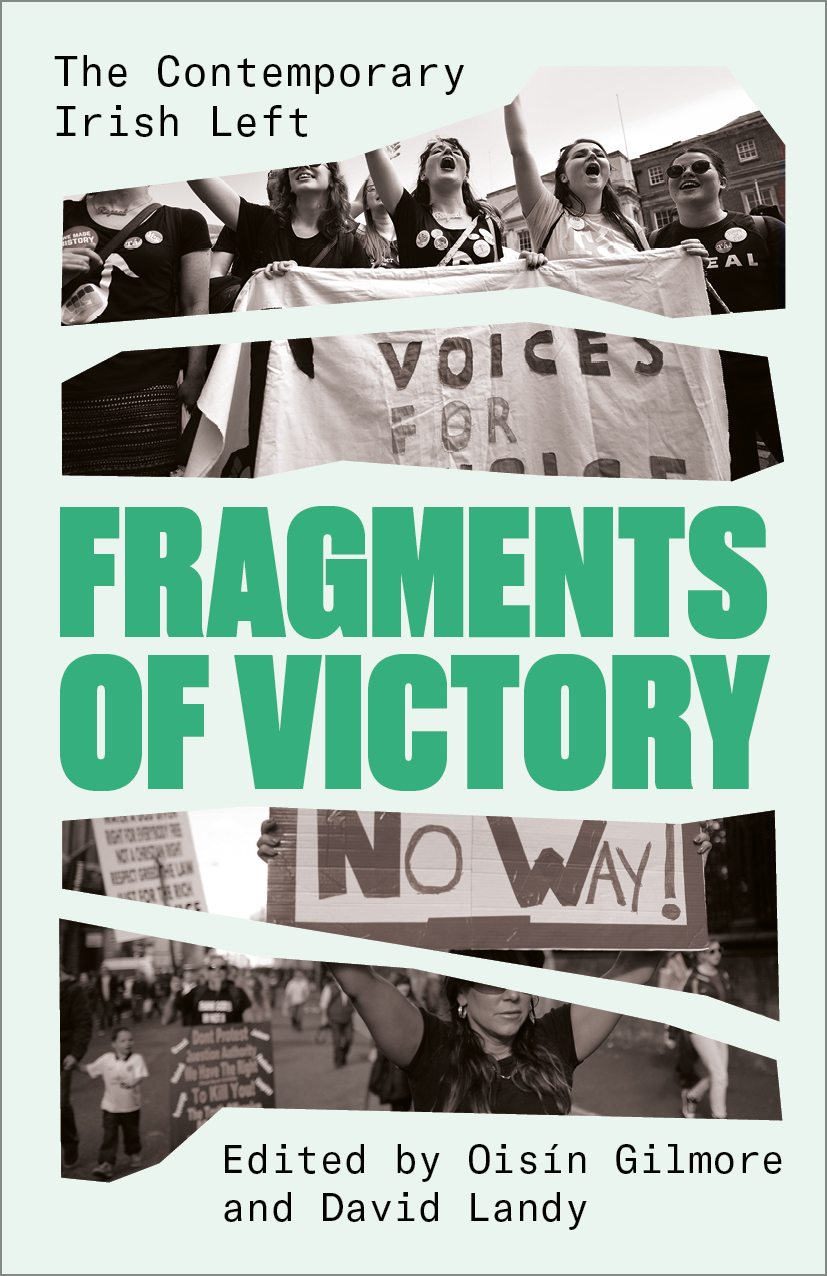
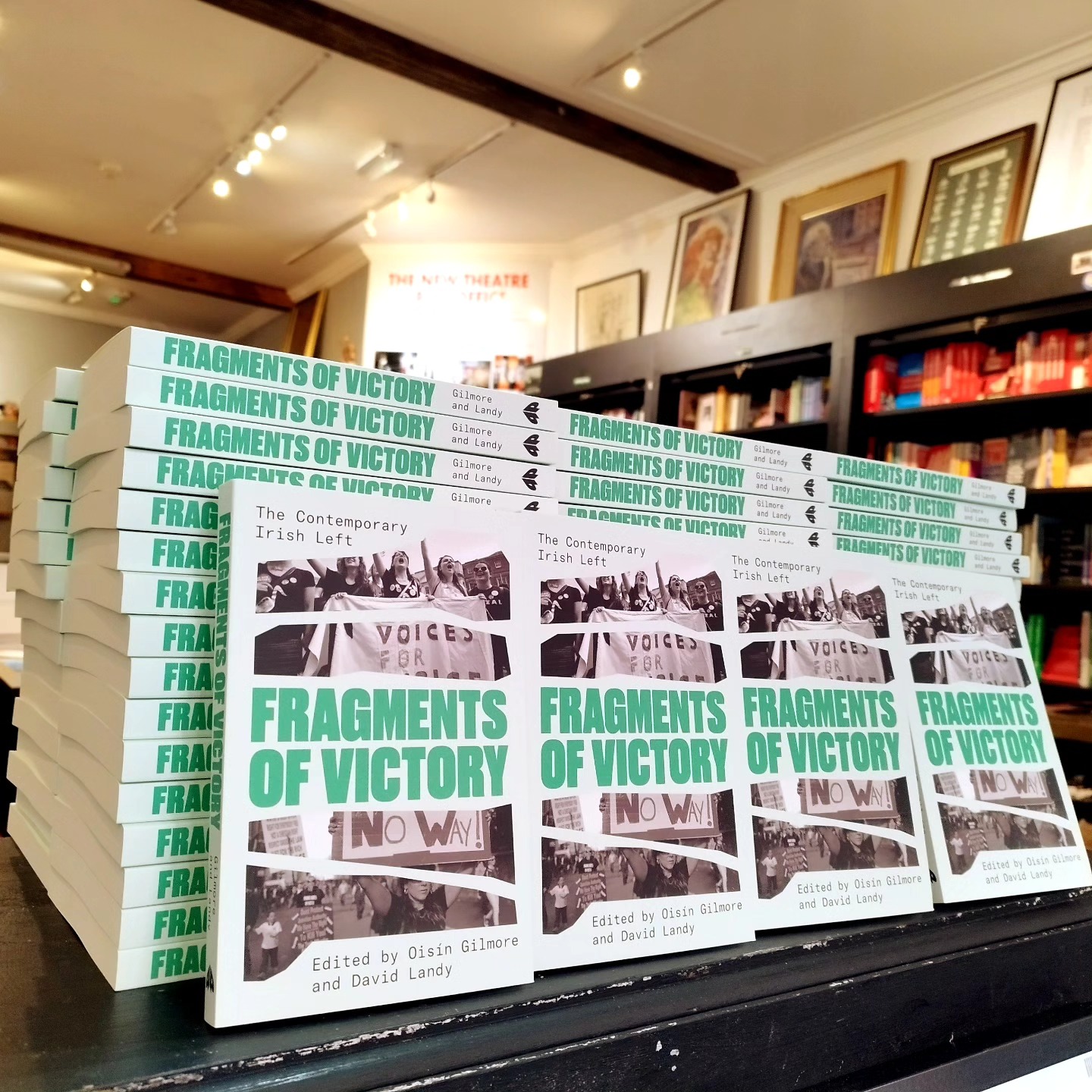
Fragments of Victory’: The Contemporary Irish Left’, book review (5 of 6)

Fragments makes a series of observations about the political consciousness of the Irish working class, some of which we have already noted, such as the view of many on the Labour Party entering office that ‘the crisis was clearly not their fault and . . . the harsh austerity measures they took were seen as both forced by the Troika and, while painful, necessary.

It records the view of another author that the first year of crisis saw a large number of demonstrations but these ‘dried up once the public realised the magnitude of the banking crisis, and they were replaced by years of “muted protest”. Certainly, there was a sense of powerlessness at the scale and suddenness of the economic crash, a degree of acceptance of the official narrative . . .’ (p31)

It notes that the muting of protest was partially the result of emigration, particularly of the young with 106,000 leaving from 2009 to 2013.  ‘However, the muting of opposition was also due to the influence of the Labour Party and trade unions, which contained protest and channelled anti-government anger down institutional routes from 2009 to 2011.’ (p30). These organisations did indeed push anger down the road of inevitable failure, and yes, they were betrayed, but how was this possible?

One contributor notes that by late 2013 ‘it is difficult to overstate the feeling of exhaustion and disillusionment’, with the radical left ‘comprehensively defeated on the one anti-austerity struggle they’d seriously fought – household taxes.’ The ‘public mood was judged sullen but compliant’ and was successfully ‘blackmailed’ into voting yes to the EU’s fiscal Treaty in 2012 ‘even though this treaty restricted the possibility of future government spending” (p 40-41)

wrote about this result at the time, noting that:  ‘At 60 per cent Yes against 40 per cent No there is no room for doubt.  It is a decisive endorsement of government policy and a mandate for further cuts and tax increases.  The result should not have been unexpected given the political forces ranged in support of the Treaty, the support of big and small business, the failure of the trade union movement to oppose it and the inevitable support of the mass media.  In the general election last year the Irish people voted by a large majority for a new government in no important way different from the previous one and with no claim to pursue significantly different policies.’

I also noted that ‘Austerity isn’t popular despite the vote and never will be.  Even the Yes campaign was under instructions not to celebrate its victory . . . In October last year when the Austerity Treaty was originally being negotiated an opinion poll recorded 63 per cent opposed to it with only 37 per cent supporting.’  I noted that some people had changed their minds or perhaps did not have the confidence to follow through on their opposition.  This might have united around the demand to repudiate the debt taken on by the state on behalf of the banks and their bondholders, but this also meant opposition to the Troika upon whom the state had become reliant.  It also meant opposition to the administration in the US, even though its Secretary to the Treasury Timothy Geithner thought it was ‘stupid’ to guarantee the banks liabilities. 

I wrote a number of blogs on the issue of repudiating the debt herehere and here, and the disastrous and ‘stupid’ decision to bail out the bondholders in the first place.  Doing so was a real political challenge and required an alternative that didn’t exist.  Without this the failure of the opposition to austerity was inevitable, even if the question of the debt was only one element of the necessary political alternative.

Where the book completely fails is the neglect of what the political content of the alternative might have been, although this is revealing.  In recording the activity of the left its non-appearance reflects the absence of this in the anti-austerity movement as a whole and the failure to win any significant section of it to a socialist perspective.

The same contributor noted above goes on to say that at a later time ‘A proper balance sheet would recognise how the Labour Party and the aligned section of the union movement were rendered powerless to influence or sidetrack the anti-austerity movement.’ (p 42). He points to the drop on the Labour vote from 19 per cent in the 2011 general election to 7 per cent in the 2014 local elections and the ‘victory for left-wing independents and Trotskyist parties alike.’ (p 43)

He argues this was possible because in 2014 100,000 marched against water charges in October followed by 150,000–200,000 in November and 80,000 (in Dublin alone) in December in what was ultimately a winning struggle.  We have already noted the limp role that was expected of the trade unions and political parties in the campaign in the previous posts but the argument that the Labour Party and trade union leaders could not divert the campaign is correct.

It won because it was a community campaign based on mass protests, blocking the installation of water meters and non-payment of bills.  Independents and left wing candidates benefited from their role in the campaign which also distinguished itself by exposing the equivocating role of Sinn Fein. Despite the political weaknesses of the campaign that we noted previously its tactics were able to beat the counter-measures of the government where the previous campaign against household charges could not.

The campaign proved that individual campaigns, given the right circumstances, could defeat particular austerity measures even where the wider offensive was continued successfully. It should be recalled that the water charges campaign took off almost a year after the state exited the Troika bailout programme. It is also worth recording again the failure to draw the right political lessons as the trade union official who contributed the chapter on the campaign finishes his story by endorsing the statement by ‘one of the world’s greatest authorities on water’ that:

‘The Irish system of paying for water and sanitation services through progressive taxation and non-domestic user fees, is an exemplary model of fair equitable and sustainable service delivery for the entire world.’ (p 61)

In fact, the Irish water industry was wasteful and inefficient and state ownership is neither democratic nor socialist.  For this, workers’ cooperative ownership or the demand for workers’ control would have been necessary but the Irish left, like so much in the rest of the world, have become habituated to statist views of socialism that Marx repudiated but that have become entrenched through the domination of social democracy and Stalinism over the last one hundred years.

With such a political platform the problem of the state being the solution, when the solvency and policy of the state was the problem, was once again avoided because doing otherwise would raise the question of ownership and control that would show the platform’s inadequacy.

The main victory in Fragments of Victory was thus necessarily limited and could not be a springboard to address the many deficiencies of the resistance identified in the book.  These included the failure ‘to build lasting political and social institutions’ and ‘no lasting form of working-class self-organisation.’  Reliance on capitalist state ownership as ‘an exemplary model’  illustrates why a problem could not be addressed: that ‘the steps between the current situation and the long-term goal of socialism are less clear than ever before.’ (p192)

The view that the trade union bureaucracy was ‘rendered powerless to influence or sidetrack the anti-austerity movement’ is therefore only partially true. The politics of the bureaucracy, and of the Labour Party, were not challenged by a wider political alternative and the much-trumpeted militant tactics of the campaign were no substitute for it.

back to part 4

Forward to part 6
Fragments of Victory’: The Contemporary Irish Left’, book review (4 of 6)

In the previous post I argued that the leadership of the trade unions were unable and unwilling to challenge austerity because it would involve a political challenge to the state it had decades of ingratiating itself with it as its ‘social partner’.  However, I also noted that ‘the undeveloped and inadequate political consciousness of the working class itself [was] also a major factor’ in the union movement being unable to successfully resist austerity.

The socialist critique of the bureaucratic leadership of the trade unions is not that its passivity never reflects the views of its members but that the occasions in which members are prepared to take action are often betrayed and their passivity reinforced through ensuing demoralisation.

Protests and demonstrations (called by trade unions early in the economic crisis and also later) are only useful in so far as they are necessary steps to more effective action: by rallying the troops and persuading others that there are alternative courses of action and the means to achieve them.  Otherwise, they are what they are defined as, simply public expressions of objection, disapproval, or dissent, and public exhibitions of the attitude of a group toward an issue.

There is currently no other rival union leadership that believes in independent working class politics that is separate from and opposed to the state and seeks to increase the class’s political consciousness.  Bureaucratic organisation stifles any democratic control that might permit episodic bouts of struggle to advance and accumulate an understanding of class politics.  Lack of democracy and low participation are both causes and effects of political weakness.

Both the leadership and membership are wedded to the view that fundamental change can come only through the state as the only (legitimate) agent capable of achieving it.  All sections of ‘the left’, from Sinn Fein to supposed ‘Trotskyists’, have a political programme that hold that achievement of governmental office will enact this social transformation, and campaign on this basis.  How a capitalist state will permit this is never explained.

Of course, People before Profit and Socialist Party pay obeisance to the view that the capitalist state will have to be overthrown but this plays a role analogous to republicans’ view that the legitimate government of Ireland resides within the IRA.

During the crisis there was little to no awareness of the possibility of an independent working class political force as more than perhaps a vehicle to pressurise the state, or with a view to having its representatives occupy positions in its parliament so that they could legislate sought after policies and adopt necessary measures.

This reflects the widespread support for the democratic credentials of the state and its political system, further legitimised by the country’s colonial history and the struggle against it.  This gives the nationalism that is the express ideology of almost all political parties a progressive veneer and a reactionary essence.

Accompanying this is an acute awareness of the weakness of the small Irish state and its dependence on US investment and EU membership, where most power resides in the much larger European states.  There are some illusions in the independent sovereignty of the state but also awareness of its constraints.  When the Irish state became bankrupt the view that it could not resist the demands of the EU and US that it bailout the banks was reluctantly accepted because there appeared no alternative.

When your politics is based on winning concessions from the state, and/or the perspective of being the official government of the state, it is difficult to present these as possible when that state is bankrupt and your proposed actions are opposed by much more powerful states.  Not only does it look unconvincing, it actually is.  Hence the comment in the book, in relation to the Dáil, of the ‘futility of marching to an institution that was taking its own marching orders from elsewhere.’

One contributor to Fragments, writing about the trade union input into the one anti-austerity campaign that was successful – against water charges – reports that ‘political economy training . . . was the most impactful part of the campaign’. (p57) Except this training appears to have been peddling the same mistaken conception that state ownership is the answer that the whole crisis, and the response to it from the Irish state, should have utterly dispelled.

This campaign morphed into the Rights2Change movement that on paper united much of the left and some trade unions.  Its programme of rights, which went beyond the question of water, made sense only if the state had an obligation to satisfy them, and it didn’t begin to address the claims by the government about the lack of state resources to do so.  A programme based on the supposed moral obligations of the state was as weak as the commitment of the various organisations to the project. It demonstrated only that this spectrum of organisations was united in illusions in, and subservience to, the capitalist state.

Two aspects mentioned in the book illustrate these weaknesses: ‘throughout the period of Right2Water’s existence, nobody was working on the campaign full time. The bulk of the work on the union side was done by two or three trade union officials who also had their day jobs.’ (p61)

As to the unions role as a ‘pillar’ of the campaign, it was to ‘bring organisational skills . . . politically neutral; provide economic and political research; have activists in workplaces all over the country and bring financial assistance.’  (p 55) Nothing about workers action in the workplace and what sort of action its ‘activists’ should fight for.

The role of political parties was equally somnolent – to ‘bring political knowledge; an ability to raise issues in the Dail and have activists in communities all over Ireland.’  (p55) Again, without an acceptance that political debate over aims and strategy was absolutely required, as opposed to already accepted, there was no specifically political input sanctioned for political parties.

Like so many left campaigns, broadness was confused for depth, and political shallowness for agreement and unity.  One ridiculous outcome was that at one demonstration ‘we ended up with 36 speakers or acts.’ (p53) One unambiguously positive legacy of the campaign claimed by the writer is that the ‘unions and progressive political forces were in place to prevent the movement from being co-opted by the far right.’ (p60). Not a high bar.

If the original platform for the campaign was weak (that water was a human right), there remained differences on appropriate tactics, so it could be no surprise that this attempt at turning a ‘mass movements’ into a’ story of mass organisation’ rather than simply mass mobilisation’ was a failure (p180-1 &182). This meant that it was ‘large but ephemeral’, ‘failed to lay deep social roots’, ‘failed to identify an avenue through which society might be changed, and given this, . . .  failed to develop a mass political consciousness around the capitalist nature of our society or around what needs to be done to change it.’ (p183)

Sowing illusions in the state and failing to educate those mobilised on its unreformable class nature is guaranteed not to ‘develop a mass political consciousness around the capitalist nature of our society.’  The major success of resistance to austerity set out in the book came nowhere near this because it didn’t try, and it didn’t try because the left didn’t know what this would have to involve.

Back to part 3

‘Fragments of Victory’: The Contemporary Irish Left’, book review (3 of 6)

The summary conclusions in the previous post raise a host of questions about the struggle against austerity following the crash of the Celtic Tiger: the lack of permanent organisation; the lack of working class consciousness and awareness of its specific political interests; lack of credible political programme and the inability to ‘articulate a viable alternative’; reliance on electoralism and thus on Sinn Fein, and lack of clarity on ‘the long-term goal of socialism’.

This is quite a list, and it is to the book’s credit that they are recognised.  What is also recognised, more by implication than by explicit critique, is that this is the result of the conscious approach taken by ‘the left’, which the book sees as one of failure qualified by some success.  It also implies that the answer to overall failure is not simply more and better activity.  For the left however, it is the roller-coaster of activity that is consciously seen as necessary to keep the show on the road.

If we briefly look at these issues, the first question is why ‘mass movements were less a story of mass organisation than mass mobilisation’ and were ‘large but ephemeral’.  These mobilisations were campaigns so were inevitably time limited and impermanent.  The issue is why they were temporary when their object of attack – austerity – had not been defeated and why the permanent organisations that did exist failed to keep the campaign going?

The second question is posed mainly to the trade unions and particularly ICTU, which called initial demonstrations and then left the stage.  Two further questions then arise – why did they do so and why were they able to get away with it?

The first answer is that since 1987 the trade unions have seen the state as a ‘social partner’ and very definitely not an antagonist – never mind enemy, and conducted themselves as partners in not opposing austerity itself but only seeking to modify its implementation. This to be done in the normal way of partners, through lobbying and negotiation.

The decline in strike activity and union density during the period of partnership was therefore not simply a result of economic conditions because they improved dramatically in the 1990s, at first rather slowly in terms of employment and then rapidly.  In 1986, just before the first deal, there were 309,198 days ‘lost’ in strikes and in 2007, just before the crash, a total of 6,038 days. By 2022 this had fallen even further to 5,256 while union density declined from 46 per cent in 1994 to 30 per cent in 2007.

Economic power and state revenue shifted to foreign multinationals that unions largely failed to organize, resulting in many skilled, educated, and younger workers being excluded.  One of the early results of partnership was the 1990 Industrial Relations Act that made illegal a strike unconnected to a ‘legitimate’ trade dispute, which successfully thwarted solidarity action – one of the very purposes of a trade union movement.  ‘Partnership’ also did not prevent the bosses refusing to recognise or negotiate with trade unions

Since the crisis was one of solvency of the state, arising from it guaranteeing the deposits and liabilities of the banks that it could not itself finance, the response was cuts in state services and the pay of public sector staff. The initial ICTU response was therefore a public sector strike that recognised its weakness in the private sector.  Bourgeois politicians and its media made hay with accusations about the privileges of these workers that sought to divide private sector workers from those working for the state, which the unions had themselves done little to prevent through their failure to organise across the whole working class.

Private sector workers were met by a withdrawal of their bosses from the social partnership arrangements, one result of which was their repudiation of sectoral pay arrangements.  This demonstration of the hollowness of partnership with the state and bosses, both of whom had withdrawn, did not prevent the unions going into another deal in 2010, the Croke Park Agreement, which gave way to Croke Park 2 as more cuts were sought.  When the proposals for it were initially rejected by a large majority of members the union leaders were able to manoeuvre ultimate acceptance by warning of the consequences of rejection while providing no strategy for fighting for its members decision.

‘Mass mobilisation’ was not therefore meant to involve ‘mass organisation’ but dependence on the trade union’s own bureaucratic organisation.  Its purpose was to assist union leaders’ lobbying with some pressure from below that was to be applied to the government while releasing it from the working class, amounting to simply blowing off steam. By February 2013 ICTU speakers at one of their demonstrations gave over the stage to musicians before many marchers had arrived at the finish in order to avoid being heckled.  They avoided it afterwards by not having any demonstrations at all.

Mobilisation wasn’t mean to be permanent, and it wasn’t meant to be an alternative to social partnership and the union bureaucrcay.  Although it was formally dissolved by the state it never ended given the objectives and strategy of the trade union leaders who simply pursued it unofficially, originally pushing the idea that the Labour Party in government might mitigate the worst effects of austerity.

The trade union movement, through its bureaucracy, is wedded to the state.  Most of its members are in state employment and the state facilitates its organisation through facilitating membership subscriptions, while the share of members in the private sector has declined.  The alternative offered by the trade union leaders was therefore the Labour party in government; rises in taxation instead of expenditure cuts, and ‘sharing the burden’ rather than its repudiation.  While the unions’ organisational weakness was material, they were partly responsible for this themselves, and while this weakness was also the basis of political passivity and failure, this too was partly their leaders’ own responsibility.

If we look to answer the questions about the lack of permanent working class self-organisation and failure to maintain mobilisation against austerity, we need to look at the prior commitment to social partnership and dependence on the state, which itself had become dependent on the Troika of the European Commission, European Central Bank (ECB) and the International Monetary Fund (IMF).  The unions were, and are, not the expression of the self-organisation of the working class and for this their leadership is partly responsible, with the undeveloped and inadequate political consciousness of the working class itself also a major factor.  While in times of social peace the union leaders can represent the passivity of the membership, in times of heightened political awareness and activity they consciously act to limit this independent action and the possibility and potential for advancing political consciousness.

Had there been any permanent opposition to social partnership within the trade union movement prior to the crisis it might have presented a starting point to build an alternative to the union bureaucrats.  Any opposition however was generally of a temporary campaigning character while the bona fides of the bureaucrats became generally accepted.  No independent political alternative was built within the trade unions, reflecting the political weakness of the left outside it.

In these circumstance the bureaucracy was able to mobilise spontaneous anger, demoralise it and then dump it, getting away with it primarily because the politics of the union movement went unchallenged.  This in turn partly reflected the political weakness of the left.

Back to part 2

Forward to part 4

‘Fragments of Victory’: The Contemporary Irish Left’, book review (2 of 6)

In the book’s introduction we are informed that after the 2016 general election one in 20 members of the parliament was a Trotskyist”, which would, for example, translate to over 30 MPs at Westminster.  In the conclusion it notes that this election was ‘perhaps the greatest electoral success of Trotskyism in any western country ever’, ‘the development of one of the strongest electoral lefts in western Europe’ (p177)

Except this avoids the question of what manifesto – what political programme – did these ‘Trotskyists’ get elected on that was in some way supported?  Was it in any way a revolutionary socialist one and if not, in what sense was it a vote for Trotskyism or for Trotskyists? What wider movement, if any, did the vote reflect?  How isolated was it, or was it the vanguard of a much wider radicalisation?

Fragments initially appears to be organised around the concept that there is some identifiably coherent ‘left’, except reading it reveals that this is not the case.  There is however some commonality that we alluded to at the end of the previous post, but it is this commonality that is itself incoherent.

We are informed that the Irish were one of the ‘strongest electoral lefts in western Europe’ and that this ‘left’ not only includes the ‘Trotskyists’ but also Sinn Fein; so we know that however strong this left became in electoral terms its political unity is at the very least questionable. You can assemble the various parts but it becomes less an alternative the more it is put together.

On page1 we learn that the left ‘won some victories’ (a near unique achievement in western Europe during this period) that ‘other countries could learn from.’  Yet in this introduction we are also informed that the austerity following the economic crisis ‘created a collapse of living standards, experienced by many’ with emigration that exceeded ’even the highest rates . . . of the past’.(p 13) 

On page 3 we learn that apart from Sinn Fein other left wing parties and campaigns ‘have struggled in the face of the new political challenges’ while despite ‘widespread support for leftwing politics, the left has failed to build lasting political and social institutions . . . After a decade that saw the left win real victories, mobilise hundreds of thousands and transform the electoral landscape, in many ways the left finds itself in a strangely weak position.’  These judgements are all in one paragraph!

In the conclusion, after noting some successes, including electoral gains, it states that ‘despite these successes, the left is in many ways as weak as it was pre-2008.  No lasting form of working-class self-organisation has emerged.  Union density is lower now than it was in 2007.  No mass parties have emerged.’ (p177-8)

On the next page we learn that ‘These apparent advances by the left in Ireland contrast sharply with the decline of its counterparts in most of the West . . . the left in many countries is in a worse position than it was before the crisis.’ (p 178). ‘The advance of the left in Ireland is even more striking when the political situation in pre-crisis Ireland is compared with that of Western European states.’ (p179).

It notes the failure of Syriza in Greece and Irish hopes for it, although Ireland did not even produce a Syriza and, as the book acknowledges, its defeat led Sinn Fein to shift its rhetoric to the right, opening the door to junior partnership in government with one of the two main bourgeois parties.  Gerry Adams is quoted –“I have to say, I never really subscribed to that notion of a left-wing government, certainly not in the short term.  I mean, who are the left.” (p 171) A very good question, to which Adams gives one element of an answer – it doesn’t include Sinn Fein.

This favourable comparison with the rest of Europe sits uncomfortably with the observation that ‘Missing in Ireland, especially in the early years, were the massive explosions of protest seen in other countries during 2009–13’. (p 184). 

Nevertheless, we are told that ‘The material successes of the Irish left and its social movements have been unique . . .’ (p185) and ‘the achievements of the social movements since 2008 are striking.  There are some real, substantial victories. Hundreds of thousands were mobilised. And the political culture of Ireland was definitely changed.  The neoliberal consensus . . . is over.’  ‘Today the left in Ireland is no longer marginal. While in almost all of Europe the last few decades have witnessed the decline of the left. In Ireland it has grown in strength’ demonstrating ‘what can be achieved.’  ‘There is today in Ireland significant support for the left . . .’ (p191)

These advances were apparently based on an already well-positioned movement because ‘in some ways, the left in Ireland was well prepared for the crisis.’ (p185). By this is meant that it was not focused on identity politics and ‘cultural questions’ although in fact this is not the case.  It is just that the majority of the Irish left have swallowed gender identity politics for example with hardly a debate, mirroring the introduction of gender self-id recognition carried out by the state purposely also without debate.

The conclusion presents ‘two key findings’, including that ‘the 2008-18 period saw the emergence of major mass movements that have both fundamentally changed Ireland’s political life and can provide lessons for the left internationally.’ (p188)

‘Trickier to identify, but unquestionably real, Ireland is a more leftwing country than it was in 2007 . . . Between the summer of 2021 and the summer of 2024, the left consistently outpolled the right, whereas before 2008, the left only had a third of the support for rightwing parties.’  Also adduced as evidence is that there is now recognition of the need for state intervention to solve the housing crisis. (p184). The problem with the latter however is that this state intervention has largely been to incentivise private sector solutions, which the left has denounced.

The success is qualified – ‘looking forward, the achievements of the last 15 years seem rather more fragmented’ and even the ‘electoral gains arising from a period of struggle . . . is now very much in the rear-view mirror.’  In the same paragraph it notes that the campaign victories over abortion rights and water tax ‘failed to result in lasting organisations.’ (p191). The other ‘side of the coin’ as the book puts it. (p3)

Capitalist crisis did not see ‘the re-emergence of working-class self-organisation and provide a space for the activity of the radical left’ while ‘mass movements were less a story of mass organisation than mass mobilisation’ (p180-1,182)

The movements since 2008 were ‘large but ephemeral’, ‘failed to lay deep social roots’, ‘failed to identify an avenue through which society might be changed, and given this, they have failed to develop a mass political consciousness around the capitalist nature of our society or around what needs to be done to change it.’  While they apparently ‘frequently terrified the ruling elite’ ‘they have never presented a serious challenge to the existing order.’ (p183)

Despite the positive evaluation and even with the qualifications, which leave a rather confusing picture, the real damaging conclusion is contained in these comments:

‘In many ways, despite the victories of the left since 2008, the future looks bleak.’ (p190). ‘It is hard to believe Sinn Fein will deliver the change that many desire . . [and] It is unlikely the Trotskyist People before Profit will manage to articulate a viable alternative . . .’ (p191) So despite short-term victories’, ‘the steps between the current situation and the long-term goal of socialism are less clear than ever before.’ (p192)

The book’s last words are that ‘it is clear that fragments of victory are not enough.’ (p 192) with the fatal verdict that despite the ‘striking’ advance of the left and ‘the apparent success of the Irish left’, the radical left ‘were engaged in a form of politics incapable of realising its own aims.’  (p179 &181)

Back to part 1

Forward to part 3

‘Fragments of Victory’: The Contemporary Irish Left’, book review (1 of 6)

Reading ‘Fragments’ I was reminded of the statement by Marx that ‘We develop new principles for the world out of the world’s own principles. We do not say to the world: cease your struggles, they are foolish; we will give you the true slogan of struggle. We merely show the world what it is really fighting for, and consciousness is something that it has to acquire, even if it does not want to.’

Fragments sets out to record the struggles of the Irish left (in the Irish state) over the past few decades so that the reader can form a view on its successes and failures.  In doing so we can apply Marx’s prescription and determine to what extent it shows the left ‘what it is really fighting for’ so that it can be conscious of the lessons that should be learned.

There are some obstacles in the way, including the variety of authors with different viewpoints although an introduction and conclusion is meant to summarise the results.  The major problem is the definition of what it means to be ‘left’.  In the introduction Sinn Fein and the Green Party are listed as left even though the major theme of the book is the response to the implementation of austerity following the collapse of the Celtic Tiger and the consequent bankruptcy of the State.

During this period Sinn Fein presided over austerity while in a coalition government with the DUP in the North, while the Green Party entered into a coalition with Fianna Fáil in 2007 that bailed out the banks and inaugurated widespread cuts in social welfare and wages.

As part of the relaunch of Stormont in 2015 the ‘Fresh Start’ agreement committed the parties, including Sinn Fein, to reducing NI civil service staff numbers: ‘Between April 2014 and March 2016, the NICS is set to reduce headcount by approximately 5,210 and between April 2015 and March 2016 a further 2,200 will exit from the wider public sector.’ The Green Party supported the bank bailout that the state could not afford, which resulted in the intervention of the Troika of the European Commission, European Central Bank and IMF, along with the huge austerity necessary to satisfy their demands.

Even taking account of the elastic possibilities permitted by employing a relative term such as ‘left’, it is difficult to sustain any claim that these parties are in any substantial or verifiable way left-wing.  Sinn Fein was described by a comrade of mine a long time ago as containing members with left-wing opinions and right-wing politics.  The party has, in the meantime, fully confirmed this judgement while in government.  The Green Party began life as The Ecology Party promising ‘a radical alternative to both Capitalism and Socialism’ but in office twice it has displayed no alternative to capitalism and therefore no alternative to socialism.

Looking at political struggle through the lens of ‘left’ versus ‘right’ has therefore the potential to obfuscate as much as it clarifies.  A more illuminating approach is to set out the class nature of the politics of a political party and to explain why different parties with generally similar class natures have the politics that they do, even if they have different colouration.

Thus, as a nationalist party, Sinn Fein is a petty bourgeois party that considers the Irish people as one, with any class distinctions completely secondary and subordinate to the interest of the nation and its state, which can represent the true interests of all the people simply because of their nationality.  The Green Party claimed at its birth to have a radical alternative but also rejected a class approach through its largely petty bourgeois base and ideology.  It confirmed its class character by its members enthusiastically joining Fianna Fáil in government (voting 86% in favour) and by its commitment to the banks and austerity.

It might appear difficult to assign a class identity to some parties, and any classification has to be justified, but this is precisely the point of identifying the class nature of the forces involved.  As petty bourgeois parties, both Sinn Fein and the Greens have imposed austerity on workers while espousing radical rhetoric.  Calling them left is an attempt to obscure this and works to introduce doubt that they will not always fall on the side of the capitalist class in a struggle.

Fragments demonstrates this repeatedly, even when making secondary observations, for example that individual members of Sinn Fein were active in the Campaign Against the Household and Water Taxes but that the party was not: ’This form of partial (non-)commitment proved to be the defining feature of Sinn Fein’s approach to most political struggles of the time.’ (p37)

Approaching politics this way allows us to make judgements of other ‘left’ parties such as the Labour Party and Social Democrats etc. and permits an understanding of their behaviour during this period.  While the Labour Party paraded its ‘Labour’s Way’ as resistance to ‘Frankfurt’s Way’ while in opposition, it had no alternative to austerity when in government.  The doubling of its vote in the 2011 general election was a prelude to its consequent decimation in the next one.  ‘Labour’s Way’ didn’t become Frankfurt’s Way’, not having an alternative meant it always was.

Was the 2011 vote for Labour therefore a victory for the ‘left’ and was its subsequent decimation a defeat?  Did those who voted Labour in 2011 make an advance in consciousness or do so by deserting it in 2016? Or were they just registering disappointment and resignation?

Fragments offers the view that despite Labour delivering austerity when in office ‘the new government retained a huge amount of goodwill . . . the crisis was clearly not their fault and . . . the harsh austerity measures they took were seen as both forced by the Troika and, while painful, necessary’, while ‘the ‘honeymoon lasted for much of 2011 . . .’  (p31) So, were these views completely discarded when the Labour Party was dumped out of office? Was there any real advance in consciousness of an alternative when it happened?  Is roping the Labour Party into ‘the Left’ clarifying either history or the future?

Today, all these parties are allied in supporting Catherine Connolly for the post of President with the additional enthusiastic support of People before Profit and Solidarity.  The latter’s politics are supposed to be based on the view that existing power in capitalist society does not come from parliament but from the permanent state apparatus and the economic and social power of the capitalist system, yet they promote the idea that election to a post that is admitted not only to be without power, but forbidden to exercise any, would be a major advance.

Paul Murphy, People before Profit TD, states on Facebook that ‘this is a rare opportunity for the left to come together, and elect a voice for workers, for women and for neutrality.  Change starts here.’ This is a left that includes all the parties above that have been tried and tested.

In doing so all sorts of illusions in the role of bourgeois politics and institutions; about the ability of one person to represent the nation, and all the people within it; because of a one-off vote, and of the way ‘change’ can be made, are strengthened against an alternative view that real change comes from the organisation and struggles of the working class itself.

Are such views ‘Trotskyist’, as Paul Murphy’s organisation is called in the book? Or is this term used because that is just how it is usually described, or should such a designation not require some comparison of its political practice to a reasonable account of what Trotskyism is?  The umbrella term of ‘left’ addresses these questions by rendering them unimportant, and this is a problem.

To anticipate one message of this review; Fragments provides enough testimony to show that a different approach is necessary and that an alternative is required to the illusion that there is a ‘left’ that should be united to advance the cause of the working class.

It demonstrates, in its own way, that only a class analysis can explain events, including the actions of the state, why it succeeded in imposing austerity and why the resistance to it was unable to rise to the challenge.  Explaining all this in terms of whether certain actors, institutions or policies were ‘left’ or ‘right’ is hopeless not only because of the vagueness of the terms but because all of these acted out of material interests, as they perceived them, and these in turn were based on objective factors that were fundamentally determined by class relations.

Forward to part 2

Prospects for a left Government in 2016

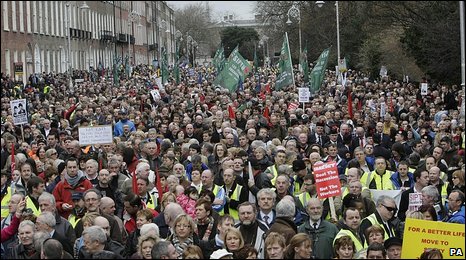
10/12/2014 Anti Water Charges Protests. Pictured are members of the public protesting against water charges at the Right 2 Water event outside Government Buildings in Dublin today. Picture: Sam Boal / Photocall Ireland

10/12/2014 Anti Water Charges Protests. Pictured are members of the public protesting against water charges at the Right 2 Water event outside Government Buildings in Dublin today. Picture: Sam Boal / Photocall Ireland

Twenty sixteen will see a general election in Ireland, one that will be a referendum on the policy of austerity and by implication the continued subordination of the Irish State to global multinational capital.  Austerity will be hailed by the Government as a success and the policy of bailing out the banks and bondholders inevitable and unavoidable.  Rising employment and falling unemployment; small reductions in taxes instead of large increases, and small increases in public expenditure will be held up as proof that the return of economic growth is no mere statistical artefact.

The policy of giving enormous tax breaks to the richest multinationals while Irish workers tightened their belt, or left the country, will continue to be hailed as successful and absolutely necessary.  So, for example, the takeover of Allergan by Pfizer will result in hundreds of millions of tax Euros for the Irish State every year and is the latest illustration of its importance.

Yes, times were tough but we had to tough them out, and we did.  This essentially will be the argument of the supporters of austerity and these are the arguments that those standing in the election will have to address.  They will have to present a critique which means presenting an alternative.

Central to this alternative is the idea of creating a left Government.  The strategy of most of the left in Ireland has centred on protest politics through single issue campaigns and building up constituency bases from which to launch a credible electoral campaign.  The ultimate purpose of this is to get a left Government elected because without it there is an enormous hole in the strategy of the left organisations.

Single issue campaigns, such as over water charges, can push back attacks but the bulk of austerity caused by pay reductions, unemployment, tax increases and cuts in services will not be reversed by protest and are the results of the actions of the Government.  This shows how central the perspective of entering government is to the left despite often protesting that it is subordinate to mass action by workers, although it is usually difficult to see by what mechanism mass action will achieve stated aims.

The left in Ireland has now developed to a scale where some electoral success is more than probable and such success can always be relied upon to cover up for deeper strategic failure and political weakness, such as failure to achieve a left Government or to satisfactorily address the arguments for austerity.

There will however be no left government elected in 2016, even by the widest interpretation of ‘left’.  In December the Red C/Sunday Business Post opinion poll put Fine Gael on  32% [+1]; the Labour Party on 9% [+2]; Fianna Fail on 17% [-2]; Sinn Fein on 19% [+1] and Independents/Others on 23% [-2].  Of the last figure, independents were 14 % with the left Anti Austerity Alliance and People before Profit Alliance on 3% and, the Greens, Renua and the Social Democrats all at 2% support.  In other words the three main parties that have implemented austerity are receiving 58% support, rising to well above 60% if we include the smaller right wing fragments of these parties and right wing independents.

Clearly the argument for an alternative has a long way to go. As it is obvious that there will be no left government elected in 2016 the left is beginning to address what the implications of this are.

Most obviously, the immediate prospect of a left government has no credibility if it does not include Sinn Fein.  Of course the idea of ‘the left’ is a purely relative one and in the past has included the Green Party, which implemented the biggest single attack on workers in the history of the State through the bank bailout and consequent austerity.  Sinn Fein itself has dropped much pretence of opposing austerity in the North, where it will implement most of it by itself in a coalition with the most reactionary party on the island, while handing powers back to the Tory Government in Britain to implement the bits it promised to defeat.

The idea of being on ‘the left’ is one easily appropriated and needs a clear context in which to be meaningful, but the traditional left organisations have for a long time sought to describe themselves in ways that they see as more immediately accessible to Irish workers, who have a very weak socialist tradition and low level of political class consciousness.  They have led the way in diluting political descriptions so that all sorts of words are used to replace the traditional vocabulary.  Misappropriation is one price to be paid for this.

There therefore exists a need to identify what exactly constitutes ‘left wing’, requiring a fight over ideas, which will ultimately be determined only when these are allied to a practice that demonstrates what they mean in reality.  The relationship of Sinn Fein to the idea of a left Government means that the left has had to address this in order to retain the perspective of a left Government at the centre of its strategy.

In this series of posts I will look at two aspects of this – what the political weakness is of the left’s strategy and what proposals the two left organisations – the Socialist Party and Socialist Workers Party – have put forward in order to deal with the problems posed to their electoral approach.

On 9 December an article appeared in ‘The Irish Times’ by two TDs from the Socialist Party  about their views on a possible alliance with Sinn Fein in the coming elections.  The Socialist Workers Party has also published an analysis upon which it has constructed a policy on a left Government for its electoral front, People before Profit.

Two things stand out in ‘The Irish Times’ article.  First is the decisive role “of a left Government that can mark a fundamental and radical shift away from a society dominated by the profits of the 1 per cent to one where the needs of the 99 per cent and the environment come first.”

Second is the definition of left Government as one that excludes the “traditional establishment parties” of Fine Gael, Fianna Fail and Labour but which does not immediately reject the participation of Sinn Fein.  Instead, it is challenged to accept the following programme – that a left Government:

“would have to include the reversal of the cuts implemented over the last years, abolition of austerity taxes such as water charges and property tax, investment to resolve the housing crisis and increasing the minimum wage and improving working conditions.  Implementing these policies means prioritising public services and housing over paying the bankers’ debts, shifting the burden of taxation on to the wealthy, corporations and high-income earners and challenging the straitjacket of the EU’s “Austerity Treaty”. A left government would also repeal the Eighth Amendment and challenge the oppression faced by women, Travellers, migrants and others.”

The Socialist Party TDs state that “Unfortunately, we have major doubts as to whether Sinn Féin would agree to such a programme.”  The doubts are justified but this isn’t altogether the point.  There is nothing on this list which one could immediately say Sinn Fein could not accept.  This being the case the task would therefore logically be to fight to get an agreement with Sinn Fein to agree a programme for Government on these lines in order to maximise the chances of such a Government after the elections.

It could be argued that promises from Sinn Fein would be worthless and there’s a long history of broken promises in the North.  However the North isn’t the South and the South isn’t the North and the very fact the anti-republican Socialist Party even raises the possibility of a Government with Sinn Fein acknowledges this.  Challenging Sinn Fein and doing so in front of its supporters would help to either expose lack of seriousness in its proclaimed policies or pressure them to commit to formation of a left Government while setting out clearly the policies on which this would be based.

It could also be argued that Sinn Fein would not be prepared to take the steps advocated by the Socialist Party to the same extent; it would not raise taxes on the rich or increase state investment to the same extent.  This objection however is only one of degree and not fundamental.  If it is considered by the Socialist Party that the commitment of Sinn Fein is too weak it could state what level of taxation and state investment it would see as constituting a minimum anti-austerity platform – certainly for both it will be more than the effect of the 2016 budget, which is estimated to raise household disposable income by 0.7%.

Sinn Fein however has endorsed the Right2Water campaign’s policy principles which are supported by a number of significant trade unions within the anti-water charges campaign.  Again these principles are vague but they do include a commitment to public investment of between €6 – €7 billion in water infrastructure alone, funded through progressive taxation, and they have provided a more detailed document setting out fiscal planning that envisages total spending of €9.4 billion from 2016 to 2020.  This was written in June 2015 and will have come before the most recent economic growth so will probably understate the amount that the authors would commit to.  In any case the amounts proposed appear to be the minimum they considered possible.

The Socialist Party’s own budget proposals contained in the Anti-Austerity Alliance (AAA) statement involve increased expenditure of €12.8 billion funded by increased taxation and savings of €16.4 billion and are clearly more extensive, but again it is a question of degree not of qualitative or fundamental difference.  For all the latter’s talk of “anti-capitalist” and “socialist measures” the budget proposals are in no sense qualitatively different from the former and the AAA budget is put forward only as “an illustration of how things could be organised differently”.

In terms of what is defined as a left Government there appears no decisive difference between the Socialist Party and Sinn Fein, regardless of what more radical ambitions to socialism the Socialist Party lay claim to.  It is what the Socialist Party proposes as the minimum programme for a left Government that is at issue.

Sinn Fein’s manoeuvring around potential coalition with what the Socialist Party calls the establishment parties, particularly the Labour Party, does not absolve the Party from responsibility to test the claims of Sinn Fein  and to fight to win it to a purely left Governmental programme.

None of this should be taken to mean that I endorse the strategic importance of a left Government as put forward by the Socialist Party or the rest of the left, or that I have any illusions in Sinn Fein.  Nor should it be taken that I endorse the measures proposed by the Socialist Party in the AAA budget proposals as essentially socialist, or even the road to socialism – I do not.

What I do believe is that the formation of a left Government in the Irish state would be a step forward for the working class and present much improved conditions within which workers could fight to advance their own organisational capacity and political consciousness.  This means that not only is the possible existence of such a Government important but so also is the programme on which it stands and the programme that it subsequently implements.

To simply damn the whole enterprise as reformist on the grounds that it will not see the overthrow of capitalism (which is true) is to abstain from the political issues as they present themselves and the struggles that are there.  In addition, to condemn the left organisations that proclaim to be Marxist for adopting a non-Marxist approach (which again is true) is hardly sufficient since the bigger question is not the erroneous views of these organisations but the much wider number of workers who are (rightly) looking for an alternative and see this project as involving an alternative (again correctly).

All these considerations matter, even though it is clear there will be no left Government in Ireland in 2016.

Forward to part 2

Trade union leaders support austerity? Oh yes they do!

Pantomime season is upon us, where actors go through well rehearsed and sometimes laughable theatrics to keep us distracted in the chilly season, performing roles we have seen so many times we could write the script ourselves.  Familiarity creates half the fun for the adults and innocent gullibility the mirth for the children.  Or at least for some.

A number of years ago a work colleague reported a conversation between two young boys sitting behind him while he was watching a panto with his kids.  “He’s behind you”, roared the children in the audience, only for the object of their warnings to turn round and miss the actions of the dastardly villain about to carry out the nefarious deed.  “Oh no he’s not” exclaimed the gormless actor.  “Oh yes he is!” screamed the children in the audience.  “He’s behind you!” they would roar again and so again would the witless actor turn round to see nothing amiss.  This obviously went on at some length until my friend heard one very well-spoken boy behind him tell his companion to shut up about the “he’s behind you” stuff – “be quiet Roger, the man’s obviously a fool.”

This story came into my head when I read the latest statement from the Irish Congress of Trade Unions (ICTU) about the “Fresh Start” agreement between the British Government, Irish Government and Northern Ireland parties.  The agreement was a stunning exposure of the hollowness of Sinn Fein’s opposition to austerity as it agreed and subsequently praised its agreement to Tory austerity, with less mitigation of the cuts than they had previously denounced as harmful to the most vulnerable.  The rest and larger part of austerity, including job losses, it had simply ignored as it happily implemented the cuts without a murmur of protest.  Shame and embarrassment are fundamentally important human emotions but there is something that Sinn Fein and the Tories share – they don’t have any such feelings.

The ICTU statement is a staged event which acts out opposition that is without even the merit of being funny and which could only be bought as serious if one was a small child, or rather the vast majority of small children.  It sets out ICTU’s support for the agreement even though this agreement is an agreement to implement austerity.  How then do ICTU hope to oppose austerity while supporting the agreement that implements it?

Why, you may as well shout “he’s behind you”, because austerity lies inside, behind, beside and in front of the ‘Fresh Start’ but ICTU will pretend not to see it – “Oh no it’s not! – it’s over there”.  “It’s inside, behind, beside and in front of you!” you might cry, to no avail.  And so it might go on.

As you can see, not half as funny as your regular panto.

The ICTU statement is full of lies and pathetic, vapid declarations of opposition that are a tiny leaf protecting its extremely modest pretence at opposition.  Not so much the naked emperor as the emperor’s naked servant.

So we can’t get past the first line of the statement before we get untruthful nonsense – “Given the critical role of the NI trade union movement in promoting and securing a peace process, Congress views it as essential that our devolved institutions remain intact.”

As a matter of fact it was not the trade unions and their large rallies that created the peace process but the secret negotiations between the British Government and republicans plus the unionists.  Everyone knows this.  All the rallies organised by ICTU did was reinforce support for the view that peace lay with those responsible for the violence.  It is only in the sense that ICTU continues to support the same sectarian politicians that can it claim to continue to “secure” the peace.

As I pointed out before, the demand for local sectarian institutions was justified by the erroneous claim that this was required to end the violence, while now acceptance of violence is justified by needing to do so to save the institutions.  Now ICTU claim that the existence of the sectarian institution is necessary to oppose austerity – “The imposition of Direct Rule would have unimagined consequences for the most marginalised in our society, as well as for trade unionists”, when in fact it has just been demonstrated to all but gullible children that austerity is necessary for the survival of the sectarian institutions.

In order to avoid reality ICTU is required to peddle the same nonsense as Sinn Fein but because it cannot be seen to be politically partisan it has to go further and cover up for all the political parties, including those whose policies are to the right even of the evil Tories and who make little pretence about their support for austerity: “Congress accepts the validity of the statements made by political parties that they pressed the UK Government for additional financial resources for NI to no avail  . . . Congress in this context recognises that our political parties are facing up to their responsibilities to ameliorate the negative impact of welfare reform.”

Other embarrassing aspects of the agreement are hard to just ignore so instead they are ‘noted’ –“Congress, while noting the insertion of a clause in the Fresh Start Agreement which specifies that the cut in Corporation Tax can only occur if the NI Executive’s finances are on a ‘sustainable footing’, will continue to oppose the cutting of CT in the unconditional method as advocated in the Agreement.”

I don’t know what this means. Is cutting corporation tax ok if finances are on a ‘sustainable footing’; does ICTU oppose “unconditional” cuts only but support cuts with conditions; what would these be?  Does the agreement not already state conditionality – finances on a ‘sustainable footing’ – so does this not therefore mean it supports the agreement on this issue as well?

ICTU claims it will oppose the terrible austerity but only in so far as it is the responsibility of the Tories in London, without accepting the responsibility of the local reactionary parties for agreeing to it and implementing it.  All so that ICTU can pretend that the face of austerity is not in front of them when they go to lobby the local parties but is “behind them”.

ICTU pledges that it will “continue a vibrant opposition to austerity” but this opposition rests on a platform of “actions” that read not as solutions to austerity but as a list of “actions” that provide jobs for trade union bureaucrats.  Their alternative policies consist of economic strategies, models, policies and quangos that culminate in a plea for the notorious patronage in existence not to pass them by – “That the membership of the trade union movement, as the largest civil society organisation in NI, be reflected in the composition of public bodies proposed under the Fresh Start Agreement.”  So while thousands of public sector jobs disappear ICTU wants jobs for their head boys and girls.

The duplicity of the drafting of this rotten statement is exposed by the first lines of the statement being contradicted by the last – “Congress advises all of its members to note that the Fresh Start Agreement is not a trade union agreement but one reached by democratically elected political parties and both governments.”  Having claimed credit for the process at the beginning they deny responsibility for its results at the end, from embracing it they state it’s nothing to do with them.

Which of course implies that one of their claims is actually true.  And since I’ve just said that the opening lines were a lie, this means their concluding lines are correct.  But only in the literal sense that the deal was made by the local parties and British Government, and the Irish government were in attendance as well.

The political purpose of the statement however is clear – don’t blame us for the consequences of the deal we’re supporting, we didn’t negotiate it, the “democratically elected” politicians did.  More bluntly – you elected these people so you’re getting what you voted for.

This is also true and explains the ability of the two main parties to come out of negotiations confident they will still be the two biggest parties after the next election.  But this does not excuse ICTU or its rotten statement.  It simply means they lack the courage of their declared convictions.  Most crucially it means they provide no alternative to austerity but are unable and unwilling to admit it.

But doesn’t the fact that the majority has voted, and repeatedly voted, for these sectarian parties that are imposing austerity mean that there really is no alternative?

Well, yes and no.  Yes, because there is no political alternative at present to the collective plans of the British and Irish governments and the sectarian parties – no one can credibly claim that there is even a semi-coherent practical alternative being debated, or even ignored.

No, because these agreements always erupt into crises because the parties just don‘t agree on what their agreements are. ICTU backs every rotten deal that comes along and then they fail; so there will at some point be an alternative.  The problem is that there is no progressive, working class one on the horizon.

No again, because the statement not only fails to oppose the agreement and the austerity that necessarily goes with it but endorses it.  Exposing the austerity that resides in the heart of the agreement would begin to weaken it on grounds that are minimally progressive.  When the leaders of ICTU can’t even oppose austerity then what we need is to oppose the ICTU leaders.

Use ‘ A Fresh Start’ to whitewash your dirty linen – maximum spin programme recommended

2015-11-24 21.25.27

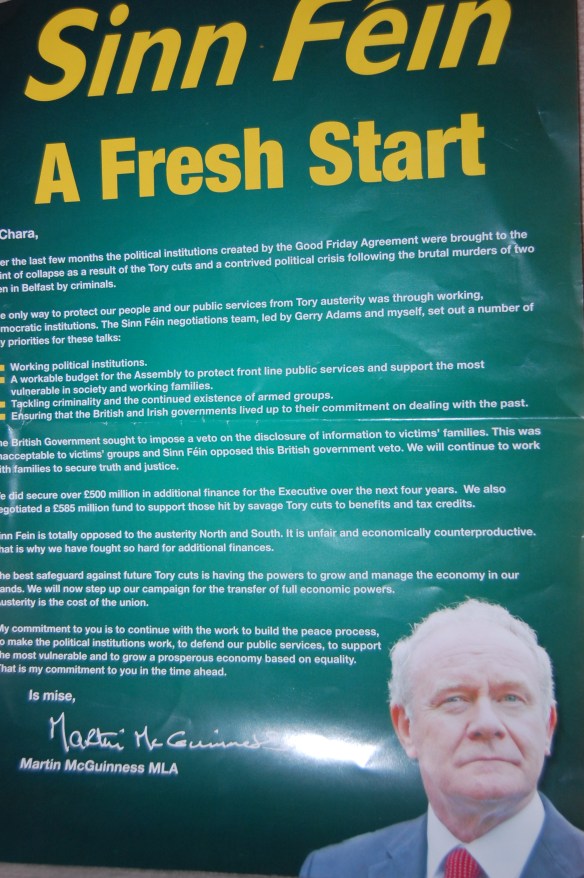
The richest political party in Ireland paid for the Northern nationalist newspaper ‘The Irish News’ to include a glossy leaflet inside it, selling the latest political deal which has been negotiated between it, the British government, Irish government and the Democratic Unionist Party.

It’s called ‘A Fresh Start’ although it isn’t: the whole point of it is to refurbish the previous agreement, of which Sinn Fein had been an enthusiastic supporter.

So it’s not fresh, since it contains no new ideas, and because we have been here countless times before and the main point is to implement the Stormont House Agreement, it’s not a start either.   In fact according to Sinn Fein no fresh start was even necessary.

Not necessary because the first paragraph in its open letter states that the crisis which prevented the implementation of the Stormont House Agreement was provoked by Tory cuts and a contrived political crisis caused by the murder of two people; one of which was carried out by Provisional republicans (so the contrivance must be partly their responsibility).

The other respect in which they were responsible for the ‘contrived’ crisis was their acceptance and then refusal to implement all the Tory welfare cuts, in the process claiming opposition to austerity while implementing it in all its other aspects.   In their leaflet they state that “the only way to protect our people and our public services from Tory austerity was through working the democratic institutions.”  Except that implementing Tory austerity became the only way of saving “the democratic institutions”.

The new deal implements the Tory cuts to welfare, with apparently some local mitigating measures already agreed, and nothing more than that.  The hollowness of the previous angry Sinn Fein opposition to the Tories and their cuts has been exposed through the ‘Fresh Start ‘Agreement making provision for transferring the powers to make the cuts from Stormont to Westminster.  Not so much standing up to Tory cuts as handing over the knives to the Tories to make them.

In parenthesis it may be noted that during all this fake opposition to welfare cuts the people affected were as utterly dependent on Sinn Fein as they are on the benefits themselves and have seen this opposition withdrawn along with some of their benefits.  What it proves is that the only way to protect our people and our public services from Tory austerity is through working people organising to fight back and creating an alternative.

The next paragraph in their open letter notes that Sinn Fein is standing up for victims by demanding the British Government discloses information, which it is refusing to do.  What a pity then that this is repeated on the other side of the leaflet below a picture of Gerry Adams whose complete disclosure of the past involves complete denial of ever being in the IRA.

The next paragraph boasts of “securing over £500 million in additional finance for the Executive over the next four year.  We also negotiated a £585 million fund to support those hit by savage Tory cuts to benefits and tax credits”.

The last deal they walked away from, because it failed to protect welfare recipients sufficiently, provided for £564 million over 6 years.  Sinn Fein claimed that this roughly £95 million per year was not enough “to protect the most vulnerable in our society” but has now accepted that £86.25 million a year over 4 years to cover the same cuts will be a better deal!  The money they claim to have negotiated now – £585 million in total – will have to be set against not only previous cuts but the new cuts to tax credits introduced since the previous agreement.  Even the ‘new’ money may not be new at all and the lone Green party member of the Assembly has claimed that some of it will come out of the existing Social Security Agency budget!

So what about the first £500 million claimed by Sinn Fein?

Well most of that is earmarked for those traditional objects of Sinn Fein sympathy – security and social security.  £188 million will go to security, with £160 million going to the Police Service of Northern Ireland to tackle republicans (the dissident ones?), and £125 million going to clamping down on social security fraud and error ( the irony of this is matched only by their calling those who murdered Kevin McGuigan “criminals”).

In the debate following the Agreement neither Sinn Fein nor the DUP have been able to demonstrate that all the claims about there being new money stand up and that the partial and temporary welfare relief is not just going to be paid by existing budgets.

So when Sinn Fein claims in its leaflet that “Sinn Fein is totally opposed to the austerity North and South” this really means nothing very much in the North and will very likely mean not a great deal in the South either.

In the penultimate paragraph it says that “the best safeguard against future Tory cuts is having the powers to grow and manage the economy in our hands.”  So how have they done this and how do they propose to do it in future?

Well, the Agreement notes approvingly the reduction of 7,410 jobs from state employment in the three years between April 2014 and March 2016 and “If cost cutting does not achieve the results required the Executive will “consider revenue raising measures.”   To indicate the meeting of minds involved, and to demonstrate that we are all in it together, “the Executive commits itself to lowering corporation tax to 12.5% in April 2018.”

In addition the British Government will legislate to ensure that local spending plans cannot exceed what is permitted and will review the Block grant to Northern Ireland after four years to take account of the effect of the reduction in corporation tax, no doubt with a view to further reductions.  How all this is opposition to Tory austerity is anyone’s guess.

Rather stupidly the other side of the Sinn Fein leaflet advertises the opposition of the British Government to disclosing its role in the past, about which Sinn Fein has achieved absolutely nothing.  The Agreement includes as the first of its principles “the ending of paramilitarism”.  This is straight after The British Government has issued an ‘independent’ report saying that the IRA army council still exists, and of course following the murder of Kevin McGuigan, all while Sinn Fein continues to claim that the IRA has left the stage.

On the Unionist side the repeated collaboration with loyalist paramilitaries by the unionist parties is studiously ignored.

It would be tempting to point the finger at both Sinn Fein and the DUP for their hypocrisy but the British have a special talent when it comes to this sort of thing.  It was reported only last week that there have been only ten convictions based on membership of a paramilitary organisation since 1998 and none for nearly seven years.  So how come, all of a sudden, it’s become such a big deal?

A new task force made up of the Northern and Southern police forces and tax authorities is to be established but this will achieve what its masters want it to achieve.  It is the stick to the carrot of additional (or not so additional) money.  However, as it’s a cross-border body it’s clearly aimed at republicans.

What sticks in the craw most about this part of the deal is that the Executive, made up of Sinn Fein and the DUP etc., is to “undertake a public awareness campaign to raise public understanding of the harm done by paramilitarism.”  Yeah, we really don’t have a clue.

The heading for a ‘Shared Future’, costing £60 million over four years, gets one paragraph and explains nothing, which could mean it will never be spent or might be spent on buying off ‘community representatives’, as flagged in the latest loyalist offensive for ‘inclusion’ of their gangster outfits in the Stormont gravy train.

By contrast the section ‘Irish Government Financial Support’ gets two and a half pages, with the highlight a meager £75 million for a road, although it also includes such key aspects of the Agreement as “development of further cross-border Greenways and Blueway cycling-walking-water leisure routes, including the Ulster canal.” The Irish Government also champions the use of private finance to fund further infrastructure projects.  In other words the Irish Government is pretty irrelevant except to allow nationalists to claim some role for it, what role is pretty clear.

The rest of the Agreement promises to implement the previous Agreement on Flags, Identity, Culture and Tradition.  So, while the paper mentions sectarianism twice it mentions Flags twenty-two times.

The ‘Fresh Start’ also rather embarrassingly reminds nationalists that the British Government endorses “the need for respect for and recognition of the Irish language in Northern Ireland” but again this means nothing and reminds everyone of the failure of Sinn Fein to achieve its long held objective of an Irish language Act.

What to do about the past is the one area where failure is so total that the Agreement has to admit it.  Yet, rather than skirt round the issue in its leaflet, Sinn Fein states that dealing with the past was one if its four priorities – so what happened then?

If the only thing now that has yet to be agreed, and which will therefore involve yet more talks, is about the past, it will continue to be easy to present the problem as one of living in it.

The Sinn Fein leaflet then is a catalogue of failure and the new Agreement is an attempt to build on that failure.  It is such an open declaration of defeat that even some of those opposed to Sinn Fein appear to find it a bit embarrassing.  The ‘Irish News’ columnist Newton Emerson begins his assessment of the Agreement by saying:

“The ‘fresh start’ agreement is such a total defeat for Sinn Fein that it is positively bizarre.  Even as a unionist, I find it unnerving”

The leaflet aimed at their supporters is just as bizarre as their negotiations and their spin on it is empty and pathetic.

It should also be said that the Agreement is also a rejection of unionist appeals to take steps to ditch Sinn Fein and allow the unionists to begin running the local state apparatus without them.  This would represent a clear break from British strategy and a divided unionism is in no position to achieve this.

Besides, for the British, with ‘enemies’ like Sinn Fein who needs friends?


Greece Crucified

ws jimagesAlexis Tsipras justified his humiliating U-turn, and commitment to imposition of austerity worse than he had just rejected, by saying that he had no mandate for Greece to exit the Euro.  Very true.  But he had just claimed that the referendum a week before had not been about the Euro.  By 61 to 39 per cent he has no mandate for austerity, which is what he said the referendum was really about.

He came into office promising an end to failed bail outs and has ended with a third one bigger than the first.  He called for debt reduction and now seeks support for debt inflation.

Such is the scale of the crushing terms of the latest ‘bailout’ that no one is attempting to say that it is nothing other than complete humiliation for Greece.  Even the Eurozone bureaucrats stated the truth behind the unpalatable words spewed out by their leaders – Tsipras had been subjected to “mental waterboarding” and had been “crucified”.

What has been mental torture for Tsipras will be brutal and catastrophic austerity for the Greek people.

I could write a whole blog on the capitulation of Tsipras and what looks like the majority of Syriza, and there would be good political reasons for doing so.  The policy and strategy of Syriza has been endorsed by Irish opponents of austerity such as Sinn Fein and these now lie in tatters.

In fact in my own view Sinn Fein is not even as radical as Syriza and this is an easy claim to substantiate.  It has already implemented austerity in the North of Ireland while hiding behind opposition to some welfare cuts.   In the South it supported the fateful decision to make the debts of corrupt banks and property speculators the burden of Irish workers and in doing so made the struggle against paying this odious debt much more difficult.

But there will be plenty of voices pointing out that what radical politics Sinn Fein has to offer have been trialled in a real life laboratory and been found wanting.  The capitulation of Syriza is in principle no greater than the Republican’s own acceptance of British rule in Ireland, acceptance of partition, surrender of weapons and dissolution of the IRA.  But that is all now a history that no one wants to talk about.

What is more important therefore is to try to understand what has happened and whether it could have been any different.  Not that it must be accepted that the ‘coup’ against Greece cannot or will not be resisted.  It can and will but it would be blindness to reality not to acknowledge that under Syriza the fight against austerity has suffered a demoralising defeat.

As that new aphorism says: it’s not the despair, I can take the despair.  It’s the hope.  Syriza gave hope.

Working out what has happened is not easy. For the man or woman on the street they see television reports of quantitative easing by the Eurozone involving the figurative printing of  millions of Euros by the European Central Bank, yet this same institution is involved in the vindictive pursuit of Greece for sums it could easily accommodate.

The proposals of the conservative leaders of the EU seem equally hard to understand or justify.  In fact for many they seem stupid, if not crazy. So draconian are they that they seem designed to achieve the very opposite of what they claim to be for.

The imposition of yet greater austerity when this austerity has demonstrably failed might be explained by ideological blindness.  And the humiliation involved might seem to invite rejection while being another attempt to remove Syriza from office.  But many commentators have explained that Syriza may possibly remain the only force that can push austerity through without complete chaos and collapse.

This humiliation is perhaps not just a message to a small and weak Greece but an unmistakeable one to a larger Italy and France: that the development of the EU will be under a model defined by Germany and its allies.  Yet even here the degree of malevolence can only invite small countries with parties equally blinded by reactionary ideology as Germany to wonder just what fate would befall them in an EU with such a definition of ‘solidarity.’

So while ‘good’ reasons might be found for what would appear to be ideological blindness the proposal for a “timeout” exit by Greece from the Euro appears as simply stupid; unless of course it is also a means of pushing Greece out permanently. But then it is such a stupid idea as justification that its purpose might only seem to be how open the imperial bullying can become, ‘pour encourager les autres’.

For the Greek people the surrender of even nominal control of their affairs is way beyond what has gone before.  The original proposal to ring fence €50 billion of Greek assets under German control,  to be sold at the discretion of its creditors, was such an open declaration of debt bondage as to render the humiliation utter and complete. What is yours is no longer even yours to sell.  Now it is reported it will simply be wasted on insolvent Greek banks with the needs of financial capital once again talking precedence not only over people but over real productive activities.

Thus in many ways, its failure to actually work being the first, its effects on undermining the legitimacy of the EU second and materially weakening the incentives to solidarity among its members third, all make the bailout deal a defeat for the idea of a European Union.  This is not even a European imperialism to rival the US, Russia or China but an imperial core and vassal periphery.

The price being paid seems so unnecessary because the main demand of Syriza – in order to give hope and reduce the impact of austerity, i.e. debt forgiveness, will be given and is already hinted.  Not in the shape of outright reduction but in the form of postponing or extending repayments and similar measures on the interest due.  After all, what cannot be repaid will not be repaid.

What matters however to the right wing conservative leadership of Germany, the Netherlands etc. is that their strength, and by extension that of the European imperialist project, is not diluted by the weak European nations and that the Euro remain in position as a world currency and not a vehicle for default and certainly not by what is considered an advanced nation.  Greece must be bled dry in order that the Euro remains strong and the pretensions of the EU remain in place.

The vision of a united Europe is not being abandoned by Germany etc, but it is one in which austerity is the bond that unites. It can be claimed that austerity will be inflicted on German workers if crisis hits the German banks; except of course that Germany has broken the rules before and would do so again.  It is easier to be ideologically blind when the price is paid by someone else.

Could it have worked out differently?    Syriza had hoped that enlightened self-interest would have combined with pressure from the US and the legitimacy gained by the referendum to mitigate the demands for austerity by Germany, The Netherlands and all the other little right-wing led states that curry favour with the powerful.  They have been rudely disabused of their illusions.

The more fundamental reason for this outcome is the weakness of the alternative at an international level.  Where were the left wing Governments calling for debt forgiveness, an alternative to austerity or even its reduction?  Where were the mass movements pressurising their Governments to accede to Greek requests?  Greece could not push back the demands of much stronger states on its own but on its own it was.

The demand for a revolutionary socialist alternative seeking the destruction of the Greek capitalist state and take-over of the Greek economy by its workers fails to provide any sort of immediate alternative, which is what we are discussing, for two rather obvious reasons.

Such a strategy relies on the aspiration and activity of the working class and the Greek working class neither desires nor is organised to destroy the existing state, create its own and take over the running of Greek production.  The anti-capitalist ANTARSYA for example got less than 1 per cent of the vote and Syriza, it should not need to be said, is not a revolutionary party.  How does a revolution arise out of this except through a long and painful process of learning lessons and making advances on this basis?

I was recently reading an article entitled ‘Marxism and Actually Existing Socialism’ written, what seems like a long time ago, before the collapse of the Soviet Union, and which defended Marx’s theory and politics.  In it the author wrote that:

“Marx envisaged that socialism would come first in the most advanced industrial societies of Europe, and it has not done so. Arguably, however, Marxism is capable of comprehending this fact. In any case, this is a matter of detail, even if an important one; and it seems difficult to resist the conclusion that, in its broad and general outlines, Marx’s account of the historical tendencies of capitalism has been remarkably confirmed by historical events.”

But of course the coming of socialist revolution not to the most advanced countries is not a detail, not even an important one.  It has been fundamental to the development and future possibility of socialism and has led to the very definition of socialism being distorted and disfigured.

Socialism is not possible in Greece alone any more, and certainly less, than it was in Russia not least because it is too weak and poor.   It is obvious that no other working class within any other country in Europe is at a stage of development where it could either join or support working class rule in Greece.

This does not mean Syriza should not have taken office or that it should not have engaged in negotiations with the Troika. Its strength however derives fundamentally from the class consciousness and organisation of the working class and not from any superior moral position.  The building of an international European party of the working class, of a militant current within the working class movement including trade unions, and of international workers’ cooperatives is the only road to creating the foundations for a successful conquest of political power.

On the other hand capitalist economic and political crises and socialist propaganda are, respectively, simply the occasion for such a conquest and the means of spreading word of the need for it.

As I have said before: the worst result would be Syriza implementing austerity.  It should now reject the bailout, call fresh elections on such a platform and if elected pursue an alternative.  If in opposition it should develop a movement as set out above.

The alternative it should pursue is that which the Irish should have carried out in 2008.  Let the banks go bust and let its owners and lenders take part in a ‘bail-in’ in which they pay the price for their investment in insolvent companies.  This is sometimes known as capitalism.

A radical Greek Government would encourage Greek workers to turn the banks into cooperatives that would shed their bad debts into a ‘bad bank’ (like NAMA in Ireland, in theory if not in its practice) and guarantee deposits that would fund development of worker owned enterprise.

The Greek debt would thereby suffer default and the reactionary gamblers Merkel, Juncker, Schäuble, Draghi and Dijsselbloem would see where the chips fall.

The blogger Boffy has suggested that a solution to the currency problem would involve electronic Euros that would allow circulation of money without the requirements for additional notes etc. from Brussels.  While this could work for the domestic economy I cannot see how it could function as a means of payment for international trade and, while Greece is a relatively closed economy, it cannot function without it.

In any case the leadership of the EU would, on current form, expel Greece from the Euro and introduce its own capital controls on the country.

Greece would be forced into issuing a new currency, a new Drachma, which the people do not want.  This could not be done quickly or without significant disruption.  It has been asserted that the argument that this would result in devaluation and a massive reduction in Greek living standards is false because the catastrophe predicted has already happened.  ‘Internal devaluation’ has already achieved what external devaluation of the new currency would otherwise have done.

I am not convinced by this argument but this too might be academic if the EU decided that Greece would no longer be part of the Euro.

The strategy suggested therefore provides no guarantee of success.  There is no ‘technical’ solution or answer in this sense.   And why should one be expected?

I have said that socialist revolution depends on the prior creation of a working class power consisting of an international party, international trade union action and development of workers’ cooperatives on an extensive scale.  What on earth could substitute itself for these?

What is suggested is a strategy for struggle and not a ‘solution’ but we have reached the stage where not even the leaders of the EU can present false promises on this with any credibility.  Austerity will continue not to work.  Struggle is what we have.


Some comments on the Greek referendum

Greece3543The decision of the Syriza Government to call a referendum on the proposed austerity proposals of the Troika (European Commission, European Central Bank and IMF) in return for another ‘bailout’ programme reminds me of the Irish austerity referendum three years ago.  It gave rise to one of the first posts on this blog.

The Irish people voted by a large majority to support austerity.  Will the Greeks do the same?

The Irish voted reluctantly to accept austerity (how else could you do so?) because there was no alternative at hand.   The arguments of the Left that the Irish State could lead a growth agenda of Keynesian stimulus hardly convinced when that State had just bankrupted itself bailing out the banks.

Both the reason for the defeat and its effects have not been appreciated.  Of the latter it is enough to ponder the proposals of the trade unions behind the largest sustained opposition to the austerity agenda – the Right2Water proposals for ‘A New Fiscal Framework for a Progressive Government’, which proposes additional State expenditure of €9.4 billion over 4 years.  This would amount to less than 4.5% of the 2014 level of Government expenditure.

The Right2Water’s ‘Policy Principles for a Progressive Irish Government’ contains a section which proclaims the need for additional investment in the water and sanitation system of “between €6 and €7 billion”, which leaves just around €2.5 to €3.5 billion for education, health, investment and everything else.  This is not so much an alternative to the current Government’s strategy as a variant of it.  So much have horizons been lowered.

According to the authors of this document the rules of the EU will be adhered to while seeking flexibility within them and negotiating additional scope for spending.  But the case of Greece exposes that the rules of the EU, ECB and IMF can be bent to suit.

So the claim that joining the Euro was irrevocable has been discarded by the leading powers in the EU to be replaced as the biggest threat to the Greek Government and people – vote against our austerity plan and you are voting to leave the Euro.

The propaganda campaign by the EU leaders includes European Commission President Jean Claude Juncker, who says he feels ‘betrayed’, and complains about a lack of “good faith” and “sincerity” from the Greeks.  This from a man who presided over the building of Luxembourg into a tax haven.  Yet he sees fit to question the Greek Government and people over their right and capacity to raise taxes.  Has the tax evasion facilitated by Luxembourg not contributed to the Greek predicament?

Christine Lagarde of the IMF proclaims she wants “adults in the room” with whom to negotiate, attempting to infantilise the Greek Government representatives and by extension the Greek people.  This is the Lagarde who has been placed ‘under investigation’ in a fraud case.  One can’t help but recall the behaviour of the previous head of the IMF, Dominic Strauss-Kahn.  Getting fucked by the IMF is a pleasure for no one.

In the current case this involves Troika demands for drastic reductions in the pensions of some of the poorest Greek pensioners and increases in VAT that will hit both those who will pay increased prices and the small businesses compelled to charge them.

On the Left these demands of the Troika are likewise treated as in effect an ultimatum which should lead to exiting the Euro – as the only effective response to the unceasing demands for austerity.  What for the leaders of the EU is a threat which the Greek people should retreat from is for some on the Left a major part of the solution.  What for the former is a recipe for chaos is for the latter the way out of it.

In my view the former are correct.  Exiting the Euro would lead to a new Drachma that would involve massive devaluation and a large reduction in Greek workers’ living standards.  Cutting one’s own throat is not preferable to having someone else do it.  If Greece is thrown out of the Euro it naturally has no choice but that is not a choice it should itself make.

It is clear however that the choice at the end of the day is not Greece’s to make.  It is not in a position to compel a significant reduction in austerity or debt relief even while many commentators who support the austerity demanded admit that debt relief is inevitable.  The reason that they demand austerity nevertheless, even while recognising that it has failed, is that they seek the removal of the Syriza Government.

The EU leaders tried it last week and now seek it this week through refusing to accept Syriza’s huge concessions, refusing to extend the ‘bailout’ and through freezing ECB liquidity provision to the Greek banks.

The Greek workers should reject the austerity plan from the EU and reject the non-solution of leaving the Euro.  Only on the basis of fighting austerity and refusing a go-it-alone nationalist solution can it minimally seek to build a movement that would stem the demands for austerity.  What the Greek crisis shows is that such austerity can only be fought at an international level.

What does this mean?

Well, let’s look at what the Channel 4 journalist Paul Mason, who is covering the crisis, had to say.   Exit from the Euro may be inevitable he says because of democracy – the population of Northern Europe would not support the transfers required to reverse austerity inflicted on Greece while the Greek people may no longer accept it.

In this he is at least partly right.  Only an international campaign of solidarity with the Greek people, which explained that the bailout was not for them, but for the German and French banks and hedge funds who invested in lending to Greece, could explain the real function of austerity and lay out the grounds for convincing those outside Greece to reject it.  On this basis it might force a retreat from the austerity demanded by other EU Governments, including the repulsive Irish one.

Within Greece it would require not just an ‘OXI’ vote but a mass movement that would compel implementation of a Syriza programme to tax the oligarchs through occupations to open the books of these businesses and in doing so help put in place a rigorous system of tax collection.

In itself this would only form the starting point of a workers’ alternative – one that is based on development of worker owned production.  Such workers’ cooperatives are the alternative to the weak and crony capitalism from which Greece suffers.  It offers practical proof of the socialist alternative and is a basis for its growth this side of political revolution.  The latter in turn will gain credibility from practical demonstration of a socialist programme.

The lack of such international and domestic conditions caused defeat for Irish workers in their referendum.  A very different vote in Greece would be a step forward for Irish workers now.

On the other hand the very worst result would be defeat in the referendum and a Syriza Government implementing austerity.

While the Dutch hatchet-man Jeroen Dijsselbloem again reveals the Euro leaders agenda of getting rid of the elected Greek Government – “ who are we trusting” he says if Syriza promised to implement the austerity it had just rejected, Varoufakis is quoted as saying that Syriza would do just this.  “If the people give us a clear instruction to sign up on the institutions’ proposals, we shall do whatever it takes to do so – even if it means a reconfigured government.”

Such an approach would discredit any sort of Left alternative and pave the way for a hard right Government to eventually push through austerity on a demoralised workers’ movement.

The long resistance of Greek workers to austerity has given hope that we are not yet at such a result and that the struggle against austerity will continue.