Karl Marx’s alternative to capitalism part 74 – the dictatorship of the proletariat (3)

It is ironic that Marx’s idea of the dictatorship of the proletariat is held up as evidence of his authoritarian and oppressive politics when his view was advanced against such conceptions, held by many of his immediate socialist predecessors and contemporaries.  These included such figures as the utopian socialist Saint-Simon, Blanqui, Wilhelm Weitling and Ferdinand Lassalle, who are no longer so well known, but whose views are still the staple of many today who are unaware of their ancestry.

In the previous posts on the book Citizen Marx, we noted that early in his political career he was on the extreme democratic wing of republicanism, and against the constraints on democracy supported by liberalism, going much further in identifying the road to a positive conception of freedom.  The first ‘dictatorship’ championed by him was the dictatorship of democracy in 1848 during the bourgeois revolutions of that year, which the bourgeoisie betrayed.  Such a democratic “dictatorship” would energetically repress any counter-revolution to defend itself from reaction.

For Marx the dictatorship of the proletariat was synonymous with terms that now sound less jarring, such as the ‘political power of the working class’ or the ‘rule of the proletariat’, and meant nothing more nor less than these.  In his book Citizen Marx, Bruno Leipold suggests that the various terms Marx used to describe the Paris Commune could also be employed – “Communal Constitution”, “Communal Republic”, “Republic of Labour” and “Social Republic”.  What this entailed was set out in the previous post, most particularly the abolition of classes leading to the abolition of the state, understood by Marx as the mechanism for imposing and defending class rule.

As Engels set out, ‘the state is nothing but a machine for the oppression of one class by another, and indeed in the democratic republic no less than in the monarchy; and at best an evil inherited by the proletariat after its victorious struggle for class supremacy, whose worst sides the victorious proletariat just like the Commune, cannot avoid having to lop off at once as much as possible until such time as a generation reared in new, free social conditions is able to throw the entire lumber of the state on the scrap heap.’ (Engels Introduction to Karl Marx’ s The Civil War in France 1Vol 27 p 190)

Marx ventured some views on how the state would develop that history has confirmed: 

“The bourgeois state is nothing more than the mutual insurance of the bourgeois class against its individual members, as well as against the exploited class, insurance which will necessarily become increasingly expensive and to all appearances increasingly independent of bourgeois society, because the oppression of the exploited class is becoming ever more difficult.”  (Marx, Le Socialisme et l’Impôt, par Emile De Girardin, Collected Works Vol 10 p 333)

Hal Draper, in his third volume of Karl Marx’s Theory of Revolution, entitled The Dictatorship of the Proletariat ventures that ‘Marx’s term ‘rule of the proletariat’ was reformulated as ‘dictatorship of the proletariat’ when Marx had to confront the Blanquist mind. (KMTR Vol III p 293).  Draper also notes the comparatively few times – six – that Marx used the term, within two defined periods: 1850–52 and 1871–75.  What matters is that it follows from the idea of a working class political struggle, leading to a working class revolution, and new collective property relations based on the working class.

Draper further states that ‘Not before the “Critique of the Gotha Program” and not after it did Marx ever indicate that the party program should include the ‘dictatorship of the proletariat’, or any formulation involving the word ‘dictatorship’. (KMTR Vol III, p 305)

We have also seen in the posts on Citizen Marx that Marx and Engels believed that a democratic republic provided the best conditions in which to fight for socialism and was therefore more important to the working class than the bourgeoisie. The latter could, if it had to, have its interests defended by dictatorial political regimes that rested on capitalist property relations, while collective and cooperative property relations are inimical to such political forms.  Whether the form of the bourgeois state was a bourgeois democratic republic or an authoritarian regime, all entailed the dictatorship of the capitalist class in their understanding of the term since the property relations were capitalist and defended by the state.

As The Communist Manifesto put it “All previous historical movements were movements of minorities, or in the interest of minorities. The proletarian movement is the self-conscious, independent movement of the immense majority, in the interest of the immense majority.”

“The immediate aim of the Communists is the same as that of all other proletarian parties: formation of the proletariat into a class, overthrow of the bourgeois supremacy, conquest of political power by the proletariat.”

What distinguished Marx’s conception from that of others was that the “dictatorship” was to be one of the proletariat not over it.  As Engels said of one who advanced the latter view:

‘Since Blanqui regards every revolution as a coup de main by a small revolutionary minority, it automatically follows that its victory must inevitably be succeeded by the establishment of a dictatorship—not, it should be well noted, of the entire revolutionary class, the proletariat, but of the small number of those who accomplished the coup and who themselves are, at first, organised under the dictatorship of one or several individuals. (Engels, The Program of the Blanquist Fugitives from the Paris Commune Collected Works Vol 24 p 13)

Emancipation was to be achieved by the working class itself, counterposed to the schemes of the supporters of Blanqui:

‘Brought up in the school of conspiracy, and held together by the strict discipline which went with it they started out from the viewpoint that a relatively small number of resolute, well-organised men would be able at a given favourable moment, not only to seize the helm of state, but also by a display of great, ruthless energy, to maintain power until they succeeded in sweeping the mass of the people into the revolution and ranging them round the small band of leaders. This involved, above all the strictest, dictatorial centralisation of all power in the hands of the new revolutionary government.’  (Engels Introduction to Karl Marx’ s The Civil War in France 1Vol 27 p 188)

This was to be true not only of the workers’ party in relation to society but within the party itself. As Engels put it in a letter in 1890 regarding the German Workers Party: “The biggest party in the empire cannot remain in existence unless every shade of opinion is allowed complete freedom of expression, while even the semblance of dictatorship à la Schweitzer must be avoided.” (Marx and Engels, Collected Works Vol 49 p 11)

Back to part 73

Karl Marx’s alternative to capitalism part 73 – the dictatorship of the proletariat (2)

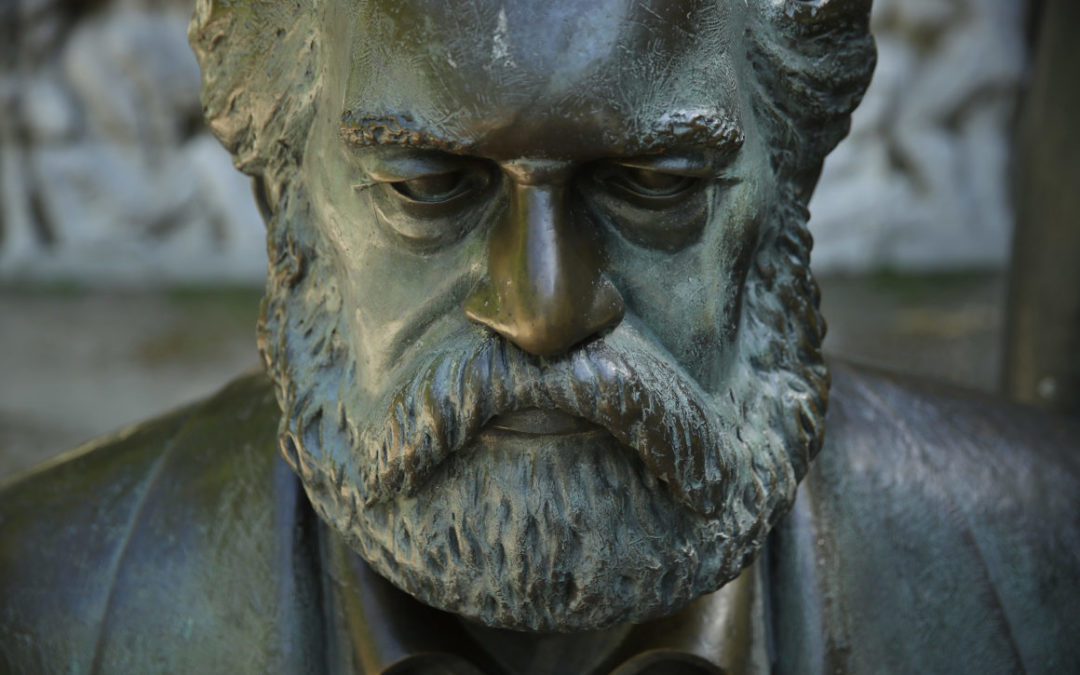
Statue of Karl Marx in Berlin May 4, 2018. Photo by Sean Gallup/Getty Images)

“Between capitalist and communist society there lies the period of the revolutionary transformation of the one into the other. Corresponding to this is also a political transition period in which the state can be nothing but the revolutionary dictatorship of the proletariat.” (Marx, Critique of the Gotha Programme, Collected Works Vol 24 p 95)

The qualitatively greater degree of freedom to which the dictatorship of the proletariat is directed is explained firstly by Marx’s opposition to the idea of a “free state”:  “Freedom consists in converting the state from an organ superimposed upon society into one completely subordinate to it, and even today forms of state are more free or less free to the extent that they restrict the “freedom of the state.”

The mistaken view of the state as the mechanism that can bring about freedom arises from the view that instead “of treating existing society (and this holds good for any future one) as the basis of the existing state (or of the future state in the case of future society), it treats the state rather as an independent entity that possesses its own “intellectual, ethical and libertarian bases”. (Critique of the Gotha Programme) This false idea is today more or less widespread among many ‘Marxists’ who champion nationalisation, ‘the public sector’, income redistribution and welfarism, or ‘national sovereignty’ and ‘self-determination’.

The basis of the state under the dictatorship of the proletariat is the development of cooperative economy to the national level and beyond so that society as a whole becomes a cooperative venture consciously moulded to human need by being consciously planned.  Capitalism begins this transition through its socialisation of production but only by raising its contradictions to a higher level while cooperative production begins its positive supersession.

This development within capitalism, however, cannot be adequate or sufficient to achieve its replacement, as Marx explained: “Restricted, however, to the dwarfish forms into which individual wages slaves can elaborate .. by their private efforts, the co-operative system will never transform capitalist society. To convert social production into one large and harmonious system of free and co-operative labour, general social changes are wanted, changes of the general conditions of society, never to be realised save by the transfer of the organised forces of society, viz., the state power, from capitalists and landlords to the producers themselves.” Marx Instructions for the delegates of the Provisional Geneal Council, Collected Works Vol 20 p.)

If the road to socialism can loosely be called rule by the working class Marx explains more clearly the steps which the dictatorship of the proletariat must take upon the conquest of political power (which, to emphasise, is inseparable from social power more generally): “What we are dealing with here is a communist society, not as it has developed on its own foundations, but on the contrary, just as it emerges from capitalist society, which is thus in every respect, economically, morally and intellectually, still stamped with the birth-marks of the old society from whose womb it emerges.  Accordingly, the individual producer receives back from society—after the deductions have been made—exactly what he gives to it.”

Marx explains that in these “altered circumstances no one can give anything except his labour, and . . . on the other hand, nothing can pass to the ownership of individuals except individual means of consumption.” The accumulation of capital by a minority class, and therefore also a class that must work on its behalf, cannot arise, so that with this “abolition of class distinctions all social and political inequality arising from them would disappear of itself.”  (Critique of the Gotha Programme, Collected Works Vol 24 p 96 & 92)

This must lead ultimately “In a higher phase of communist society, after the enslaving subordination of the individual to the division of labour, and thereby also the antithesis between mental and physical labour, has vanished; after labour has become not only a means of life but life’s prime want; after the productive forces have also increased with the all-round development of the individual, and all the springs of common wealth flow more abundantly—only then can the narrow horizon of bourgeois right be crossed in its entirety and society inscribe on its banners: From each according to his abilities, to each according to his needs!”

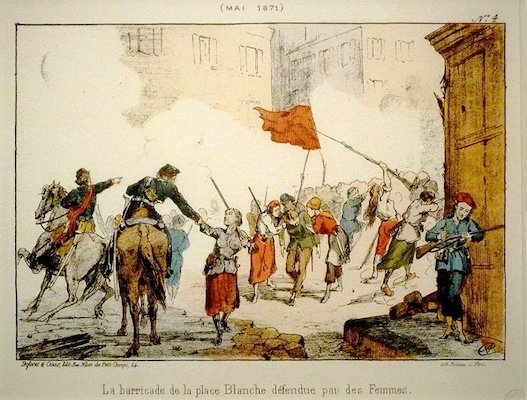
Not only did Marx and Engels put forward this prospectus, but they lived long enough to see an initial attempt to begin it, if only in a very limited fashion – in one city, for a short time, and by an undeveloped working class still short of full consciousness of its task:

“Well and good, gentlemen, do you want to know what this dictatorship looks like? Look at the Paris Commune. That was the Dictatorship of the Proletariat”. (Engels) “The political rule of the producer cannot coexist with the perpetuation of his social slavery. The Commune was therefore to serve as a lever for uprooting the economical foundations upon which rests the existence of classes, and therefore of class rule.” (Marx, The Civil War in France, Vol 22 p334)

“ . . the present “spontaneous action of the natural laws of capital and landed property”—can only be superseded by “the spontaneous action of the laws of the social economy of free and associated labour”, by a long process of development of new conditions, as was the “spontaneous action of the economic laws of slavery” and the “spontaneous action of the economical laws of serfdom”. “But they know at the same time that great strides may be taken at once through the Communal form of political organisation and that the time has come to begin that movement for themselves and mankind.” (Marx, The Civil War in France, Vol 22 p491-2)

“Its true secret was this. It was essentially a working-class government, the produce of the struggle of the producing against the appropriating class, the political form at last discovered under which to work out the economical emancipation of Labour.” (Marx, The Civil War in France, Vol 22 p334). This “economical emancipation of Labour” was thus to be ‘worked out’ by the working class itself, not by the new state or its governmental executive, but ‘under’ a ‘political form’ that obviously would require organisations of the working class separate from the state, even its own workers’ state to carry out this task..

The new relations of production, which it is the role of the workers’ state to defend, are the means by which the collective and associated labour will develop “by a long process” towards socialism: t”he superseding of the economical conditions of the slavery of labour by the conditions of free and associated labour can only be the progressive work of time.” (Marx, The Civil War in France, Vol 22 p 491)

This, in practice, and not just in theory, demonstrated the wholly democratic credentials of proletarian dictatorship in its earliest form.  In order to avoid bourgeois political corruption, Engels claimed that “the Commune made use of two infallible expedients. In this first place, it filled all posts—administrative, judicial, and educational—by election on the basis of universal suffrage of all concerned, with the right of the same electors to recall their delegate at any time. And, in the second place, all officials, high or low, were paid only the wages received by other workers. The highest salary paid by the Commune to anyone was 6,000 francs. In this way an effective barrier to place-hunting and careerism was set up, even apart from the binding mandates to delegates to representative bodies, which were also added in profusion” (Engels, postscript to The Civil War in France, Collected Works Vol 27 p190)

Back to part 72

Forward to part 74

Another brutal lesson on imperialism

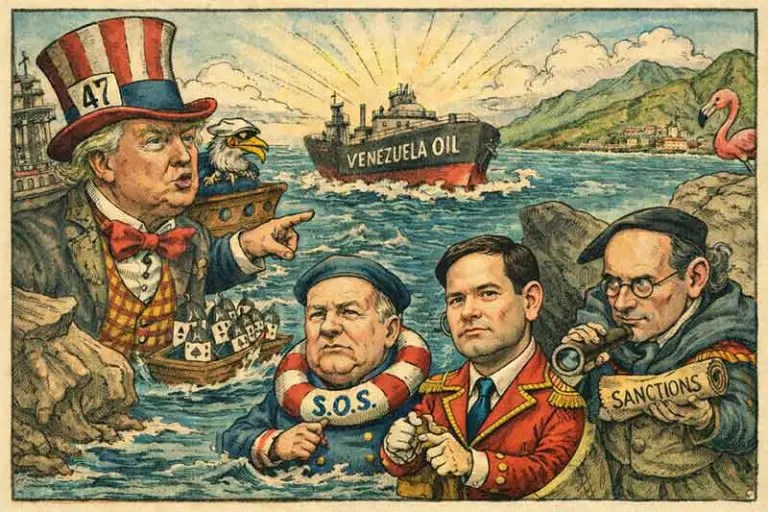
The attack on Venezuela and Trump’s declaration that the US is going to run the country is about as naked a demonstration of imperialism as one can get.  It is also a crystal clear expression of the new ‘multipolar’ world order that many on the far right and on the left have supported.  You think not?  Do you think the ‘multipolar’ world will not have a pole that includes United States imperialism?

The dust has hardly settled before speculation on future attacks on Cuba and Iran.  Apparently the one on Venezuela was held back because Trump wanted to bomb Nigeria first. Under the cover of the latest events the Brits and French bombed Syria while the war in Ukraine drags on amid European forecasts of war with Russia in a few years.

The nauseating assent by the leaders of European imperialism was displayed by agreed statements that so reeked of hypocrisy that they would have been better to say nothing.  We support international law but it’s great that Maduro was ousted and can we now please have peaceful regime change! What will they do if Trump decides he would like Greenland?

The plea for peace is not without self-interest.  The European leaders know that their own legitimacy is undermined by naked US aggression, and at a time when for many people their support for genocide in Palestine already damns them.  It further isolates them not only from their own populations but also from the rest of the world and places a question mark over how they can find a way out of it while preventing total subordination to the United States.

The attack on Venezuela is also an attack on Chinese and Russian interests as both are heavily invested in the current regime, both politically and economically, with Trump making it plain in his own vulgar way that it’s about oil.  Control of the world’s greatest reserves would weaken the power of Russian ownership, the supply to China, and permit lower risk in attacking Iran.  So, no one thinks the attack on Venezuela is simply about Venezuela.

Yet that is how much of the left behaves.  As I wrote in a post nearly a week ago, ‘it seems to think European imperialism is the alternative to US imperialism, which used to be the alternative to Russian imperialism.’  This is illustrated in its solidarity with the Ukrainian state, which is supported by European imperialism, to take the place (or rather to complement) that of the US. Ukraine proclaims its support for European imperialism in return, and seeks to lock it and the US into a formal alliance far into the future.  This left thinks it can support Ukraine in its alliance with European imperialism while it also seeks the continuation of US support, and at the same time defend Venezuela by opposing the same US imperialism and the European assent for its aggression!

It thinks it can pick and choose what imperialism to support in each conflict; now defending the intervention of European imperialism in Ukraine while damning its hypocrisy over Venezuela; damning US imperialism today while supporting its intervention in Ukraine a year ago and seeking it to continue, while still absolving it of any responsibility for the war starting in the first place.  It is wilfully blind to the accumulation of conflicts and wars, of which Ukraine is just one, that discloses a World conflict and presages a World War that will involve every imperialist power.

The myopia is admitted when they state that the war in Ukraine will only become an inter-imperialist one once Western troops are directly fighting on the ground.  Do they not know that this is already happening? In which case, how many will there have to be for them to recognise it?

Imperialism is not a feature derived from individual states, governments or regimes but of the imperatives of the international accumulation of capital and the irreconcilable competition it involves. It is this that destroys the illusions that ‘multipolarity’ is a step forward; as if the development of new and stronger imperialist powers is good because it weakens the older ones.  The left suffers a derangement of ‘anti-imperialism’, which prescribes an arbitrary checklist to allow the surrender of working class political independence to support for one or other imperialist pole.

And just as this ‘anti-imperialism’ allows one to un-recognise one or other imperialism, so does it prevent one from recognising what isn’t, and therefore what is, socialism.  It’s a long time since many declared illusions in Venezuelan or Chavez ‘socialism’ and the current Maduro regime lacks legitimacy, although it now exceeds anything that Trump could attempt to put in place.

There is no insuperable obstacle to the existing regime being made to accommodate US interests but the demand to allow the US to ‘run’ the country is certainly one of them.  It is not possible to achieve this, and Trump’s limited action may betray some dim awareness of it, while his dismissal of the main opposition leader reveals the weakness of any of his plans.  The Venezuelan regime may or may not seek to cut a deal although Trump may stupidly seek more than he can get if recent history is any guide.

We have been told that US policy is pivoting away from Asia and towards its own hemisphere but even this involves global geopolitical consequences, as we have seen, and does so because imperialist competition encompasses the globe.  Whoever fails to see this has not learned the first thing from two world wars.  In any case, it is very doubtful that the new US national security strategy means any such thing.

The absence of the working class from the global class struggle has allowed many on the left to pick one imperialist camp against another, with further delusions that they are fighting campism!  The failure to establish the political basis on which the working class should take a stand means that we have leftists in my own country opposing Irish NATO membership, and the presence of British rule in the north of the country, while supporting the Ukrainian state, which currently declares the absolute necessity for a NATO-like agreement and for the presence of British and French troops on the ground as part of its ‘solution’.

The attack on Venezuela is widely accepted by the left as an exercise by imperialism that will have a worldwide impact but much of it currently displays no coherent understanding of the reason for these consequences, never mind a consistent policy to oppose it.

Karl Marx’s alternative to capitalism part 72 – the dictatorship of the proletariat (1)

In a previous post I noted Marx’s statement that 

‘Now as for myself, I do not claim to have discovered either the existence of classes in modern society or the struggle between them. Long before me, bourgeois historians had described the historical development of this struggle between the classes, as had bourgeois economists their economic anatomy. My own contribution was 1. to show that the existence of classes is merely bound up with certain historical phases in the development of production; 2. That the class struggle necessarily leads to the dictatorship of the proletariat; 3. that this dictatorship itself constitutes no more than a transition to the abolition of all classes and to a classless society.’ (Marx letter to Joseph Weydemeyer, Marx Collected Works Vol 39, p62 & 65)

If we quote Lenin on this, he puts it in his typically forthright way:

‘The question of the dictatorship of the proletariat is the fundamental question of the modern working-class movement in all capitalist countries without exception… Whoever has failed to understand that dictatorship is essential to the victory of any revolutionary class has no understanding of the history of revolutions, or else does not want to know anything in this field.’ – Lenin, “A Contribution to the History of the Question of the Dictatorship”.

‘Those who recognise only the class struggle are not yet Marxists; they may be found to be still within the boundaries of bourgeois thinking and bourgeois politics. To confine Marxism to the doctrine of the class struggle means curtailing Marxism, distorting it, reducing it to something which is acceptable to the bourgeoisie.’

‘Only he is a Marxist who extends the recognition of the class struggle to the recognition of the dictatorship of the proletariat. This is what constitutes the most profound difference between the Marxist and the ordinary petty (as well as big) bourgeois. This is the touchstone on which the real understanding and recognition of Marxism is to be tested’. (Lenin, The State and Revolution.)

It is almost universal that when introducing this question, it is felt necessary to explain what is meant by the word “dictatorship”.  The feeling is justified. The history of Stalinist regimes that repudiated the common understanding of (bourgeois) democracy has made these statements appear as early political endorsement of later practice. This explanation of its meaning is ahistorical, and it is necessary to present the very different understanding of the term as it was understood by Marx.

This usually starts by noting that the word ‘dictatorship’ has a long history, going back to the ancient Roman Republic, denoting various specific political ideas that are not the same as the current conception of it – as a form of government in which absolute power is exercised by a dictator, or as signifying absolute, imperious, or overbearing power or control.  Like so many other political or philosophical thinkers, terms routinely employed by Marx often have a specific meaning which it is necessary to know to correctly understand his work.  In Marx’s case the use of the word dictatorship during his time was not confined to him and was widely understood.

For Marx it denoted not the overthrown or denial of democracy but its achievement, as put forward in The Communist Manifesto, which he generally subscribed to for the rest of his life:

“We have seen above, that the first step in the revolution by the working class is to raise the proletariat to the position of ruling class to win the battle of democracy.” In doing so “the working class can not simply lay hold of the ready made state machinery, and wield its ubiquitous organs of standing army, police bureaucracy, and judicature for its own purposes.’

“The proletariat will use its political supremacy to wrest, by degree, all capital from the bourgeoisie, to centralise all instruments of production in the hands of the State, i.e., of the proletariat organised as the ruling class; and to increase the total productive forces as rapidly as possible.” (Marx and Engels, The Communist Manifesto)

The dictatorship of the proletariat therefore refers to the period after the working class achieves political power, so that this power becomes that of the majority.  At this time Marx set out that the state would lead this process, but he subsequently emphasised the working class itself carrying out this task, initially through the growth of workers cooperatives and then through their forming a national (and international) cooperative economy.  This would be distinguished not so much by its planning as by the governance and control by the working class. (See note below)

Subsequent history has demonstrated that without this working class control socialism cannot be built, which is in many ways a truism, since socialism is (loosely) the name for the working class becoming the ruling class.  History also confirms Marx’s analysis of the position of the state: ‘the government machine or the state insofar as it forms a special organism separated from society through division of labour.’ (Marx, Critique of the Gotha Programme, Collected Works Vol 24 p 96)

In creating this ‘dictatorship’, society is radically changed and the previous economic and political power of the capitalist class – through their ownership and control of the means of production defended by the instrument of the state – is replaced by that of cooperative ownership and a state machinery, composed of workers, and controlled by the working class as a whole.  

Note: ‘That the workers desire to establish the conditions for co-operative production on a social scale, and first of all on a national scale, in their own country, only means that they are working to revolutionise the present conditions of production, and it has nothing in common with the foundation of co-operative societies with state aid. But as far as the present cooperative societies are concerned, they are of value only insofar as they are the independent creations of the workers and not proteges either of the governments or of the bourgeois’. (Marx, Critique of the Gotha Programme, Collected Works Vol 24 p 93-4)

Back to part 71

Forward to part 73