The Irish President election

Irish Times columnist, Fintan O’Toole, described the election of Catherine Connolly as President of Ireland as winning “a hollow crown.”  “Connolly” he said “cannot be unaware that she was also soundly trounced by the real winner: indifference.”  He makes this call based on the low turnout and unprecedented number of spoiled ballots.  Let’s look at his case.

While Paul Murphy of People before Profit boasts that the turnout increased, and it did from 43.87% in 2018 to 45.83% this year, it is also true that the 2018 turnout was the worst on record.  Bragging about the turnout this year is not particularly convincing.

The number of spoiled votes was extraordinary: spoiled papers were 12.9% of the poll, and when you take account of the Fianna Fail candidate’s vote, who had withdrawn from the race but remained on the ballot, you can add a further 6.3%.  Approaching one fifth of the poll effectively spoiled their vote while over 54% didn’t vote at all.

So, a majority didn’t vote, and while Presidential elections have traditionally had a lower turnout than general elections, it is also true that it has declined in recent elections.  Some of this year’s decline will have resulted from dissatisfaction with the choice of candidates and will have come from the less motivated cohort of those who spoiled their vote.  In this respect we are not talking about indifference but opposition to the process.

Nevertheless, taking all this into account, it remains the case that Connolly got a huge majority: over 55% of the poll and over twice the Fine Gael candidate.  The result was a stinging rebuke to the Government parties, and while the vacant character of their campaigns may reflect the largely vacant powers of the post of President, Connolly put up a rhetorical challenge that these parties spectacularly failed to address.

She championed Palestinian rights, supported Irish neutrality (such as it is) and criticised growing militarism in the West, including that of the European Union.  The government parties couldn’t or wouldn’t defend their purely verbal support for the Palestinian people alongside their lack of action, or their effective complicity through this inaction in the genocidal crimes of the Zionist state.  They couldn’t defend their policy of destroying the already threadbare claims to neutrality and wouldn’t defend their increasing collaboration with Western imperialist militarisation.

Their poor candidates were faithful reflections of the poverty of their political record, and they lost because they reflected too clearly their failure to address the myriad problems that they have created despite economic success. This includes the housing crisis to which their main political response is now to blame immigration upon which the economic success at least partly depends.

O’Toole’s “hollow crown” is not therefore because the “real winner” was “indifference”; the real problem was not that Connolly’s win was insubstantial, but because, for all his regular gripes about the governing class, he doesn’t like the Connolly alternative on offer.  In particular, he doesn’t want to call into question the liberal credentials of the West and its war drive against Russia.  He wants fundamental change, but not the only fundamental change that could bring it about.

Where the “hollow crown” comment has some correlate in reality is his observation that ‘the left’, of which Connolly’s campaign was comprised, has “as yet no clear alternative programme for government; and a very wide and disparate constituency of the disillusioned, the disgruntled and the disengaged.”

The campaign and voters for Connolly clearly have illusions in the importance of their victory but they were not so “disillusioned” that they submitted to inactivity and abstention.  Their being “disgruntled” is just the author seeking an alliterative pirouette for his column when words like anger, outrage, sanguinity and hopefulness would be more apposite.  So “disengaged” were they that they campaigned and voted and had the temerity to win.

What is correct is that this left is “disparate” and has “no clear alternative programme for government.”  The completely “insipid, inarticulate, ineffectual” Fine Gael campaign (Pat Leahy) that sought “to make a harmless niceness all over Ireland” (O’Toole) might have made Connolly coherent and substantial by comparison, at least for the post of President, but it was not, and not intended to be, a coherent and substantial political programme. Nor is it a mandate to especially do anything since the post of President is not empowered to do anything. It is mainly a ceremonial part of the political establishment, an establishment the left is meant to oppose. If it is argued that this aspect is unimportant this raises more questions about the importance of the exercise that will not be asked or answered.

As I have elsewhere laid out, Sinn Fein and the Green party have been tested in governmental office repeatedly. You can call them ‘left’ if you want, but only to render the term pretty meaningless. They are not socialist, and neither are the Social Democrats or Labour Party.  That People before Profit wants this ‘movement’ to continue under one political platform is the very definition of opportunism – the pursuit of immediate gain at the expense of principle.  The campaign only shows that elections breed more electoralism, especially the successful ones.

The coalition of forces behind the Connolly campaign is not currently a coherent one although it might cohere around the leadership of Sinn Fein. If ‘the left’ is more genuinely identified as limited to People before Profit and Solidarity then this left is creating a trap for itself by putting forward a joint political movement and platform with these forces.  If it succeeds it too can surrender any genuine claim to be left, or again the word ‘left’ will be rendered meaningless, if it isn’t rendered as betrayal.
Mission Creep Ukraine (1of 2)

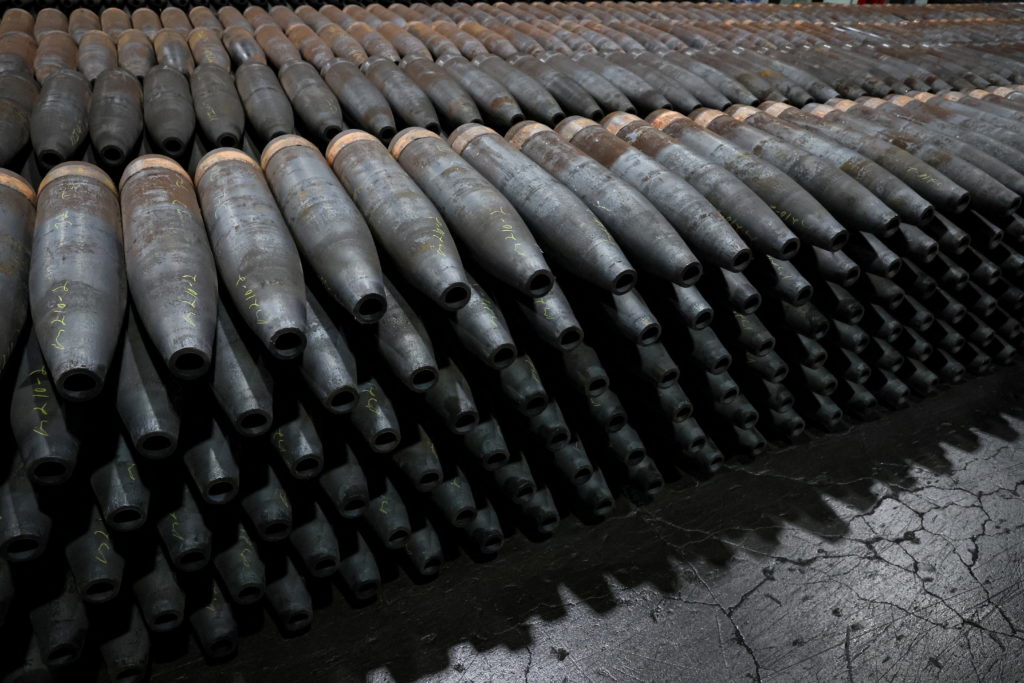
REUTERS/Brendan McDermid

‘NATO won’t intervene because it doesn’t want a new world war. However, the Ukrainians have the right to take weapons from wherever they can get them in a fight to the death with the invaders.  Let them have anti-aircraft weapons instead of petrol bombs. ‘

‘There’s a difference between calling for that and saying that Ukraine shouldn’t ask for/accept such help. Which it won’t get. Meantime the government is handing out guns and calling on people to make Molotov cocktails to throw on invading Russian troops.’ 

The two comments above were made by two supporters of Ukraine over three years ago in a Facebook discussion just after the Russian invasion in 2022.  Besides the puerile notion that one of the largest armies in Europe would be fighting with Molotov cocktails, the idea that NATO would not be involved was even more ridiculous.  The predictions obviously haven’t aged well, but the point is that they were nonsensical even at the time.

The prediction that there would be no NATO involvement could only be made through ignorance (or rather ignoring) that it was already involved.  This facilitates the equally spurious notion that the war was ‘unprovoked’, the staple claim of the western media and political class.  From the US sponsorship of regime change in 2014 (following years of interference) to the training of it army, military exercises and provision of weapons; to the new Ukrainian regime putting the goal of NATO membership into the constitution. All these were steps towards war when Russia had said repeatedly that NATO membership was unacceptable.

In a third Facebook contribution, another supporter of Ukraine said that the right to self-determination meant the right to join NATO if that is what a country wanted.  Given the difficulty of arguing that supporting membership of an imperialist alliance was a ‘right’, and therefore something socialists should support, the majority of left supporters of Ukraine decided that it would ignore the logic of its support for Ukrainian self-determination and pretend membership of NATO was not the issue.

Hence all the previous history of NATO enlargement and repeated Russian objections could be ignored, along with all the other western imperialist involvement just mentioned.  Opposition to imperialism now meant opposition to Russian imperialism, no more and no less.

The problem was that it was very hard to claim that NATO membership was irrelevant.  Even in western media there were enough newspaper columns pointing out the Russian attitude to NATO expansion to make it clear that pushing Ukraine to join NATO, either from the inside or from outside, was ‘crossing the brightest of Russian red lines’, as the US ambassador, and later CIA Director, put it around the time of the 2008 NATO summit.

In this summit NATO declared it wanted Ukraine as a member, which was subsequently enshrined into Ukraine’s constitution in 2019.  Supporters of Ukraine are keen to quote Putin in claims that he does not recognise Ukraine as a separate country but ignore statements that make its membership of NATO central to Russian policy.  Equally, statements by leading western figures have demonstrated the importance of NATO membership; NATO Secretary General Jens Stoltenberg stated in 2023 that Putin “went to war to prevent NATO, more NATO, close to his borders….” 

The head of the Ukrainian delegation, Davyd Arakhamia, at the peace talks just after the Russian invasion, stated that Ukrainian neutrality was the main Russian condition for a peace deal and that the war could have ended in spring of 2022 if Ukraine had agreed to neutrality:“Russia’s goal was to put pressure on us so that we would accept neutrality.  This was the main thing for them: they were ready to end the war if we accepted neutrality, like Finland once did. And we would give an obligation that we would not join NATO. This is the main thing…”

But the main thing wasn’t done and the war continued as the US and British promised to provide more support to Ukraine, whereupon once again the left supporters of Ukraine denied the role of these imperialist states in perpetuating the war, and continued supporting it themselves.  Zelenskyy has claimed that he was told by Biden and other NATO leaders before the invasion that Ukraine would not be allowed to join NATO but that publicly, “the doors will remain open.”

If this is untrue, then it can be assumed that the public position of future Ukrainian membership was a real possibility.  If it is true, and Biden had no intention of permitting NATO membership, perhaps because of the risk of more or less immediate war with Russia, it means that the invasion was provoked without the perceived threat to Russia being an immediate possibility.

It also means that Biden and others were content for the war to happen, not to ensure NATO membership for Ukraine, but with the objective of pursuing the project of crippling Russia through war and sanctions – turning the ‘Ruble into rubble’ .  It also means Zelenskyy was happy to engage in the war because this is what Ukrainian policy already involved – recovery of Crimea and Russian occupied areas of Donbas. There was no attempt to prevent it by signalling agreement to neutrality. Now, however, it is Ukraine and its economy that is being turned into rubble.

In any case, the war was the result of inter-imperialist rivalry that the supporters of Ukraine have determined is of no consequence to its cause or nature, so that the only issue that matters is self-determination for a country and state that is already independent but whose political leadership colluded with western imperialism to subject its people to war.  In effect, the war ensured that Ukraine became an even greater vassal of Western imperialism, although this has not prevented these self-declared ‘anti-imperialists’ supporting its imperialist alliance.

The striking thing is not only the stupidity of pretending that NATO ‘won’t intervene’ and that Ukraine will seek weapons ‘which it won’t get’ but that the vassalage of Ukraine to Western imperialism was not denied right at the start! Ukraine, it was claimed, ‘wishes its vassalization in the belief that it is the only guarantee of its freedom. We must, of course, also oppose its vassalization, but for the time being, the most urgent need must be addressed . . .’

Vassalage is the position of a person granted the use of land, in return for rendering homage, allegiance, and usually military service or its equivalent to a lord or other superior.  A perfect description of Ukraine – a subordinate instrument of Western imperialism that the left supports while claiming it is fighting an anti-imperialist war!

The duty of socialists is not to support the subordination of a working class to the results of vassalage by imperialism, through its bourgeois class and state, on the spurious grounds that ‘it is the only guarantee of its freedom’. Vassalage is not freedom.  The ‘urgent need’ of the Ukrainian working class before the invasion was to prevent its bourgeois leadership from taking it into war on behalf of western imperialism. The urgent need thereafter has been to bring it to an end; against the efforts of Western imperialism and the Ukrainian state to keep it going.

Forward to part 2

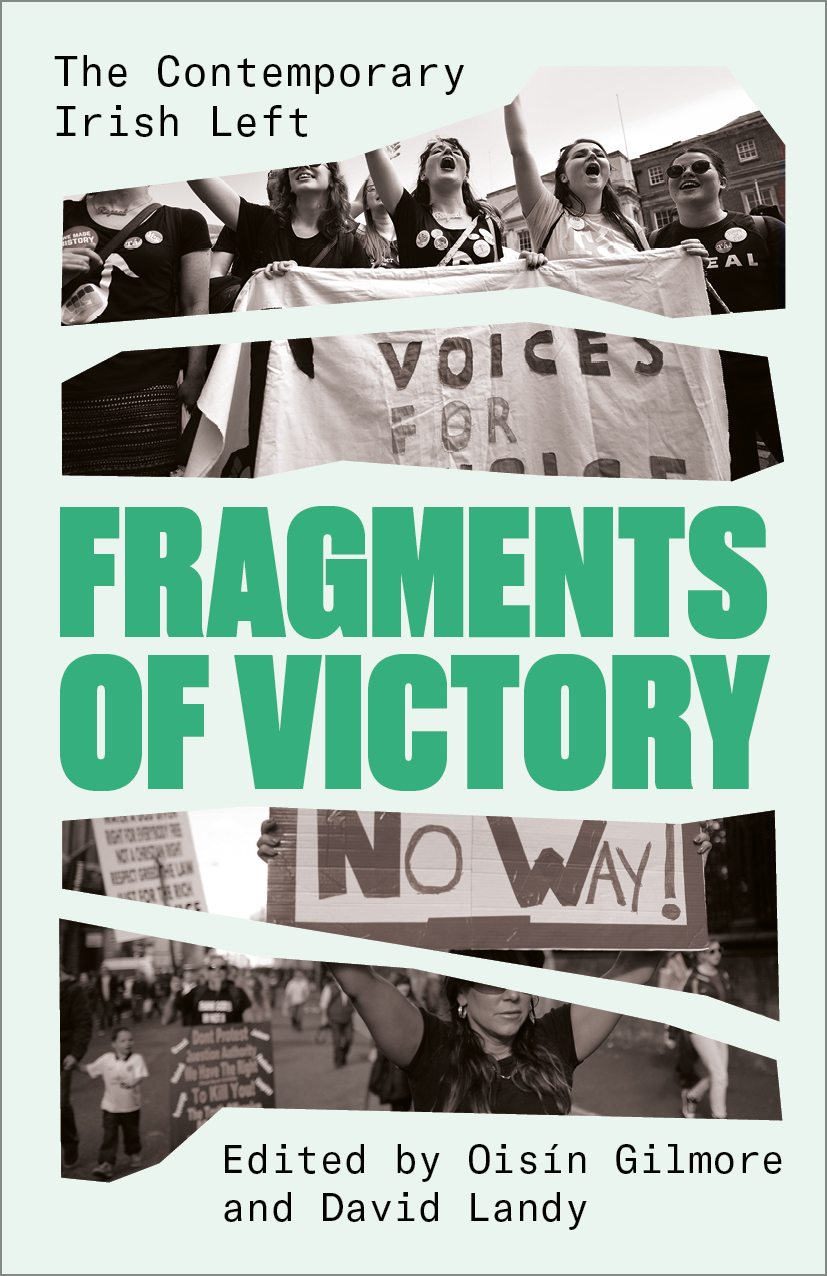
‘Fragments of Victory’: The Contemporary Irish Left’, book review (3 of 6)

The summary conclusions in the previous post raise a host of questions about the struggle against austerity following the crash of the Celtic Tiger: the lack of permanent organisation; the lack of working class consciousness and awareness of its specific political interests; lack of credible political programme and the inability to ‘articulate a viable alternative’; reliance on electoralism and thus on Sinn Fein, and lack of clarity on ‘the long-term goal of socialism’.

This is quite a list, and it is to the book’s credit that they are recognised.  What is also recognised, more by implication than by explicit critique, is that this is the result of the conscious approach taken by ‘the left’, which the book sees as one of failure qualified by some success.  It also implies that the answer to overall failure is not simply more and better activity.  For the left however, it is the roller-coaster of activity that is consciously seen as necessary to keep the show on the road.

If we briefly look at these issues, the first question is why ‘mass movements were less a story of mass organisation than mass mobilisation’ and were ‘large but ephemeral’.  These mobilisations were campaigns so were inevitably time limited and impermanent.  The issue is why they were temporary when their object of attack – austerity – had not been defeated and why the permanent organisations that did exist failed to keep the campaign going?

The second question is posed mainly to the trade unions and particularly ICTU, which called initial demonstrations and then left the stage.  Two further questions then arise – why did they do so and why were they able to get away with it?

The first answer is that since 1987 the trade unions have seen the state as a ‘social partner’ and very definitely not an antagonist – never mind enemy, and conducted themselves as partners in not opposing austerity itself but only seeking to modify its implementation. This to be done in the normal way of partners, through lobbying and negotiation.

The decline in strike activity and union density during the period of partnership was therefore not simply a result of economic conditions because they improved dramatically in the 1990s, at first rather slowly in terms of employment and then rapidly.  In 1986, just before the first deal, there were 309,198 days ‘lost’ in strikes and in 2007, just before the crash, a total of 6,038 days. By 2022 this had fallen even further to 5,256 while union density declined from 46 per cent in 1994 to 30 per cent in 2007.

Economic power and state revenue shifted to foreign multinationals that unions largely failed to organize, resulting in many skilled, educated, and younger workers being excluded.  One of the early results of partnership was the 1990 Industrial Relations Act that made illegal a strike unconnected to a ‘legitimate’ trade dispute, which successfully thwarted solidarity action – one of the very purposes of a trade union movement.  ‘Partnership’ also did not prevent the bosses refusing to recognise or negotiate with trade unions

Since the crisis was one of solvency of the state, arising from it guaranteeing the deposits and liabilities of the banks that it could not itself finance, the response was cuts in state services and the pay of public sector staff. The initial ICTU response was therefore a public sector strike that recognised its weakness in the private sector.  Bourgeois politicians and its media made hay with accusations about the privileges of these workers that sought to divide private sector workers from those working for the state, which the unions had themselves done little to prevent through their failure to organise across the whole working class.

Private sector workers were met by a withdrawal of their bosses from the social partnership arrangements, one result of which was their repudiation of sectoral pay arrangements.  This demonstration of the hollowness of partnership with the state and bosses, both of whom had withdrawn, did not prevent the unions going into another deal in 2010, the Croke Park Agreement, which gave way to Croke Park 2 as more cuts were sought.  When the proposals for it were initially rejected by a large majority of members the union leaders were able to manoeuvre ultimate acceptance by warning of the consequences of rejection while providing no strategy for fighting for its members decision.

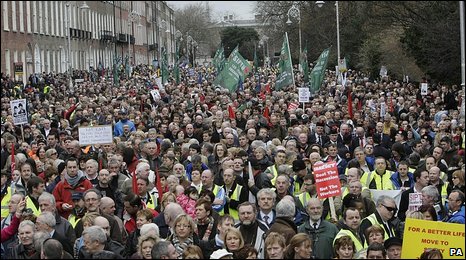
‘Mass mobilisation’ was not therefore meant to involve ‘mass organisation’ but dependence on the trade union’s own bureaucratic organisation.  Its purpose was to assist union leaders’ lobbying with some pressure from below that was to be applied to the government while releasing it from the working class, amounting to simply blowing off steam. By February 2013 ICTU speakers at one of their demonstrations gave over the stage to musicians before many marchers had arrived at the finish in order to avoid being heckled.  They avoided it afterwards by not having any demonstrations at all.

Mobilisation wasn’t mean to be permanent, and it wasn’t meant to be an alternative to social partnership and the union bureaucrcay.  Although it was formally dissolved by the state it never ended given the objectives and strategy of the trade union leaders who simply pursued it unofficially, originally pushing the idea that the Labour Party in government might mitigate the worst effects of austerity.

The trade union movement, through its bureaucracy, is wedded to the state.  Most of its members are in state employment and the state facilitates its organisation through facilitating membership subscriptions, while the share of members in the private sector has declined.  The alternative offered by the trade union leaders was therefore the Labour party in government; rises in taxation instead of expenditure cuts, and ‘sharing the burden’ rather than its repudiation.  While the unions’ organisational weakness was material, they were partly responsible for this themselves, and while this weakness was also the basis of political passivity and failure, this too was partly their leaders’ own responsibility.

If we look to answer the questions about the lack of permanent working class self-organisation and failure to maintain mobilisation against austerity, we need to look at the prior commitment to social partnership and dependence on the state, which itself had become dependent on the Troika of the European Commission, European Central Bank (ECB) and the International Monetary Fund (IMF).  The unions were, and are, not the expression of the self-organisation of the working class and for this their leadership is partly responsible, with the undeveloped and inadequate political consciousness of the working class itself also a major factor.  While in times of social peace the union leaders can represent the passivity of the membership, in times of heightened political awareness and activity they consciously act to limit this independent action and the possibility and potential for advancing political consciousness.

Had there been any permanent opposition to social partnership within the trade union movement prior to the crisis it might have presented a starting point to build an alternative to the union bureaucrats.  Any opposition however was generally of a temporary campaigning character while the bona fides of the bureaucrats became generally accepted.  No independent political alternative was built within the trade unions, reflecting the political weakness of the left outside it.

In these circumstance the bureaucracy was able to mobilise spontaneous anger, demoralise it and then dump it, getting away with it primarily because the politics of the union movement went unchallenged.  This in turn partly reflected the political weakness of the left.

Back to part 2

Forward to part 4

‘Fragments of Victory’: The Contemporary Irish Left’, book review (2 of 6)

In the book’s introduction we are informed that after the 2016 general election one in 20 members of the parliament was a Trotskyist”, which would, for example, translate to over 30 MPs at Westminster.  In the conclusion it notes that this election was ‘perhaps the greatest electoral success of Trotskyism in any western country ever’, ‘the development of one of the strongest electoral lefts in western Europe’ (p177)

Except this avoids the question of what manifesto – what political programme – did these ‘Trotskyists’ get elected on that was in some way supported?  Was it in any way a revolutionary socialist one and if not, in what sense was it a vote for Trotskyism or for Trotskyists? What wider movement, if any, did the vote reflect?  How isolated was it, or was it the vanguard of a much wider radicalisation?

Fragments initially appears to be organised around the concept that there is some identifiably coherent ‘left’, except reading it reveals that this is not the case.  There is however some commonality that we alluded to at the end of the previous post, but it is this commonality that is itself incoherent.

We are informed that the Irish were one of the ‘strongest electoral lefts in western Europe’ and that this ‘left’ not only includes the ‘Trotskyists’ but also Sinn Fein; so we know that however strong this left became in electoral terms its political unity is at the very least questionable. You can assemble the various parts but it becomes less an alternative the more it is put together.

On page1 we learn that the left ‘won some victories’ (a near unique achievement in western Europe during this period) that ‘other countries could learn from.’  Yet in this introduction we are also informed that the austerity following the economic crisis ‘created a collapse of living standards, experienced by many’ with emigration that exceeded ’even the highest rates . . . of the past’.(p 13) 

On page 3 we learn that apart from Sinn Fein other left wing parties and campaigns ‘have struggled in the face of the new political challenges’ while despite ‘widespread support for leftwing politics, the left has failed to build lasting political and social institutions . . . After a decade that saw the left win real victories, mobilise hundreds of thousands and transform the electoral landscape, in many ways the left finds itself in a strangely weak position.’  These judgements are all in one paragraph!

In the conclusion, after noting some successes, including electoral gains, it states that ‘despite these successes, the left is in many ways as weak as it was pre-2008.  No lasting form of working-class self-organisation has emerged.  Union density is lower now than it was in 2007.  No mass parties have emerged.’ (p177-8)

On the next page we learn that ‘These apparent advances by the left in Ireland contrast sharply with the decline of its counterparts in most of the West . . . the left in many countries is in a worse position than it was before the crisis.’ (p 178). ‘The advance of the left in Ireland is even more striking when the political situation in pre-crisis Ireland is compared with that of Western European states.’ (p179).

It notes the failure of Syriza in Greece and Irish hopes for it, although Ireland did not even produce a Syriza and, as the book acknowledges, its defeat led Sinn Fein to shift its rhetoric to the right, opening the door to junior partnership in government with one of the two main bourgeois parties.  Gerry Adams is quoted –“I have to say, I never really subscribed to that notion of a left-wing government, certainly not in the short term.  I mean, who are the left.” (p 171) A very good question, to which Adams gives one element of an answer – it doesn’t include Sinn Fein.

This favourable comparison with the rest of Europe sits uncomfortably with the observation that ‘Missing in Ireland, especially in the early years, were the massive explosions of protest seen in other countries during 2009–13’. (p 184). 

Nevertheless, we are told that ‘The material successes of the Irish left and its social movements have been unique . . .’ (p185) and ‘the achievements of the social movements since 2008 are striking.  There are some real, substantial victories. Hundreds of thousands were mobilised. And the political culture of Ireland was definitely changed.  The neoliberal consensus . . . is over.’  ‘Today the left in Ireland is no longer marginal. While in almost all of Europe the last few decades have witnessed the decline of the left. In Ireland it has grown in strength’ demonstrating ‘what can be achieved.’  ‘There is today in Ireland significant support for the left . . .’ (p191)

These advances were apparently based on an already well-positioned movement because ‘in some ways, the left in Ireland was well prepared for the crisis.’ (p185). By this is meant that it was not focused on identity politics and ‘cultural questions’ although in fact this is not the case.  It is just that the majority of the Irish left have swallowed gender identity politics for example with hardly a debate, mirroring the introduction of gender self-id recognition carried out by the state purposely also without debate.

The conclusion presents ‘two key findings’, including that ‘the 2008-18 period saw the emergence of major mass movements that have both fundamentally changed Ireland’s political life and can provide lessons for the left internationally.’ (p188)

‘Trickier to identify, but unquestionably real, Ireland is a more leftwing country than it was in 2007 . . . Between the summer of 2021 and the summer of 2024, the left consistently outpolled the right, whereas before 2008, the left only had a third of the support for rightwing parties.’  Also adduced as evidence is that there is now recognition of the need for state intervention to solve the housing crisis. (p184). The problem with the latter however is that this state intervention has largely been to incentivise private sector solutions, which the left has denounced.

The success is qualified – ‘looking forward, the achievements of the last 15 years seem rather more fragmented’ and even the ‘electoral gains arising from a period of struggle . . . is now very much in the rear-view mirror.’  In the same paragraph it notes that the campaign victories over abortion rights and water tax ‘failed to result in lasting organisations.’ (p191). The other ‘side of the coin’ as the book puts it. (p3)

Capitalist crisis did not see ‘the re-emergence of working-class self-organisation and provide a space for the activity of the radical left’ while ‘mass movements were less a story of mass organisation than mass mobilisation’ (p180-1,182)

The movements since 2008 were ‘large but ephemeral’, ‘failed to lay deep social roots’, ‘failed to identify an avenue through which society might be changed, and given this, they have failed to develop a mass political consciousness around the capitalist nature of our society or around what needs to be done to change it.’  While they apparently ‘frequently terrified the ruling elite’ ‘they have never presented a serious challenge to the existing order.’ (p183)

Despite the positive evaluation and even with the qualifications, which leave a rather confusing picture, the real damaging conclusion is contained in these comments:

‘In many ways, despite the victories of the left since 2008, the future looks bleak.’ (p190). ‘It is hard to believe Sinn Fein will deliver the change that many desire . . [and] It is unlikely the Trotskyist People before Profit will manage to articulate a viable alternative . . .’ (p191) So despite short-term victories’, ‘the steps between the current situation and the long-term goal of socialism are less clear than ever before.’ (p192)

The book’s last words are that ‘it is clear that fragments of victory are not enough.’ (p 192) with the fatal verdict that despite the ‘striking’ advance of the left and ‘the apparent success of the Irish left’, the radical left ‘were engaged in a form of politics incapable of realising its own aims.’  (p179 &181)

Back to part 1

Forward to part 3

‘Fragments of Victory’: The Contemporary Irish Left’, book review (1 of 6)

Reading ‘Fragments’ I was reminded of the statement by Marx that ‘We develop new principles for the world out of the world’s own principles. We do not say to the world: cease your struggles, they are foolish; we will give you the true slogan of struggle. We merely show the world what it is really fighting for, and consciousness is something that it has to acquire, even if it does not want to.’

Fragments sets out to record the struggles of the Irish left (in the Irish state) over the past few decades so that the reader can form a view on its successes and failures.  In doing so we can apply Marx’s prescription and determine to what extent it shows the left ‘what it is really fighting for’ so that it can be conscious of the lessons that should be learned.

There are some obstacles in the way, including the variety of authors with different viewpoints although an introduction and conclusion is meant to summarise the results.  The major problem is the definition of what it means to be ‘left’.  In the introduction Sinn Fein and the Green Party are listed as left even though the major theme of the book is the response to the implementation of austerity following the collapse of the Celtic Tiger and the consequent bankruptcy of the State.

During this period Sinn Fein presided over austerity while in a coalition government with the DUP in the North, while the Green Party entered into a coalition with Fianna Fáil in 2007 that bailed out the banks and inaugurated widespread cuts in social welfare and wages.

As part of the relaunch of Stormont in 2015 the ‘Fresh Start’ agreement committed the parties, including Sinn Fein, to reducing NI civil service staff numbers: ‘Between April 2014 and March 2016, the NICS is set to reduce headcount by approximately 5,210 and between April 2015 and March 2016 a further 2,200 will exit from the wider public sector.’ The Green Party supported the bank bailout that the state could not afford, which resulted in the intervention of the Troika of the European Commission, European Central Bank and IMF, along with the huge austerity necessary to satisfy their demands.

Even taking account of the elastic possibilities permitted by employing a relative term such as ‘left’, it is difficult to sustain any claim that these parties are in any substantial or verifiable way left-wing.  Sinn Fein was described by a comrade of mine a long time ago as containing members with left-wing opinions and right-wing politics.  The party has, in the meantime, fully confirmed this judgement while in government.  The Green Party began life as The Ecology Party promising ‘a radical alternative to both Capitalism and Socialism’ but in office twice it has displayed no alternative to capitalism and therefore no alternative to socialism.

Looking at political struggle through the lens of ‘left’ versus ‘right’ has therefore the potential to obfuscate as much as it clarifies.  A more illuminating approach is to set out the class nature of the politics of a political party and to explain why different parties with generally similar class natures have the politics that they do, even if they have different colouration.

Thus, as a nationalist party, Sinn Fein is a petty bourgeois party that considers the Irish people as one, with any class distinctions completely secondary and subordinate to the interest of the nation and its state, which can represent the true interests of all the people simply because of their nationality.  The Green Party claimed at its birth to have a radical alternative but also rejected a class approach through its largely petty bourgeois base and ideology.  It confirmed its class character by its members enthusiastically joining Fianna Fáil in government (voting 86% in favour) and by its commitment to the banks and austerity.

It might appear difficult to assign a class identity to some parties, and any classification has to be justified, but this is precisely the point of identifying the class nature of the forces involved.  As petty bourgeois parties, both Sinn Fein and the Greens have imposed austerity on workers while espousing radical rhetoric.  Calling them left is an attempt to obscure this and works to introduce doubt that they will not always fall on the side of the capitalist class in a struggle.

Fragments demonstrates this repeatedly, even when making secondary observations, for example that individual members of Sinn Fein were active in the Campaign Against the Household and Water Taxes but that the party was not: ’This form of partial (non-)commitment proved to be the defining feature of Sinn Fein’s approach to most political struggles of the time.’ (p37)

Approaching politics this way allows us to make judgements of other ‘left’ parties such as the Labour Party and Social Democrats etc. and permits an understanding of their behaviour during this period.  While the Labour Party paraded its ‘Labour’s Way’ as resistance to ‘Frankfurt’s Way’ while in opposition, it had no alternative to austerity when in government.  The doubling of its vote in the 2011 general election was a prelude to its consequent decimation in the next one.  ‘Labour’s Way’ didn’t become Frankfurt’s Way’, not having an alternative meant it always was.

Was the 2011 vote for Labour therefore a victory for the ‘left’ and was its subsequent decimation a defeat?  Did those who voted Labour in 2011 make an advance in consciousness or do so by deserting it in 2016? Or were they just registering disappointment and resignation?

Fragments offers the view that despite Labour delivering austerity when in office ‘the new government retained a huge amount of goodwill . . . the crisis was clearly not their fault and . . . the harsh austerity measures they took were seen as both forced by the Troika and, while painful, necessary’, while ‘the ‘honeymoon lasted for much of 2011 . . .’  (p31) So, were these views completely discarded when the Labour Party was dumped out of office? Was there any real advance in consciousness of an alternative when it happened?  Is roping the Labour Party into ‘the Left’ clarifying either history or the future?

Today, all these parties are allied in supporting Catherine Connolly for the post of President with the additional enthusiastic support of People before Profit and Solidarity.  The latter’s politics are supposed to be based on the view that existing power in capitalist society does not come from parliament but from the permanent state apparatus and the economic and social power of the capitalist system, yet they promote the idea that election to a post that is admitted not only to be without power, but forbidden to exercise any, would be a major advance.

Paul Murphy, People before Profit TD, states on Facebook that ‘this is a rare opportunity for the left to come together, and elect a voice for workers, for women and for neutrality.  Change starts here.’ This is a left that includes all the parties above that have been tried and tested.

In doing so all sorts of illusions in the role of bourgeois politics and institutions; about the ability of one person to represent the nation, and all the people within it; because of a one-off vote, and of the way ‘change’ can be made, are strengthened against an alternative view that real change comes from the organisation and struggles of the working class itself.

Are such views ‘Trotskyist’, as Paul Murphy’s organisation is called in the book? Or is this term used because that is just how it is usually described, or should such a designation not require some comparison of its political practice to a reasonable account of what Trotskyism is?  The umbrella term of ‘left’ addresses these questions by rendering them unimportant, and this is a problem.

To anticipate one message of this review; Fragments provides enough testimony to show that a different approach is necessary and that an alternative is required to the illusion that there is a ‘left’ that should be united to advance the cause of the working class.

It demonstrates, in its own way, that only a class analysis can explain events, including the actions of the state, why it succeeded in imposing austerity and why the resistance to it was unable to rise to the challenge.  Explaining all this in terms of whether certain actors, institutions or policies were ‘left’ or ‘right’ is hopeless not only because of the vagueness of the terms but because all of these acted out of material interests, as they perceived them, and these in turn were based on objective factors that were fundamentally determined by class relations.

Forward to part 2