Bourgeois democracy – reply to a critical reader

In the previous post a reader of the blog expressed disagreement with my approach in a comment.

He stated that “I find it hard to fathom how you can heavily criticise bourgeois democracy like you did in a recent post and at the same time advocate for something you call democratic rights.”

The comment doesn’t reference the particular post and makes only general references that are difficult to identify, including reference to the views of Marx as quoted by Paul Cockshott. I agree with the comment by Boffy in response that:

“I am always rather suspicious of people who cite what Marx and/or Engels are supposed to have said about something, without actually giving the quote, and source of it, because I have frequently found that either the claim is false, altogether, or else, the context, and text of what they said completely changes the meaning of what is being claimed. Given what they say in the Communist Manifesto about workers having no country, and the fact that they were themselves refugees from Germany, makes me doubt what is being claimed for them, here.”

I can only add that it is not altogether clear what the comment Boffy responded to is claiming.

In relation to bourgeois democracy – this post being one example – it is one political form of the dictatorship of capital – the exploitation of the working class, which is separated from the means of production and subject to wage slavery, as its labour power becomes a commodity.  I don’t see how you can be a Marxist and not take this view.

Does this mean we cannot demand and fight for democratic rights within capitalism?  Only the most formal of formal logics could lead to such a view and someone who regularly quotes philosophical thinkers should know this.

The fight for democratic rights was recognised by Marx as necessary in order for the working class to develop itself politically so that it could have the freedom to identify its separate interests, organise around them and struggle for the realisation of the dictatorship of the proletariat.  The word ‘dictatorship’ has rather changed its meaning since it was used by Marx and does not refer to lack of freedom but to the economic and social domination of the working class – uniting the working class with the means of production through cooperative and common ownership, the ending over time of the wage relationship and thus ending of exploitation.

The struggle for this freedom includes the struggle for democratic rights which are not “abstract principles . . .like as a magician pulling rabbits out of a hat” but are concrete measures to be imposed on, or accepted by, the state through working class struggle.  One of the points I have made continually is not to base the struggle for these rights on appeals to the state but to be won by the workers themselves, in opposition to the state if necessary.

He asks “Are your democratic rights legal claims that somehow endure without the presence of a State”?

Marxists do not invent a world subsisting without a state; we recognise the real world that exists in which there is one.  It is why Marxism has no need to invent such things as natural law.  Rights are not worth much if they cannot be validated and this very often is done by the state: so often the democratic rights demanded are demanded from the state, to be accepted by or imposed on it, but always with the view that it is the power and activity of the working class that will ultimately protect and defend them, to whatever extent this can be done within capitalism.

Marxists believe that society can only be understood as it really is – and thereby changed –  by recognising that it is structured by classes with their irreconcilable interests. It is the writer of the comment who is guilty of proposing ‘abstract’ ‘principles’ and ‘morals’, which is why he states that he doesn’t understand what I have written.  It is why he says such things as “I can honestly say I don’t know what these things are” and that “I might not agree with humanitarian morality but at least I could say I understood what was going on.”

When he says that he “would be happier if you and others who speak up for and march out for the asylum seekers did so on the basis of some common humanitarian morality” he simply says that he would be happier if I lapsed into the “abstract principles” he denounces as akin to “pulling rabbits out of a hat.”

He provides me with the option of justifying my position by saying that “I can see how you might get around the problem by imputing an interest and not a morality to the working class.”  And this is roughly what I have done, although I would not put it in those terms.  This, however, is an option that he obviously rejects, yet also rejecting a general “humanitarian morality” as an alternative. Where that leaves him is not my problem.

He then states: “let’s us assume that the bulk of the working class misrecognises the interest you impute to them or consciously rejects that interest. Well you are back with your principles again, an undisclosed humanitarian morality. It turns out therefore that lurking behind the objective interest of the working class is an undisclosed humanitarian morality.”

This is a big, big assumption, and the history of the working class demonstrates that significant numbers have identified that they have a separate interest.  This is demonstrated objectively in the alienation of the working class; its distrust of its rulers and opposition to many of its actions – including those rulers support for the current genocide in Palestine. It is demonstrated in its separate organisations, and in its long history across the world of class struggles big and small – from strikes to revolutions.

Naturally the bourgeois media, culture industry and education system ignores or distorts all this, which makes its undeniable existence all the more necessary to recognise and appreciate.  But let us presume that the assumption is correct for the sake of argument.

If it were true that “the working class misrecognises the interest you impute to them or consciously rejects that interest”; i.e. that it never develops class consciousness; then yes, there would be no material interests that could be realised, and any such interest would be abstract, therefore general and “undisclosed.” The point of the blog is to disclose this interest and advance understanding of what it is so that it can be realised in the real world, through informing working class struggles that are going on quite independent of it.

This is where morality ceases to be abstract, is attached to material interests, where ‘what is’ meets ‘what should be’.  To understand this, it is necessary in some way to be part of the struggle to understand and change the world.  The commentator is not part of this, so appears incapable of understanding Marxism. It is this purely contemplative perspective that, it seems, means that he never gets the point. 

Marxism and Gender Identity Ideology (7) – what the movement’s success explains about it

It might be asked how gender identity ideology, and the movement it represents, have been successful, despite its contradictions and impossible claims – claims by men to women’s rights while erasing the very meaning of woman; and claims to the ability to change one’s sex while denying the biological and binary nature of it and its basis in human reproduction.

There are various strands to the answer that have been touched upon in previous posts. Undue discrimination and prejudice evoke sympathy and support, and it is particularly popular among the young, who feel much less need to ask themselves how and why this issue has arisen and dominates certain milieus. Almost by definition they have less sensitivity to historical experience and awareness.  Their need for some historical validation – on the grounds that gender identity is innate – is shown by the attempts to read the modern idea of gender identity back into history, even if this results in yet more unsupported claims.

In the past week four ‘non-binary’ girls tried to disrupt a gay, lesbian and bi-sexual conference in London by releasing insects into the venue.  Their youth obviously permitted their oblivion to the irony of attacking the conference while claiming to be part of a wider LGBTQ+ movement – in doing so exposing their cannibalism of the original LGB and the incompatibility of their ideology with these original struggles.

It was also yet another demonstration that the T in the assortment of letters is interested solely in itself and is prepared to shaft its presumptive allies in pursuit of its own claims.  The young have had no experience of the struggle for gay and lesbian rights in many countries, or the experience of PRIDE marches not being huge parades that include numerous corporate sponsors; but rather, marginal demonstrations viewed by many with prejudicial revulsion and contempt.  But then, if men can aggressively and menacingly confront feminists while demanding that they be considered women, there would seem to be no set of circumstances for some in which gender ideology can be seen for what it is.

Defenders of women’s rights, and of reality itself, have thus found it necessary to explain how this modern and reactionary phenomenon has risen to such prominence.

As befits her occupation as a philosopher, Kathleen Stock in her book Material Girls, sets out ‘a brief history of Gender Identity’ in terms of the development of its ideas: from Simone de Beauvoir’s “one is not born, but rather becomes a woman”; through biological sex being “a continuum” and Judith Butler’s ‘gender as performance’; to the invention of the concept of TERF and the explosion of gender identities.

Helen Joyce, as a journalist, goes for ‘a brief history of transexuality’ in her book Trans, looking at the story of the medical and psychological treatment of what became transgender status.  Jane Clare Jones, in her essay on ‘the history of sex’ in the book Sex and Gender, looks at the ‘intellectual development and cogency of the sex-denialist ideas’ and identifies ‘the emergence of the contemporary trans movement to the early 1990s on both sides of the Atlantic through a blend of legal activism and academic theorisation.’

The periodisation of the movement to the 1990s helps understanding of the grounds upon which gender ideology has been able to drive its anti-woman and irrational claims into society.  Most obviously through the state and its various bureaucracies – especially health – and through NGOs, which are more and more reflections of the interests of the state despite their name. These often act as its conscience that the state can either ignore – if it is criticised – or hold up as justification for interventions if it is another rival state that is criticised

Legal changes supported by the gender identity movement have often been made surreptitiously, with little debate and without widespread public knowledge, as in Ireland, Denmark, Australia and Iceland.  No women’s organisations were included in the parliamentary enquiry by the UK Women and Equalities Committee in 2015 which led to consultation on changes to the UK Gender Recognition Act (2004), or for legislating for Gender self-identification in New Zealand.

The state has bought into and imposed gender identity ideology, from the local hospital and school, all the way up to the European Court of Human Rights and United Nations.  Sanctioning by such bodies has been seen as proof that the ideology and its claims are progressive by a left that has identified these bureaucracies as progressive, just as this left has more and more taken on the identity of an NGO rather than of a revolutionary working class organisation.  Law firms, prisons, sports organisations, religious and medical institutions, all normalise the abnormal so that we have ‘normal’ organisations claiming to believe in the preposterous.

It is rarely, if ever, noted by this left that the movement and ideology draws support from prominent capitalists, their corporate executives; bourgeois political parties, governments and state bureaucracies, and the NGOs they finance.  Some of these come together in the Gates, Soros and Ford foundations, which have committed $2.62bn to support self-identification.  (Women’s Rights, Gender Wrongs p187). And we haven’t even mentioned the fashionable philosophical and political ideologies pumped out of universities that give it the thinnest of veneers of intellectual legitimacy.

A small number of billionaires have played an outsized role in promoting the ideology and using their enormous wealth to fund the transgender movement through their own political organisations and corporations.  More important than the financing going directly to trans organisations is the money invested in health and pharmaceutical corporations in order to cater for the fact that many who undergo surgical and medical interventions can become lifetime patients.  The ideology has a growing material basis in the profitability of transgender medicine, especially in the US.

This is another difference between gay men and lesbians, who do not require medical or surgical intervention, and some who buy into gender identity and become lifelong patients, and especially in the US – lifelong paying customers.  For young people it can begin with puberty blockers, opposite-sex hormones, radical removal of healthy tissue, the addition of false secondary sex characteristics, and also the potential for repeated treatment to deal with the deleterious side-effects and consequences of these interventions.  In this respect, yet another difference between LGB and T.

Transgender health treatment has entailed creation of a medical-industrial complex with, for example, thousands of gender clinics around the world to deliver and support it, which also play a role in adding important ideological defences for it.  One writer gives the example of one billionaire sponsor of the ideology, Jennifer Pritzker:

‘Once a family man and a decorated member of the armed forces, Jennifer Pritzker now identifies as transgender. He has made transgenderism a high note in philanthropic funding through his Tawani Foundation. He is one of the largest contributors to transgender causes and, with his family, an enormous influence in the rapid institutionalization of transgenderism.’ 

‘Some of the organizations Jennifer owns and funds are especially noteworthy for examining the rapid induction of transgender ideology into medical, legal and educational institutions. Pritzker owns Squadron Capital, an acquisitions corporation, with a focus on medical technology, medical devices, and orthopedic implants, and the Tawani Foundation, a philanthropic organization with a grants focus on gender and human sexuality.’

‘Pritzker sits on the leadership council of the Program of Human Sexuality at the University of Minnesota, to which he also committed $6.5 million over the past decade. Among many other organizations and institutions Pritzker funds are Lurie Children’s Hospital, a medical center for gender non-conforming children, serving 400 children in Chicago; the Pritzker School of Medicine at the University of Chicago; a chair of transgender studies at the University of Victoria in Canada (the first of its kind); and the Mark S. Bonham Centre for Sexual Diversity Studies’ at the University of Toronto. He also funds the American Civil Liberties Union and his family funds Planned Parenthood, two significant organizations for institutionalizing female-erasing language and support for transgender causes. Planned Parenthood also recently decided to get into the transgender medical market.’

‘There doesn’t seem to be a sphere of influence that is untouched by Pritzker money, from early childhood education and universities to law, medical institutions, LGBT lobby and organizations, politics, and the military.’  (Bilek, Jennifer. Transsexual Transgender Transhuman: Dispatches from The 11th Hour (pp. 38-39, 43). Spinifex Press. Kindle Edition.. The money from these sources buys the spread of this influential ideological network across the world, including Ireland, which is hardly immune to economic, social, political and cultural influences from the US.

That such a tiny number of men, like Pritzker, have been able to impact in such a powerful fashion, and with such irrational effect from the point of view of our understanding and working of society, is a tribute to the irrational nature of capitalism and the power of the inequalities it generates.  The massive socialisation of production by capitalism that brings humanity together in innumerable connections exists beside the increasing monopolisation of production and the power of the tiny number of capitalists who benefit most from it: an illustration of the Marxist understanding of the contradiction between the forces and relations of production.

This impact should not be put down solely to the tiny number of billionaires who are themselves transgender, or are otherwise devoted to the idea of it as a way to advance some transhumanist agenda – in which technology increasingly renders biology (including sex) irrelevant – but to the wider influence and power that they can mobilise.  The author above also notes that:

‘Along with support by pharmaceutical giants such as Janssen Therapeutics, Johnson & Johnson, Viiv, Pfizer, Abbott Laboratories, Bristol-Myers Squibb, and Boehringer Ingelheim Pharmaceuticals, major technology corporations including Google, Microsoft, Amazon, Intel, Dell, and IBM are also funding the transgender project. In February 2017, Apple, Microsoft, Google, IBM, Yelp, PayPal, and 53 other mostly tech corporations signed onto an amicus brief pushing the US Supreme Court to prohibit schools from keeping private facilities for students designated according to sex. (Bilek, Jennifer. Transsexual Transgender Transhuman: Dispatches from The 11th Hour (pp. 43-44). Spinifex Press. Kindle Edition.)

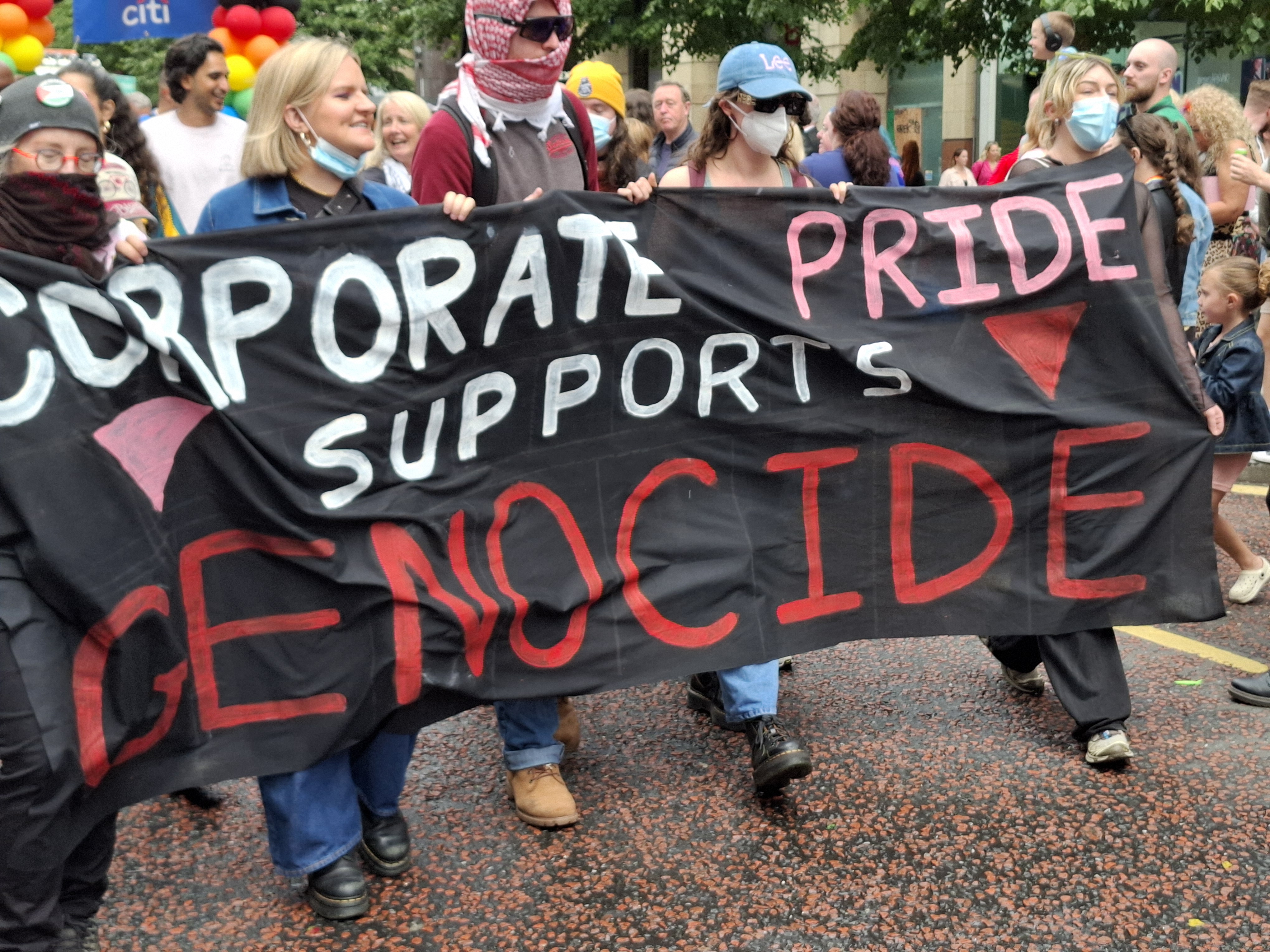
With such powerful support from big business and the state it is not hard to explain the gender identity movement’s success.  The corporate sponsorship of Pride and their HR departments’ Diversity and Inclusion departments are all examples of the appropriation of the claims of oppressed groups by capitalism.  Annual Pride demonstrations are no longer an expression of rebellious campaigns but a rainbow of multinational corporations; state agencies; NGOs; the mainstream mass media and bourgeois politicians, in what is more a fancy dress party – themed by inane slogans such as ‘love your mind’ – than a progressive campaign.  The idea that this is a grass-roots movement is as true as the claim of men to be women.

One banner at this year’s Pride parade in Belfast that hit the nail on the head.

Back to part 6

Forward to part 8

A World going to War and the resistance (3 of 3) – a multipolar alternative?

In the previous post I said that the results of the war in Ukraine would include the deaths of hundreds of thousands; massive physical destruction; a Ukrainian state more corrupt and more subject to imperialist predation; increased division within the working class; and both NATO and the reactionary Russian belligerents remaining in place.

Yet the pro-war Western left defends NATO because without it Ukrainian victory would be inconceivable and it is this victory that they prioritise above all else.  This is an inescapable consequence of their position.

Alternatively, some other leftists, in mirror image, support the victory of Russia but in doing so also bear responsibility for supporting the consequences of the war. They take this position on the grounds of opposition to US imperialist hegemony and for some, that a more multipolar or ‘pluripolar’ world is the pivotal objective.  They do not seem to appreciate that the wars in Ukraine and Middle East are the results of the developing of this multipolar world, which is another name for imperialist rivalry and conflict.  Only the historically ignorant could believe that the development of a multipolar capitalist world would not lead to imperialist conflict and war.

The idea that a more multipolar world will lead to equality of nations makes no sense to anyone who believes that capitalist states are political formations that compete with each other in an analogous way that capital itself competes – by destroying or expropriating rivals.  Socialists believe that workers should not side with their own capitalist state and should fight it, just as we call on workers to oppose their own capitalist exploiter; supporting your own capitalist state is analogous to supporting you own exploiter.

That many have come to this sorry end means that they have also ended any real connection with socialism, regardless of any subjective beliefs.  It’s not that they are stupid; it takes some intelligence to construct the respective arguments but the results above are the same whatever the rationale advanced.

It matters not if you think China is socialist and therefore you should support its ally Russia, because this means you desert the Chinese working class and Russian.  It matters not that you do so to defend colonial or semi-colonial countries, because the point about multipolarity is that many of these countries have advanced and developed so that they exploit the rivalry within the multipolar system to defend their own state and class interests.  The language of anti-imperialism, or anti-colonialism, is often employed by them to denounce other capitalists’ interests and power.

By coincidence, a friend sent me a link to an article that illustrates one consequence of the development of the multipolar world – the ability of some states to balance between US & Western imperialism on the one hand and China & Russia on the other.  The article points to this in terms of economic collaboration between many BRICS countries and the Zionist state of Israel, exploding the idea that there is emerging some state alignment of the good guys against the bad.  Not only are there no good guys but even pretence that there is a unified group doesn’t survive the obvious divisions within them, as the article illustrates.

One rationale for support for Russia was made on Facebook, which read: ‘In truth what will bring about a new revitalised working class movement is the fall of US imperialism. The world policeman will no longer be able to intervene throughout the world to suppress movements fighting for social equality. A big step forward for humanity.  For instance, if there was no US imperialism there would be no genocide of the Palestinians and Israeli would cease to exist as a settler and apartheid state.’

The article referenced above makes clear that, while the US is currently decisive in defending the Zionist state, there are no principled reasons why other imperialist and capitalist powers would not do so also, just as they currently hypocritically collaborate with it.  The principal reason that they do not, or cannot do so now, is because US imperialism is already doing it.   Israel would not be averse to being someone else’s imperialist enforcer if it had to; its history shows previous reliance on the British, German and French imperialism, not to mention the early approval of the Soviet Union.

None of the capitalist states that are rivals of the US have demonstrated that they would not carry out the same policy as the US, were they in the same hegemonic position.  Belief in a multipolar world seems to be under the illusion that such a world would involve the removal or amelioration of inter-imperialist rivalry and conflict, as opposed to the reality of its intensification, demonstrated in the current wars in Europe and Middle East.  In such a situation, support for one or other imperialist alliance is not a temporary tactical or strategic approach but a fundamental capitulation to never-ending support for imperialism, whatever its particular variety might be.

There are two ways in which ‘the fall of US imperialism’ could occur and ‘the world policeman . . .no longer be able to intervene throughout the world’.  The first is if a rival imperialist bloc defeated it, in which case there would be a new imperialist hegemon ‘able to intervene throughout the world’.  What reason, let’s call it success, would lead this hegemon to behave differently?  Would its current left supporters then withdraw their support or stick with it?

The second is if the US hegemon was overthrown by the working class.  Let’s say through a combination of military defeat and internal revolt.  The task of the working class in these circumstances, assuming for the sake of argument that only US imperialism ‘fell’, would be to defend itself against the rival hegemonic imperialist alliance.  This would be because this new hegemon would recognise what its current left supporters do not, that its real enemies are the working class.  In this case it is more likely that the rival imperialist alliance would seek to defend the newly subordinated US imperialism from overthrow by the working class and seek to crush it themselves.

What sense does it make to support this potential alternative imperialist hegemon unless one swallows the nonsense that China is either socialist, or is some sort of peaceful version of capitalism, which in either case would require ditching everything taught by Karl Marx about what capitalism is and what is involved in rule by the working class?  Or even if one doesn’t consider oneself a Marxist, how is such a view given any confirmation by the history of the world over the last 150 years?

Whatever the steps necessary to establish an independent working class force in the world, they will not be taken through supporting either Western imperialism or the China-Russia Axis, not least because each makes their working class a prisoner of its own state and thereby prevents their unity across their division.

Back to part 2

A World going to War and the resistance (2 of 3) – Two proxy wars

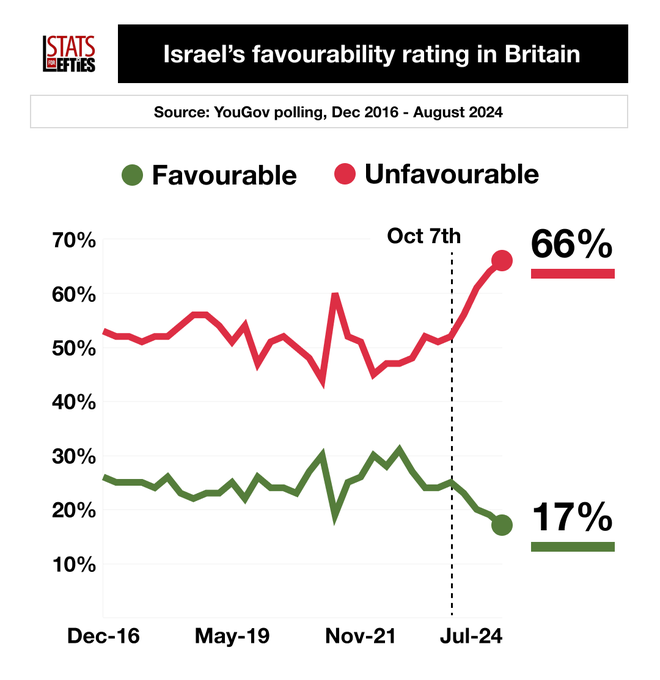
Western imperialist support for the Zionist state and its genocide in Gaza has exposed its hypocrisy to millions across the world but the developing war against Iran exposes what lies behind this support.

The repeated provocations against Iran, involving assassination of leading figures and terrorist attacks in Lebanon have in each case been designed to provoke an Iranian response that would justify further Israeli attacks and increased intervention by the US.  The US has been saying two things during this Israeli escalation: promoting a ceasefire that will release Israeli hostages but that will permit continued Zionist aggression thereafter, and repeated declarations of support for the Zionist state, backed up with more and more weapons plus financing for a deficit that is forecast to be almost three times that expected before the war but will turn out to be even greater. 

The Western media repeats ad nauseum that the US has been struggling to prevent regional war and that it has also struggled to rein in Zionist bellicosity.  What it also occasionally reports is that a new ‘reformist’ President in Iran is seeking to improve relations with Western imperialism in order to reduce sanctions against his country, and that this is why Iran is deliberately seeking to prevent escalation in its responses to provocation.

If the US wanted to rein in Israeli aggression, it would not supply the weapons that allows the Zionist state to carry out genocide, invade Lebanon and attack Iran.  It would not supply the finance that allows the Zionist state to finance “the longest and most expensive war’ in its history, according to its finance minister.  In other words the US is lying and the Western media parrots its lies, which are reported as news and then recycled by its talking heads and columnists as the truth.

Since the real enemy of the Zionist state and threat to its regional hegemony is Iran, the target of escalation in the war – through the invasion of Lebanon with the purpose of smashing Hizbollah – is the organisation’s patron.  Since the Zionist state is the projection of US/Western imperialist power in the region the main enemy of the US is Iran, because behind it is Russia. And behind it – China.

The invasion of Lebanon and attacks on Iran are not something the US opposes but is its proxy war against Iran and Russia.  Israel is thus playing the same role as Ukraine is playing in the war against Russia, which is why the US has supplied weapons and financing for both and why the Western media displays its bias in favour of both. 

However, even the Western media is increasingly reporting that Ukraine is losing the war while trying to determine what can retrieved from the defeat.  Anyone relying on this media would be surprised by this turn of events having been fed a diet of Russian failure and Ukrainian valour and success.  The story now is very different.

In the Financial Times its reporters quotes the head of the Washington office of the European Council on Foreign Relations thar “we are losing the war” while the rabidly pro-imperialist Economist editorialises that ‘If Ukraine and its Western backers are to win, they must first have the courage to admit that they are losing’; rich coming from that publication – given the lateness to recognise it themselves.  Even now it ventures a cunning plan for victory, of sorts, through yet more money to build up a Ukrainian arms industry, which is admission that Western imperialism can no longer supply Ukraine with their own weapons, not least because they are needed to kill Palestinians, Lebanese and Iranians.  

Having advocated and heralded previous escalation by imperialism, The Economist sees no need to explain its own failure but simply supports yet more escalation and a plan even less credible than the one concocted by Zelensky.  

Both publications provide ample evidence that Ukraine is failing and that the views of Ukrainians themselves are changing, making them less willing to fight the proxy war, never mind ‘fight to the last Ukrainian’.

“Most players want de-escalation here’ says a senior Ukrainian official, while one Ukrainian commander states his fear of a “forever war”, and another officer notes that “if the US turns off the spigot, we’re finished.”  In The Economist yet another drone commander states that “the West and the United States in particular have an unequivocal responsibility for the deaths of Ukrainians.”

Both publications note the increasing corruption of the Ukrainian state: the forced mobilisation “is perceived as abusive, worse than if you are a criminal” according to the director of the Kyiv Centre for Economic Strategy.  “It tears people apart.  The real enemy is Russia, but at the same time they fear a corrupt, abusive enrolment office doing the wrong thing.”  The effect on the front reported by The Economist is that ‘many of those drafted into service are ill-suited to fighting: too old, too ill, too drunk.’  It notes that there is no clear path out of the army, making ‘being mobilised seem like a one-way ticket to the morgue’.  It states that 5-10% are absent without leave despite prosecutions and that ‘fewer than 30% of Ukrainians consider draft-dodging shameful.’

The Economist also notes that ‘corruption and nationalism are on the rise’ while the Financial Times reports a governing party MP that ‘the biggest domestic problem for Zelenskyy might come from a nationalist minority opposed to any compromise, some of whom are now armed and trained to fight . . . The far right in Ukraine is growing.  The right wing is a danger to democracy.”

Thus, many Ukrainians understand the important role of Western imperialist intervention, even if the pro-war Western left professes not to.  They understand the rampant corruption of the state, the life and death consequences for themselves, and seek to avoid them, while this left champions the defence of the state and supports the supply of weapons to Ukrainian conscripts who simply do not want to die.  The importance and threat of the far right is recognised while this left, never slow to denounce the fascist threat everywhere else, has minimised, glossed over and treated it as inconsequential.  All these failures flowing from the initial failure to understand the war as an imperialist one in which socialists should support neither side.

Both publications proffer incomplete and confused plans for ending the war, both of which appear to treat the Russian view of how it should end as secondary to their own.

What they both do, is treat the question of NATO membership as central, yet another vital element the pro-imperialist warmongers have treated as some sort of Russian excuse.  “Land for [Nato] membership is the only game in town, everyone knows it”, says one senior western official quoted by the FT.  “Nobody will say it out loud . . . but it’s the only strategy on the table.”  On the other hand the FT quotes a senior Ukrainian official as stating that “I don’t think Russia would agree to our participation in Nato.”

The gung-ho Economist supports Ukrainian NATO membership but simply glosses over the acknowledged risk – ‘If Russia struck Ukraine again, America could face a terrible dilemma: to back Ukraine and risk war with a nuclear foe; or refuse and weaken its alliance around the world.”  It fails to notice that the US has made a choice on NATO membership already (refusing immediate admission) and simply elides the risk by claiming that a choice of not giving membership would entail Ukraine’s defeat, which ‘would be much worse.’  What could be worse than a world war between two states armed to the teeth with nuclear weapons is not explained, but this, apparently, is the future promised by the prominent publication of Western imperialism.

For the moment, The Economist and Financial Times still support the war, with the former seeking to redefine victory as less than before.  However it ends, the war will have resulted in the deaths of hundreds of thousands with many more wounded; much of Ukraine will have been destroyed; the Ukrainian rump state will be weaker, more corrupt and more subject to imperialist predation than before; the political division within the former Ukrainian working class will have been immeasurably strengthened; and both NATO and the reactionary Russian regime will remain.

These are the already known inevitable results of the war that those leftists who think victory for one band of capitalist robbers is better than the other have to justify. Socialists will remain implacably opposed to both and will not entertain the claims of these leftist pretenders that after the fighting is over they will go back to opposing NATO or Putin.

Back to part 1

Forward to part 3

A World going to War and the resistance (1 of 3) – Palestine and Lebanon

Beirut Photograph: AFP/Getty Images

Israel is reported to have killed more than a thousand people in its two weeks of bombing Lebanon and has now started a land invasion, which has caused a displacement of more than a million people, almost a fifth of the population.  It continues to murder hundreds of civilians in Gaza with the death toll approaching 42,000, not including many more buried under the rubble of destroyed buildings. One estimate, and not the highest, is 186,000!

After repeated provocations Iran attacked Israel with an unknown number of missiles that Israel says were mainly shot down, while video evidence claimed to show that many were successful, although it is not obvious that they hit their intended targets.  A main objective appears to have been to impact military airbases.

Iran reportedly gave notice to both the US and Israel that it was going to attack, allowing the Israelis to remove their aircraft from harm’s way, while it also said that its response to the provocations had finished.

Netanyahu shamelessly and offensively publicised his order to kill the leader of Hizbollah (and those unconnected who were near him) when he was at the UN in New York, straight after a speech in which he claimed that “Israel seeks peace. Israel yearns for peace. Israel has made peace and will make peace again.” After the Iranian missile strike he warned that Iran had made a “big mistake” and threatened that it “will pay for it”.

After the continuing genocide in Gaza, the more than thousand killed in Israeli bombing and now ground invasion of Lebanon, Keir Starmer declared that he and the country he claims to speak on behalf of, “stands with Israel” and recognises its right to self-defence.  The Labour Defence Secretary John Healey said that British forces had “played their part in attempts to prevent further escalation”, which must be his way of boasting that British aircraft helped the genocidal Israeli military to stop the Iranian missiles.  The US has already sent more military into the region and also boasted of its efforts against the missilles.

No one reading this will need an exposition of the lies and hypocrisy these statements involve, told by either the Zionist leaders or their Western backers: the selective condemnation of terrorism, selective endorsement of the right to self-defence, selective concern for civilian casualties and selective condemnation and sanctions against outside invasion.  All this is obvious.  Starmer’s support and defence of the genocidal Zionist regime has played a part in the collapse of his already low popularity and that of his government – his net approval number is now minus 30 and his government less popular than the one that has just been shredded:

More demonstrations are taking place and planned across the world, following the mass walk-out of delegates to the UN at the start of Netanyahu’s speech.  The pathetic role of the Irish delegation was clearly exposed by their staying in their seats to listen to the latest catalogue of lies that insults its listeners.

The Irish people have an opportunity to demonstrate their opposition to genocide and the attack on Lebanon through a march on Saturday.  The support declared for it reveals widespread support but also the depth of much of it. What is the purpose of this demonstration and the campaign generally? Is pointing out the hypocrisy of the government and its actions anywhere near enough?

The purpose, it would seem, can only be to put pressure on the government to take action but the repeated demands on the Government by some opposition TD’s have only been met by revelations that it will not even enforce its own laws that might somewhat inconvenience the transport of weapons to Israel – allowing flights over Irish airspace without any question.  The governing parties are riding high in the polls and are busy bribing the population with their own money in the budget – their money and that amassed as a tax haven for US multinationals. If putting pressure on it is the objective, the question must be asked – what pressure?

The political voices of these 160 civil society organisations supporting the demo have been demanding various actions from the Irish government for a year, with no success beyond its hypocritical statements that rival those of the other Western powers.  After a short time, this reveals not the power of public opinion but its weakness and that of the solidarity campaign that seeks to mobilise it.  It reveals the political poverty of demanding that the Irish bourgeoisie do something that is not in its interest.  If you expect they will do so you are naïve at best and if you don’t you are fooling your supporters and yourself.  

Look at the organisations supporting the demonstration! They include the trade unions and will probably include Sinn Fein; the party that partied with genocide Joe on St Patricks day.  Who could possibly feel pressure from such hypocrites?  The governing parties could easily turn round to the trade unions and ask – what have you done to boycott the Zionist state?

In other words, the Palestine solidarity campaign should be demanding that those who claim to support it do something, beyond supporting demonstrations that long ago revealed that bourgeois governments don’t care what their populations think as long as they can get away with it. If these governments will not take action, it needs to be taken for them, or rather – against them.

That means demanding that Sinn Fein boycott the genocidal US regime and the trade unions campaign to persuade their members to take direct action to boycott Israeli bound armaments etc. and defend them when they do.  If they don’t then their participation in solidarity demonstrations is a sham and by extension is a fraud on all the other participants who are genuinely opposed to the actions of the Zionist state and want to do something about it.

The Irish state is a very junior and subordinate partner in a Western imperialist alliance that supports the Zioinist state because this state is the West’s – primarily the US’s – instrument of power in the Arab world and beyond.  To expect that it will rebel against its dominant partners is delusional, and continual demands that it do so miseducates and misdirects everyone who doesn’t understand this. It must stop, and the campaign look to Irish workers as the means to put pressure on imperialism, starting by opposing their own state that is a part of it.

Forward to part 2