The Third Year of War (3 of 3)

Arms-length second-hand imperialism from the British Ukraine Solidarity Campaign: https://ukrainesolidaritycampaign.org/

Just as political programmes have a logic of their own irrespective of intentions, and war is the continuation of politics by other means, so does war impose its logic on those who politically support it.  The pro-war left has defended support for Ukraine and the intervention of Western imperialism, but as the war has developed it has been admitted by the leaders of both Ukraine and Western imperialism that for the war to continue Western imperialism must decisively increase its intervention.

One obvious consequence is that those who initially supported Ukraine on the grounds of self-determination can no longer honestly do so, given complete reliance on the West for its success. The only way out of this lack of self-determination (that is supposed to achieve self-determination) is to argue that, ultimately, Western imperialism is a benevolent ally with no interests of its own that might conflict with those of the Ukrainian people.

Such an argument would up-end everything socialists believe about capitalism, its imperialist form, and the interests of the working class. Whatever way you look at it there is no way to avoid this consequence. You can, however, avoid admitting it, but this can only be attempted by trying to cover it up and war is very unforgiving of attempts to deny reality.

Reliance on Western imperialism has revealed the conflict as a proxy war against Russia in which the role of Ukraine is to fight and die for NATO, justified by the Ukrainian state on the grounds that membership will provide its people with security!  As we have explained in many posts, NATO powers provoked the war, with the complicity of the Ukrainian state, on the understanding that it would result in Russian defeat. The build-up of the Ukrainian armed forces with the assistance of Western powers, alongside unprecedented economic sanctions, would result at worst in the crippling of Russian power and at best a return to a subservient Russian regime à la Boris Yeltsin.

The pro-war left rejected the characterisation of the war as a proxy conflict but its continuation being possible only on the basis of Western intervention means that this is not credible. The evolution of the war has meant that the position of this left is now exposed: as the saying goes, when the tide goes out you find out those who are swimming naked.  To mix the metaphors, standing still with the existing justification for supporting the war will not do and it is necessary to find a reverse gear.  It appears the pro-war left don’t have one.

A recent article by a leader of the Fourth InternationalCatherine Samary, indicates that instead of either revising its view of the war to one of opposition, or even of attempting to substantiate the claim that there is no proxy war in place, it has decided to justify the proxy war! 

Samary now admits that Ukraine ‘had a vital need for its [Western] financial and military aid in the face of Russian power’ and that ‘the war consolidated NATO and favoured the militarization of budgets.’  In addition to the ‘vital’ role of Western imperialism, the directly regressive consequence of the war for the Western working class is admitted; as is the reactionary nature of the Ukrainian regime, characterised by the ‘social attacks of Zelensky’s neoliberal regime and its ideological positions’, including its apologetics for the “values” of the West.

So, the hypocritical claims of the West are highlighted, although not in relation to the war: the claims about Russian imperialism and sole responsibility for the war, its intention to threaten the rest of Europe, and absolute necessity for its defeat – all this is shared by this left.

* * *

The first reason given for rejecting the proxy nature of the war, and the irrelevance of the reactionary nature of the Kyiv regime and progressive character of Western intervention, is the ‘popular resistance to a Russian imperial invasion.’  This, it is claimed, is the ‘essential characteristic ignored by many left-wing movements’ – ‘the massive popular mobilization . . . in the face of the Russian invasion,’ which means that we must support ‘the reality of armed and unarmed popular resistance.’  

Unfortunately the armed popular resistance she claims does not exist–there are no independent working class militias, and the unarmed resistance equally has no political independent organisation since opposition parties have been proscribed. Even popular enthusiasm for the war amongst the Ukrainian population opposed to the Russian invasion is draining away, as it inevitably does in capitalist wars. She quotes an article stating that ‘at the start of the invasion, citizens from all walks of life lined up in front of the recruitment centres. Nearly two years later, that is no longer the case . . .’

She quotes another article that ‘the fragilities of the popular resistance are real after two years, analyses Oksana Dutchak, member of the editorial board of the Ukrainian journal Common. She evokes a feeling of ‘injustice in relation to the mobilization process, where questions of wealth and/or corruption lead to the mobilization of the majority (but not exclusively) of the popular classes, which goes against the ideal image of the “people’s war” in which the whole of society participates.’

Samary states that ‘while the majority opposes and may even dislike many of the government’s actions (a traditional attitude in Ukraine’s political reality for decades), opposition to the Russian invasion and distrust of any possible “peace” agreement with the Russian government . . . are stronger and there is very little chance this will change in the future.’ With these words Samary does not appear to realise that she admits the lack of any popular control of the war and it lying in the hands of the ‘neoliberal’ regime that she professes to oppose, ‘and there is very little chance this will change.’ The choice of many Ukrainians has been to flee abroad while increasing numbers of soldiers are choosing to surrender rather than die. Some have even done so on condition that they are not sent back to Ukraine in any prisoner swap.

Even the Western media, at least sections of it in the United States, demolish the ‘ideal image’ that Samary wishes to project. The Washington Post (behind a paywall ), reports that:

‘Civilians here say that means military recruiters are grabbing everyone they can. In the west, the mobilization drive has steadily sown panic and resentment in small agricultural towns and villages like Makiv, where residents said soldiers working for draft offices roam the near-empty streets searching for any remaining men.’

The report goes on:

A close up of a text

Description automatically generated

A screenshot of a text

Description automatically generated

The Ukrainian state is not offering people ‘the opportunity to participate in defining the future of the country’ that she says is necessary for victory.  Why would a ‘neoliberal’ regime do that?  Many don’t want to take part in what Samary calls the ‘popular resistance’ because they don’t want to die and don’t trust their authorities not to throw their lives away. 

She acknowledges the problem that ‘the majority opposes and may even dislike many of the government’s actions’ and are also in ‘opposition to the Russian invasion’ but calls on them to swallow their doubts and fight on the basis of a political perspective composed of fairy tale illusions. These include ‘a socially just view of wartime policies and post-war reconstruction’; ‘for social and environmental justice, for democracy and solidarity in the management of the “commons”, and the defeat of any relationship of neocolonial domination.’ How would an alliance of a neoliberal regime, a congenitally corrupt state and Western imperialism deliver any of that?

She says that those opposed to the war are ‘blind to the relations of neocolonial and imperial domination of Russia’ but she is oblivious to her own blindness to Western imperialist domination, which is now able to decide whether to dump its support to Ukraine or promise more escalation, with the former promising more death and destruction and the latter involving another step towards world war.

Under what political perspective would it be possible to both oppose oppression by Russia and avoid submission to being cannon fodder for the Ukrainian state and Western imperialism?  Only a socialist policy could uphold commitment to this, the first practical steps of which would be opposition to the war, opposition to the Russian invasion and NATO expansion and organisation of resistance to the demands of the Ukrainian state.

Samary has no perspective of a socialist road out of the war so has no role for the Ukrainian working class except to fight and die for a ‘national liberation’ and a ‘self-determination’ that seeks to preserve the integrity of the capitalist state but condemns many of its workers to destruction.

The first rationale for supporting the proxy war is thus becoming less and less credible as it grinds on.  The Western powers are not disturbed by the loss of Ukrainian lives; so we hear more calls by British and American politicians for the age of mobilisation to be dropped so that its youth can join the roll call of death – ‘young blood’, as it is quite accurately called. But what sort of socialist supports dying for a capitalist state fighting a proxy war for imperialism?

* * *

The second rationale from Samary is expressed succinctly in one sentence as she asks – ‘was the defence of Ukrainianness “reactionary” or “petty-bourgeois” in essence?’  To which the only socialist answer is Yes

What is ‘Ukrainness’ but a nationalist confection to be put to use by the Ukrainian ruling classes?  What is the democratic content of nationalist exclusiveness encapsulated in this word, especially in a country with historically very different conceptions of what is involved in being a Ukrainian?  For what reason was the right to national self-determination historically supported by Marxists, except as a democratic demand for the right of an oppressed people to break its colonial chains and create a separate state?  How could this apply to Ukraine, which had already become an independent state but decided that it would employ this independence to seek a military alliance with imperialism against a rival capitalist power? And now wishes to defend itself through nationalist ideological garbage! How can all this be called socialist?

Samary has a response to these objections, if not a credible reply – the Western military alliance is not a problem!   Having signed up to support for the war and the Ukrainian capitalist state she has been compelled to find reasons to also support its imperialist backers.  What are they?

She states– ‘As regards NATO, the European left missed the moment of a campaign for its dissolution when this was on the agenda, in 1991.’  So no more chance of opposing NATO!  This organisation has no anti-Russian agenda, she says, blaming Russia itself–in the shape of Boris Yeltsin–for dismantling the USSR, ignoring that it was the United States who did its best to keep him in power, subsequently rebuffing Russia even when it wanted to join NATO and helped NATO in Afghanistan.  She even admits that :

‘Putin hoped to consolidate the Eurasian Union with Ukraine’s participation in trade with the EU, on the one hand; and, on the other hand, he intended to offer the West the services of the CSTO (Collective Security Treaty Organization) after the collapse of the United States and NATO in Afghanistan.’  Yet the West refused this cooperation.

She states that this was because of ‘the consolidation of a strong Russian state, both internally and externally’. But why, if the West sought a strong alliance, did NATO not welcome Russia as a strong ally?  

It can only be that being a strong state, Russia would have its own interests that it would want accommodated, which the West was not prepared to accept.  Unfortunately, this then makes the West co-perpetrators of the conflict that Samary wants to pin blame solely on Russia.  In fact, given the Russian offer of cooperation, it looks like it is the Western capitalist powers who are primarily responsible for the increased rivalry between Russia and the Western capitalist powers that has led to the war. This, however, is somewhere that Samary doesn’t want to go, because it is Ukraine and its NATO sponsors that she wants to defend.

She states that ‘NATO, led by the US, was . . . “brain dead” and not threatening on the eve of the Russian invasion;’ a view that ignores its nuclear posture, its expansion into Eastern Europe, its wars in Afghanistan and Libya, its support for the end of Ukrainian neutrality, its policy of supporting Ukraine re-taking Crimea, and its assistance in building up the Ukrainian armed forces to enable it to do so. The war, she claims, ‘gave back a “raison d’être” to NATO and the arms industries’, presumably because they didn’t have a reason to exist beforehand? Who can seriously believe such nonsense?  And from someone claiming to be on the ‘left’!

If we sum up, support for the war now involves a new mobilisation in Ukraine while demoting its increasing unpopularity and the stench of corruption surrounding it.  It means defending the role of the Western powers against Russia, despite the consequences of militarisation on workers in the West, including its impact on working class living standards.

It involves whitewashing the role of NATO while dismissing opposition to it as a bus that has been missed.  It argues instead for ‘general socialized control over the production and use of armaments’, that is, workers control of militarisation and imperialist war!  Impossible to conceive as something real and utterly reactionary as a mere concept.

The policy of support for the current war thus inevitably entails alliances with reactionary forces in the West: ‘broad fronts of solidarity with Ukraine can include – and this is important – an “anti-Russian” Ukrainian immigration supporting neoliberal policies like those of Zelensky, and uncritical of the EU and NATO. It is essential to work towards respecting pluralism within these fronts . . .’

The circle of a reactionary pact is completed.  And all this under an article entitled Arguments for a “left agenda”.  Whoever pretends such an agenda has anything ‘left’ about it is either an idiot or is seeking to recruit one.

At some point the war in Ukraine will end but the rationale for the pro-war left to continue to defend Western imperialism will remain.  It will, in other words, continue an agenda best described, in Marxist terms, as social-imperialist – socialism in words (although Samary doesn’t even manage this!) and pro-imperialist in action.

Back to part 2
People before Profit and the Referendum – Ask not for whom the bell tolls

To paraphrase John Donne, “all supporters of the referendum are diminished, because they all were involved in saying that yes was the answer; and therefore, never send to know for whom was the failure; the failure was yours”.

This could be the epitaph for all the political forces that supported the Family and Care referendum, but especially for the opposition parties, which, faced with the text put forward by those they claim to oppose, could only find ways to support it.

In their obituary for the referendum People before Profit (PbP) invite their supporters to feel sorry for their leaders because “left-wing people” were put “in an impossible situation”, which translates as People before Profit were put “in an impossible situation’.  This is because, as the obituary noted, “working-class people voted overwhelmingly for marriage equality and a woman’s right to choose”; they voted to give “specific and positive rights”.  Yet they voted against this referendum berceuse it consisted of “vacuous words that gave no guarantee of social care, especially outside the family”, and thought that it involved a “little bit of verbal tokenism.”

Why did most working people take this view? Because, when it comes to the government “most people do not trust them, and many despise them.”  When it came to the referendum “many saw through it – especially when Varadkar appeared on television to deny the state had responsibility for social care.” So self-absorbed was he by his own privileged class background that he uttered a sort of ‘let them eat cake’ remark that revealed his arrogance, his disconnection from the reality of their lives, and in doing so inadvertently told the truth!

Did People before Profit not hear him?  Why did they not see through it as well?  Why did they not recognise the “vacuous words” and “verbal tokenism” and lead “the anti-establishment mood in the country”? Why ,instead, did they trail behind the referendum’s “stale top-down exercise”?

Now, after the event, it gives the excuse of being faced “with two bad options. Remove the sexist language but confirm that care must be the responsibility of the family or keep the sexist language in and embolden conservative forces in the church and on the right.”  Exactly what the Government hoped would compel a majority to vote yes, except a huge majority didn’t fall for this blackmail and People before Profit did.

The majority didn’t fall for it for all the reasons above, and because Yes supporters were not telling the truth when they claimed it was a ‘first step’–it was, in fact, a last step to cover for not taking any more. They already knew that this was not “a government that guaranteed social care for the elderly . . . not providing any appropriate public care for younger disabled people – or one that provided free creches or built enough social homes.”

How could anyone believe that this Government, cynical enough to hand back €13 billion of tax to one of the richest corporations in the world, was going to put the care of its people first by putting it into its constitution?  Only ‘the opposition’ it would seem, including those who think there is a problem of profit being put before people and who, in their private moments, promise to be good Marxists.  Except Marxists are the last people who think a capitalist state will ever care about its working people, never mind care for them, and who would use a referendum as an opportunity to demonstrate the truth of this through exposure of “vacuous words” and “verbal tokenism”.

PbP should have been at the forefront of challenging the Government ploy that tried to make the people responsible for keeping the existing sexist wording in the constitution and thereby compel them to support their pretence of change.  They could have made all the arguments put forward in these two posts that pointed to the question of women’s rights being conquered in the real world and not by a piece of paper promoted as a sort of branding document for the state.

Their shameless failure is demonstrated by the fact that they justified support for the referendum in order not to “keep the sexist language in and embolden conservative forces in the church and on the right”, although they now state that the referendum has resulted in exactly this outcome, while also denying it! (through their claim that the No vote was progressive on the basis of the reasons set out above).

At the same time their claim to justification relies on their supposed prior need to support the referendum so that they could not be blamed for any potential defeat of this ‘progressive’ step; yet they now see no reason not to blame the Government when the defeat has actually happened.  What was stopping them blaming any failure to get rid of the sexist wording on the Government beforehand?  Truthfully, their supporters could claim that it was not they who would be responsible, but the cynical proposals forced upon them that they had every right to reject.  Why did People before Profit not take this approach?

Their statement berates (or is it hails?) the referendum because it “also represents the close of an era when the two conservative parties tried to re-furbish their image to look ‘progressive’”, which is yet another pointer to why it should have been opposed from the start. Yet this ‘progressive’ agenda is a liberal one that People before Profit has swallowed whole.  The referendum amendments were vacuous because the liberal agenda is vacuous, and if it was basing itself on Marxist politics People before Profit would have known this.  This whopper of a mistake leading to a whopper of a defeat (in the words of Leo Varadkar) indicates how far the organisation has departed from such politics.

Rather than admit that it screwed up People before Profit wriggle with excuses–“marginally we chose to remove the sexist language and continue to fight for more care and equality but this was a difficult call and we recognised the severe limitations of the choices on offer. Many of our own supporters adopted a Yes-No position and this was reflected in an exit poll.”

If we translate – it was all very difficult, we had good intentions, we only got it a bit wrong, and some of our supporters were smarter than we were and didn’t listen to everything we said anyway.

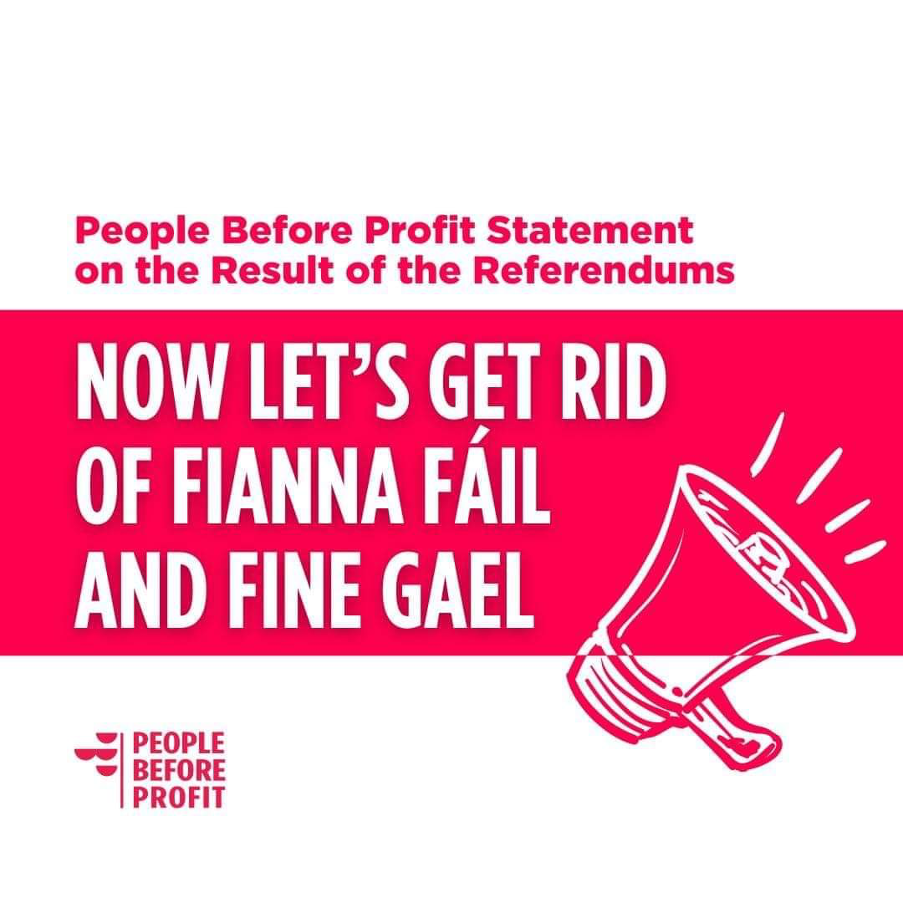
PbP go on to claim that they will go on to campaign for the Government and State to do a better job next time, so it is all in the past already and time to move on. And we know what this moving on will entail: it will involve them campaigning passionately to save their seats, desperately hoping that their constituents will forget their role and get on board with their moving on (as we see already in their graphic above this article). A bit of honesty would do them no harm but on this score they are less inclined than the bourgeois parties, are even less given too looking in the mirror while pointing the finger, and less disposed to some form of accountability.

The organisation claims that “there is also a dark side to the referendum which the left should not ignore. It brought to the fore right-wing elements who want to import Trump-style politics to Ireland.”

It goes on: “The far right and those clamouring for a return of Catholic Church power will try to use government ineptitude and anti-establishment mood in the country to rehabilitate their conservative vision for Ireland. They won a victory of sorts yesterday.” It concludes that it “will be offering a different alternative. One that takes the anger in Irish society and throws it back on the rich and their political elite. . . .  We want to see a return to mass movements that challenge this government, particularly on housing. And we want a left government that makes a real break with FF and FG.”

People before Profit doesn’t recognise that to lead any anti-establishment mood it is not enough to base itself on anger, their whole international tendency has been spouting this primitive conception for decades.  To form this mood into something coherent and organised requires a political programme and yes, building a mass movement and a working class political party to lead it, something People before Profit, despite its claims, is not doing.

To do so requires some very basic steps, including having a political alternative to the far right and not simply sticking labels on it–such as ‘far-right’ or ‘fascist’–that more or less rapidly lose their force, even when they are true.  While claiming to want to build a mass movement they put forward–to cap the alternative–a ‘left government’, which is not the same as a perspective based on the independent organisation of the working class, although they appear not to know this.  Their current approach arises from the political conceptions that led to their failure in the referendum, and their positing of a ‘left government’ – far from being realistic– is currently completely improbable. Their electoralism has now exhibited the same weaknesses as their competitors for votes, who do however have deeper roots among the classes they represent.

Most basically, to be ‘anti-establishment’ you actually have to oppose the establishment, not follow on its coattails mouthing grudging support for its empty politics.

The People before Profit statement declares at its beginning that for the Government parties “the referendum is a massive blow to their prestige and legitimacy”; but to quote John Donne again (in the more popular Ernest Hemingway version): “Ask not for whom the bell tolls; it tolls for thee.”

Record Defeat for the Government in Family and Care Referendum

“Woke is Dead”, read the banner. “It was all wokism demeaning window-dressing”, said the main voice of the ‘NO’ campaign, Michael McDowell, former Tánaiste and leader of the late and unlamented Progressive Democrats.

The Family and Care referendums, analysed previously here and here were massively defeated, the latter by the biggest ever No vote in a referendum. The amendment to the constitution on the family was defeated by 67.7 per cent of the votes and the care amendment by 73.9 per cent.

Both had been supported by the three government parties and by all but one of the opposition parties in the Dáil, including Labour, Social Democrats, Sinn Fein and People before Profit (PbP).  An ‘out-of-touch’ establishment turned out to include Sinn Fein and PbP, as well as several Non-Governmental Organisations, which supported a Yes vote.  The opposition parties all blamed the ineptness of the Government, a case not so much of rats leaving a sinking ship as jumping overboard when the ship was already at the bottom.  Sinn Fein ran so far away from the scene that it promised not to re-run the referendum, as it had previously promised if it was defeated.  It remains to be seen whether People before Profit will do the same and slink away from its similar promise in relation to ‘Care’.

The Irish Times sketch writer noted that Taoiseach Leo Varadkar’s acceptance of defeat was ‘a strangely nonchalant act of concession’, perfectly befitting the whole exercise, which was indeed “wokism demeaning window-dressing” but not only this.  The proposals also contained reactionary principles, as we set out in the two articles linked above.

On the family, it couldn’t tell anyone what the ‘durable relationships’ were that would receive constitutional ‘recognition’ or what this recognition would consist of, while it still claimed that ‘The State pledges itself to guard with special care the institution of Marriage’.  The Catholic right took this to be undermining the institution while others might have wondered how it was consistent with recognition of ‘durable relationships.’

The care amendment was bitterly opposed by some disability groups, who saw it as assigning responsibility for their care to their family and justifying the state’s abdication of any responsibility.  Varadkar let the cat out of the bag when he more or less accepted this interpretation in a media interview.

The referendum was rushed after having been delayed and without prior explanation or justification of the wording, which was deliberately withheld The debate in the Dáil was cut short with the vote pencilled in for International Women’s Day, which was taken by the electorate as a cynical ploy.

Varadkar stated that “the old adage is that success has many fathers and failure is an orphan”, but one person’s defeat is another one’s victory and the reasons for the victory of the No side were several, not limited to the arrogance of the Government.  The No vote included the opposition of right-wing Catholic opinion that is still a significant, if minority, force, while generally progressive voices could see through the lip service given to change, the reactionary implications of some of the wording, and the noted absence of other words (the word woman for example).

The care referendum was more obviously retrogressive, which prompted a slightly higher no vote and coloured many people’s appreciation of what the whole exercise was about.  The impulse to purge the existing constitution of sexism, encapsulated by a woman’s ‘life within the home’, was not enough to prompt a Yes vote, and at bottom reflects the point we made before: that no matter how reactionary it is it is not the cause of women’s disadvantage but rather reflects it.

Blame for failure of the Yes side has consisted of the unclear wording of the amendments; their change from that recommended by the Citizen’s Assembly; the government’s ‘hubris over strategy and superficiality over substance’ (Una Mullally, The Irish Times); the ‘immediate plunge into legalistic arguments’ (Una Mullally again), and the supposed ‘narrow’ campaign on the Yes side.

Since the Yes campaign included all the political parties except the smallest, the base of the Yes campaign wasn’t small. However, what was demonstrated were the limitations of the state’s political representation, including of the so-called anti-establishment parties, especially Sinn Fein.  As for the wording, its superficiality and legalistic ‘entanglement that never unravelled’, these were not accidental but intrinsic to the intention of the amendments that the Government simultaneously claimed were symbolic (but important) and meaningful (but unthreatening to the status quo).  No wonder it lost. 

Determining the nature of the vote can sometimes be established by looking at the consequences, which one journalist has called ‘a vacuum’ and another that while “it might not be the end of gesture politics . . . it will certainly give would-be gesturers pause for thought in future.’ (Pat Leahy in The Irish Times) He provides the example of some NGOs proposals for economic and social rights to be included in the constitution.  This is something we have opposed before and consider to be a complete diversion, misdirection, miseducation, and waste of time.

The threat of new Hate legislation is also offered as something that has government TDs worried about their popularity, if the public have the opportunity to understand it. The Irish government has previously passed the Gender Recognition Act with minimum publicity so that no opposition was likely to raise the issue of women’s rights.  Getting away with this now is more problematic as the profession of ‘progressive’ intentions loses its capacity to silence critical thought.  The referendum vote has certainly achieved this and for this alone it is to be welcomed.

The Third Year of War (2 of 3)

The presentation of the war in Ukraine in the Western media is exactly like that of the genocide in Gaza.  Just as history began with the Russian invasion on 24 February 2022, so the ‘war’ in Gaza was started by Hamas on October 7, 2023.  Russia and Hamas are to blame.

The majority of the Left has correctly sought to put October 7 into context, to be understood as an almost inevitable explosion arising from brutal oppression.  In the case of Ukraine the context has all but been ignored, and in any event Russia is not an oppressed people and it had a choice.  Of course, both of these observations are true, which are some of the reasons why Sráid Marx has not supported the Russian invasion, but this does not excuse the failure of the pro-war left to provide a coherent explanation of why the invasion took place.

Their impoverished attempts to do so, based on the flawed understanding of history and megalomaniacal mental disposition of Vladimir Putin, is about as useful for the task as depending on the flawed understanding of Jewish history and psychopathic tendencies of Benjamin Netanyahu to explain Israeli actions, or the antisemitic, crazed impulse for revenge of Hamas.  Personalising such causes, or placing the onus on the inhuman character of those you don’t like, prevents understanding of the real causes and in this case avoids having to account for the interests of the Russian state, consideration of which might invite deliberation on those of the Ukrainian and Western states.  This might lead to comparisons between them that would dissolve the simple narrative of big against small, good facing evil, and freedom opposing oppression.

This year is the tenth anniversary of the Maidan demonstrations and occupation, which is sometimes given as context to, and presented as the start of, the Russian aggression, although this is a particularly difficult ‘revolution’ for the left to hang its coat upon.  This ‘revolution of dignity’ was based on the illusion that an EU association agreement would lead to Western standards of living, and put an end to corruption with the introduction of democracy, so that the then Ukrainian President was wrong to accept the alternative offer from Russia and attempt to repress the popular movement by force.

Unfortunately, such a story of a pure democratic movement repressed by a Russian proxy does no justice to the events, as explained before here and here.  These include the issues raised in prior attempts to negotiate a deal with the EU, Russia making a better offer, and the EU deal threatening the livelihoods of millions of workers in uncompetitive industries in the East of the country.  The Maidan uprising was not therefore universally supported but was based on liberal illusions and sponsorship by the US, including by Western backed NGOs.

The occupation of the Square was led by far-right forces that may well have been to blame for the final massacre.  The oligarchic Government and state that arose out of this ‘revolution’ continued to be riddled with corruption and was a creature moulded at least in part by the US, including through collaboration with its secret police, the SBU.  Even this Ukrainian supporter of the war cannot help admitting that the Maidan revolt was highjacked by the right.

From 2014 Ukraine built up a large army and adopted a policy of recovering Crimea and the other areas in the East occupied by Russia.  Integration into NATO began and the penetration of the US through its usual vehicles, such as the CIA, has been admitted even by a US publication that cannot be accused of providing excuses for Russia.  This source makes it abundantly clear that the Ukrainian state was a willing proxy for US imperialism long before the Russian invasion and that 24 February 2022 was very definitely not the ‘first shot’.

This function continues and has increased enormously through the war.  Speaking about the role of the CIA at its commencing, Ivan Bakanov, then head of Ukraine’s domestic intelligence agency, stated that  “Without them, there would have been no way for us to resist the Russians, or to beat them”.  

The details of this, disclosed by The New York Times, were “a closely guarded secret for a decade”, including from the Ukrainian people.  What this demonstrates is that the Ukrainian state and political regime–that the pro-war left in the West supports–walked the Ukrainian people into a war in a process of which they were blissfully ignorant.  It proves yet again the old socialist adage that the main enemy is at home.

This left has been unable to tell the difference between the Ukrainian state, people and working class, and has loudly declared the ‘agency’ of Ukraine against charges of the war being a proxy one on behalf of Western imperialism.  It is surely beyond doubt that the price paid to become part of NATO isn’t worth it.  It is also clear what agency has been active in Ukraine before and during the war, and thus bears some responsibility for it, although this is an agency the pro-war left would like to deny.

The Ukrainian state worked against the interests of the Ukrainian people, and it behoves socialists to explain this and to work towards the working class in the country acting as an agency on its own behalf, not as cannon-fodder for the capitalist state.  The pro-war left that declares its defence of the Ukrainian people and working class can’t do this because it can’t tell the difference between their separate interests and so never makes a real distinction between them. Since the working class has no independent organisation separate and opposed to the Ukrainian state the left supports the state, while lip service is paid to working class interests that are never political but simply express economistic demands compatible with, in fact subordinated to, the war.

                                                        *                   *                    *

in November 2021, US Secretary of State Anthony Blinken announced a ‘Strategic Partnership’ with Ukraine that included a commitment to supporting its objective of taking the territory lost to Russia, including Crimea.  On the 17th December Russia sent an ultimatum demanding a reduction of Western military deployments in Eastern Europe and an official end to attempts to bring Ukraine into NATO.  Inside Ukraine, Zelensky sanctioned three ‘pro-Russian’ TV channels and arrested the opposition leader, Viktor Medvedchuk. He demanded new and immediate sanctions, and questioned why Ukraine didn’t have an ‘open door’ into NATO given that it was functioning as Europe’s ‘reliable shield’ against Russia.  The dynamic towards war and Western involvement was set, explaining why the invasion did not come out of the blue from the deranged mind of a Russian dictator.

The immediate UK media response was to paint Russia’s Special Military Operation as a ‘full-scale invasion’ that aimed to invade and occupy the whole country, with Reuters reporting that “Ukraine’s forces no match for Russia in manpower, gear and experience.”  Russia was, after all, the great bear threatening the whole Western world and prime justification for the creation and existence of NATO.

Since the total Russian invading army was smaller than the Ukrainian, and much smaller when the latter’s reserves were included, this did not make much sense, since we all learned that a ratio of at least 3 to 1 was required for the attacking force.  Russia launched 600 airstrikes in the first ten days, far fewer than the 2,000 strikes launched in the first days of the US-led invasion of Iraq in 2003.

Two years later, the civilian deaths attributed to Russia are around 10,000, less than one third of those inflicted by the Israeli state in less than a quarter of the time.  While the former led to massive economic sanctions; unprecedented supply of weapons and ammunition that drained the stock of materiel from the Western world; billions of dollars and Euros in financial support, and supply of intelligence, surveillance and reconnaissance (ISR); in Gaza it led to sanctions, weapons, finance and ISR as well, except the sanctioned were those being massacred and the assistance went to those committing the genocide.

One might think that this would torpedo Western justification for supporting Ukraine, at least among the left, but this didn’t happen, even when the Ukrainian state declared its solidarity with the Israeli state and the Israeli state reciprocated.

Presenting the Russian offensive as a ‘full-scale invasion’ that aimed to occupy the whole country made it possible for Western ‘experts’ to repeatedly denounce it as a failure when this very obviously wasn’t happening. Russia’s characterisation of it as a ‘Special Military Operation’ (that did not require full scale mobilisation beforehand) was derided as simply a dishonest pretence.

Since the West ensured that quick ceasefire negotiations in March 2022 were torpedoed, and promises were made to support Ukraine in a fight to the end, the Russian state then did much of what the western media claimed it had already done.  It expanded its military-industrial complex and mobilised hundreds of thousands of new troops, which the Western media denounced without acknowledging that this was already supposed to have happened.

The media, having predicted a quick Russian victory, then took to ridiculing the incompetence of the Russian forces, reporting its massive casualties and hailing its coming total defeat.  Their retreat from Kyiv was hailed as a huge reverse, as was the later retreat from much of Kharkiv in the East and Kherson in the West.  This ignored that fighting around Kyiv was more a series of skirmishes than a massive full-frontal assault; that the loss of significant territory in Kharkiv was due to thin defences that proved the invasion had not been ‘full-scale’, and that the retreat back across the Dnieper was a well-executed manoeuvre that made perfect sense from a military point of view.

None of this means that these were not victories for Ukraine, but they were not the disasters for Russia painted in the West.  Influential media like Foreign Affairs carried articles such as “How Not to Invade a Nation” while Russia Matters declared “No End in Sight to Beginning of Putin’s End”. Russian advances were written off–“Russia’s Capture of Azovstal: Symbolic Success, ‘Pyrrhic’ Victory?” said Radio Liberty Europe.

The British media reported that “Vladimir Putin’s total defeat is now within reach”, according to The Telegraph on 8 Sept  2022.

“Putin is finished. The Ukrainians have him on the ropes” in The Telegraph, on 11 Sept 2022 .

“Humiliation for Vladimir Putin as Ukrainians liberate key city of Lyman” said The Guardian on 1 Oct 2022, and

Ukrinform on 19 November 2022 stated that “Defense Ministry predicts Ukrainian forces be back in Crimea by end of December”.

This obviously biased and ignorant approach continued with the promise, repeatedly delayed, of a Ukrainian offensive in the spring of 2023.  Russia was apparently not only running out of missiles (repeatedly) and had suffered horrendous losses of men and tanks, but the low morale of its troops could mean a rapid victory for the new NATO armed and trained Ukrainian brigades.

In the event, Russia continued to fire its missiles at various levels of intensity; its first defences were hardly reached never mind breached, and the morale of the Russian army held while that of Ukraine fell following the utter failure of the offensive and the high level of losses incurred. It appeared, after it was all over, that during the offensive Russia had captured as much territory as Ukraine.

There then began the claim that the war was at a stalemate, with little territorial gains by either side, while stories of repeated meat grinder assaults causing horrific casualties were attributed to the Russians that had in fact become a feature of the previous Ukrainian offensive.  This was combined with incompatible stories about the considerable Russian advantage in artillery in what was characterised as a war of position.  Pro-Russian propaganda pointed out that this was precisely the Russian strategy – of degrading Ukrainian forces rather than seeking territorial gains, which would ultimately follow.

The only way to gain any appreciation of the state of the conflict from a military point of view was to look at this propaganda (with a critical eye).  This, of course, was not something the pro-war and Pro-Ukraine left was inclined to do.  The defeat at Bakhmut was thus the story of the loss of a strategically unimportant town and not that of thousands of Ukrainian soldiers, while the grinding war of attrition was still a stalemate at a time when Russia was making more advances than the previous heralded Ukrainian assaults.  Reading Western coverage of the war was like reading a crime novel in which pro-Russian outlets had already revealed in previous months who had been killed, how they had been killed and who was guilty.

Even now, the story is being told that Ukraine is losing only because of lack of resolve by the West and that victory is still possible. More weapons and ammunition should be supplied even though it is now admitted that neither the troops to wield them, nor the materiel itself, exist in sufficient quantity.  This leads to the siren calls for NATO infantry on the ground and NATO aircraft in the sky.  This became another illustration of the claim that if Ukraine falls the rest of Europe will be next, while having claimed during most of the last two years that Russia was losing.

Repeated lies by the Western media, its contradictory claims and their clash with reality should have caused the more fundamental lies about the nature of the war to be questioned and rejected.  However, having swallowed Western imperialist explanation and justification for the war, the pro-war Left by and large also became subject to the illusions peddled about its course. They have become stuck in support for a proxy war that has the potential to escalate catastrophically and a political position that can only oppose catastrophe when the grounds for it have already been created.

Back to part 1

Forward to part 3

The Third Year of War (1 of 3)

The second anniversary of the Russian invasion of Ukraine led to several retrospective summaries of the war and recapitulation of the arguments about its justification.  This should have involved an examination of the various claims made about its course over the two years and how they stand up today, but this was studiously avoided.  If we take even a cursory look at these claims, we can see how the lies told by the Western media about the war have increasingly been shredded by reality. Instead of winning against a stupid and incompetent Russia the all-powerful NATO might be losing? But let us come to that presently.

The genocide in Gaza has to a great extent eclipsed the war while the bias and lying of the Western media has increasingly been impossible to hide.  That the BBC live-streamed the Israeli case at the International Court of Justice but not the South African is just one example. While driving my car this morning Sky News reported that one hundred Palestinians had just ‘died’, which must be taken to refer to the killing by the Israeli army of their desperately starving victims attempting to get food from one of the few aid convoys the Zionists allowed through.

All this should provide grounds for clarifying the nature of the war in Ukraine but instead these have been treated as two entirely separate happenings, including by much of the left, which supports the actions of the United States in one and damns it in the other; excuses its intervention in one and rejects all its excuses in the other.  And we are supposed to believe this makes sense.

So, the war in Ukraine is the war in Ukraine; and the genocide in Gaza is but the latest murderous assault on the Palestinian people that must be addressed by a Palestinian solidarity movement. The long adopted method of single issue campaigns, designed supposedly to involve the maximum number of people, is exposed as divorced from reality.  Rather than help explain the world, it fragments reality and is an obstacle to understanding it.  Without such understanding the fundamental cause of war – capitalism – will forever lurk in the background, smothered by the appearance of this or that conflict, inviting this or that ‘solution’ that often relies on the criminals who caused it.

Much of the Western left has supported the Ukrainian state, and Western intervention, which is now accepted in Washington and Kyiv as the only thing keeping it going, with repeated threats that it will lose very soon if Western weapons do not continue to come.  Since money on its own does not kill Russians the reckless sponsorship of the war has been exposed because the Western powers no longer have the ammunition or other war materiel to keep Ukraine fighting.

Zelensky promises a new offensive in 2025 but the integrity of his armed forces might not last that long. Western powers are scrounging ammunition from various parts of the globe, but these simply mean that Ukrainians will keep on fighting and dying a little longer.  The alternative is the provision of more advanced weapons such as longer-range missiles and F-16 aircraft but these cross previous red lines, risk Russian retaliatory escalation and will not lead to Ukrainian victory.  In turn this risks further Ukrainian attempts to provoke greater Western intervention.

Threats to directly intervene with troops on the ground have only revealed that some have already been there and many of them have been killed.  A Russian officer has already stated that “NATO military personnel, under the guise of mercenaries, participate in hostilities. They control air defence systems, tactical missiles and multiple launch rocket systems, and are part of assault detachments.” The loss of over 60 French ‘mercenaries’ has already been reported in Kharkiv.  Now the German Chancellor Olaf Sholtz has let slip that the British and French are using their own troops to target and fire their missiles.  And someone else has revealed discussions within the German armed forces to attack Russia.

What successes Ukraine have achieved, such as the sinking of Russian warships and scarce and expensive surveillance aircraft, could only have been accomplished with Western systems, intelligence and personnel.  The most advanced weapons systems can only be used effectively by forces trained and familiar with them while their servicing and maintenance requires similar support. None of this has prevented increasingly rapid Russian advances on the ground.

Stopping, and reversing, this could not be achieved even by French, German, British or US troops on the ground without creation of a massive intervention force that these countries are currently in no position to construct and employ.  This has not excluded repeated announcements of the possibility of Western troops being sent to take part directly in the fighting.  This, even if on a limited scale, has the potential to lead to a World War.  The piloting of F-16 fighters by NATO pilots, with the green light by NATO Secretary General Jens Stoltenberg to attack targets in Russia, shows one path to escalation and war.

The prospect of Western infantry in Ukraine raised by Macron and shot down by others reflects awareness of the possibility of defeat, which Biden in particular has cause to fear, if this becomes clear before the November Presidential election. Even If Western escalation were partial, limited to occupation of Western Ukraine, Russia has the capacity to continue to move forward to achieving its aims, which would be expanded to account for a Western incursion. 

Left supporters of the Ukrainian state face the defeat of what has, politically, become their own proxy in their imagined progressive struggle alongside Western imperialism.  The presumed priority of Russian defeat would require massive Western imperialist intervention, with the risks discussed, and serves to justify the most reactionary nationalism in Eastern Europe (to be covered later).

Given the nature of the parties involved, exemplified in the massive disparity in power of the two forces, it is not Western imperialism that has become a proxy for the Left but the Left that has become a bourgeois proxy within the socialist movement.  Such is the position this pro-imperialist Left has put itself by supporting a pro-Western capitalist state in a war and by also supporting the assistance provided to it by Western imperialism.

The split personality of this left can be seen in their support in the case of Ukraine and opposition in the case of Palestine, as if all the Western powers are confused as to what is in their interests.  This disorder is as real for those that straight-forwardly support Ukraine and deny the proxy nature of the war as it is for those who directly express their confusion by both supporting the capitalist Ukrainian state while opposing the assistance of the capitalist states supporting it.

Defence of the Palestinian people will not be advanced by upholding in Ukraine the imperialist supporters of the Zionist state that is carrying out genocide, or by claiming that it is capable of playing a progressive role in one but not the other.

Of course, the genocide in Gaza is immediately more obvious and easier to argue, and especially more convenient for the moralistic approach that single-issue campaigns rely upon.  But for exactly this reason it is important to show how the two require the same approach and are not two single issues but two expressions of the one oppressive system that must face one combined struggle against it.

Both are wars by proxies of US imperialism in order to defend its hegemonic position in Europe and the Middle East.  Both reveal the poverty of its putative capitalist rivals.  The Russian invasion is incapable of stirring the sympathy of the workers of the world, and China, as the ultimate target of the US, cannot politically defend the Russian invasion.  In the case of Gaza, these putative leaders of the alternative pole of imperialist power have stood aside while the Zionist state commits genocide.  Russia and China have not made even a significant symbolic gesture by expelling the Israeli ambassador, while its BRICS associate, Saudi Arabia, has facilitated trade with Israel to nullify the efforts of the Houthis in Yemen to block it.  Iran has been as keen as the US to limit its opposition through its allies so that it can avoid war between them.

In both cases the Left, of almost all shades, sees no role for socialism in ending these capitalist wars but puts forward purely formal democratic proposals that do not go beyond capitalist solutions and have no bearing on reality. This includes the demand for ‘self-determination’ for Ukraine when the part of it allied to the West is already utterly reliant and subordinated to it.

In Gaza, the renewed murder and displacement of Palestinians has revived the debate over a two state or one state solution, neither of which are socialist and neither of which address the over-reaching power of the Zionist state, its US sponsors, or the opposition of the autocratic Arab regimes, which oppose the creation of any democratic Palestinian state lest it act as a beacon of inspiration for their own oppressed populations.

The hypocrisy that has been exposed by the two conflicts is a starting point to enlightening working people about the depraved and ruthless nature of the societies they live in, and that the scope and scale of the barbarity exposed is not accidental but is a fundamental feature.  This means that only a complete reordering of society will work and that this is what the socialist alternative involves.  If capitalist war does not demand and call for a socialist alternative then activists opposed to these wars will never be able to promise that one day they will end.

Forward to part 2