Karl Marx’s alternative to capitalism part 71

Marx states in ‘The Communist Manifesto’: ‘In proportion as the bourgeoisie, i.e., capital, is developed, in the same proportion is the proletariat, the modern working class, developed . . . Modern Industry has converted the little workshop of the patriarchal master into the great factory of the industrial capitalist. Masses of labourers, crowded into the factory, are organised like soldiers. As privates of the industrial army they are placed under the command of a perfect hierarchy of officers and sergeants . . . The more openly this despotism proclaims gain to be its end and aim, the more petty, the more hateful and the more embittering it is.’

‘The proletariat goes through various stages of development. With its birth begins its struggle with the bourgeoisie . . . At this stage, the labourers still form an incoherent mass scattered over the whole country, and broken up by their mutual competition. If anywhere they unite to form more compact bodies, this is not yet the consequence of their own active union, but of the union of the bourgeoisie, which class, in order to attain its own political ends, is compelled to set the whole proletariat in motion, and is moreover yet, for a time, able to do so.’

‘. . . but with the development of industry, the proletariat not only increases in number; it becomes concentrated in greater masses, its strength grows, and it feels that strength more . . .  The growing competition among the bourgeois, and the resulting commercial crises, make the wages of the workers ever more fluctuating. The increasing improvement of machinery, ever more rapidly developing, makes their livelihood more and more precarious; the collisions between individual workmen and individual bourgeois take more and more the character of collisions between two classes. Thereupon, the workers begin to form combinations (Trades’ Unions) against the bourgeois; they club together in order to keep up the rate of wages; they found permanent associations in order to make provision beforehand for these occasional revolts.’

‘Now and then the workers are victorious, but only for a time. The real fruit of their battles lies, not in the immediate result, but in the ever expanding union of the workers. This union is helped on by the improved means of communication that are created by modern industry, and that place the workers of different localities in contact with one another. It was just this contact that was needed to centralise the numerous local struggles, all of the same character, into one national struggle between classes. But every class struggle is a political struggle.’

‘This organisation of the proletarians into a class, and, consequently into a political party, is continually being upset again by the competition between the workers themselves. But it ever rises up again, stronger, firmer, mightier.’ 

‘Altogether collisions between the classes of the old society further, in many ways, the course of development of the proletariat. The bourgeoisie finds itself involved in a constant battle. At first with the aristocracy; later on, with those portions of the bourgeoisie itself, whose interests have become antagonistic to the progress of industry; at all time with the bourgeoisie of foreign countries. In all these battles, it sees itself compelled to appeal to the proletariat, to ask for help, and thus, to drag it into the political arena. The bourgeoisie itself, therefore, supplies the proletariat with its own elements of political and general education, in other words, it furnishes the proletariat with weapons for fighting the bourgeoisie.’

‘Of all the classes that stand face to face with the bourgeoisie today, the proletariat alone is a really revolutionary class.’

‘The advance of industry, whose involuntary promoter is the bourgeoisie, replaces the isolation of the labourers, due to competition, by the revolutionary combination, due to association. The development of Modern Industry, therefore, cuts from under its feet the very foundation on which the bourgeoisie produces and appropriates products. What the bourgeoisie therefore produces, above all, are its own grave-diggers.’

Marx goes on to set out the tasks of the working class revolution, which involves ‘the proletariat organised as the ruling class; and to increase the total productive forces as rapidly as possible.’ This revolution is not an eschatological thunderstrike out of the blue that suddenly transforms the world but a juncture arising within existing society through the development of its contradictions.

As a conscious process of real people, it cannot be the outcome of impetuous and spontaneous apprehension, but must arise from the considered and passionate commitment of the vast majority of the working class, arising from the history and development of their struggles as a class.

We can note at least three aspects of what Marx said that has obvious relevance to today.  The first is ‘the growing competition among the bourgeois’, which now takes place between previously inconceivably large corporations that span the globe that makes this competition an international phenomenon.  This both unites the interests of the world working class and divides it according to the strength of the capitalist system and political weakness of the working class.

The second is the the improved means of communication that can help ‘in the ever expanding union of the workers.’ We no longer need to merely read about wars but have daily, if not hourly, video coverage of its barbarity in Gaza and Ukraine.  What the working class movement has failed abysmally to do is to create its own international media, which remains in Lilliputian proportions in comparison to that of the bourgeoisie.

Through this media the bourgeoisie is compelled to appeal to the proletariat, to ask for help, and thus, to drag it into the political arena.  Hence the bias in coverage of the genocide in Gaza and the war in Ukraine.  Unfortunately again, we see the weakness of the working class movement that is happy to wallow in the lies about the imperialist character of the proxy war in Ukraine and line up behind its own ruling class.  The very saturation of the media allows those comfortable in this position to have their deception confirmed again and again.  A working class media would at least allow a wider source of information and debate, although again, such is the degeneration of much of the current left that petty bourgeois moralism is employed to silence critical voices.

In previous posts, we noted one result of such moralism in the call to hate capitalism more as a spur and guide to action.  We argued in response that a revolution conceived out of ‘negativity’ and ‘hate’, even if it is born out of oppression and exploitation, is utterly insufficient.  Such a view faces the problem of how such a social revolution could become the long-term goal of the working class and could be achieved by it.

Miéville, for example, can say that ‘capitalism is unbearable and yet, mostly, it’s borne’, resulting from the success of ‘capitalist-realist common sense that it’s impossible, even laughable, to struggle or hope for change.’  In part he puts this down ‘to a deliberate ruling-class propaganda strategy to discourage any belief in any such possibility’, but ‘also, at a base level, because it’s so difficult to think beyond the reality in which one has been created, lives and thinks now . . . conditioned as we are by existing reality, we cannot prefigure or simply ‘imagine’ such radical alterity.’

The result is that ‘it’s beyond our ken – we can only yearn for it, glimpse some sense of betterness out of the corner of the eye.’ (A Spectre Haunting: On the Communist Manifesto, p 89)

Such is the idealist view of the possibility of social revolution that cannot ground the future society from the current one but sees the current in purely, or at least mainly, decisively and definitively, in negative terms for which the appropriate emotion is hate.  This is why he states that ‘it’s so difficult to think beyond the reality’ when it is precisely this reality, clearly seen – not out of the corner of the eye – that provides the grounds for the social revolution, giving rise to the appropriate emotions of hope and courage derived from passionate belief in the cause, with hatred of oppression as a motivation but not determining the struggle.

This reality, according to Marx, includes the development of the forces of capitalist production and the associated relations of production that include the creation, expansion, development, organisation and growing consciousness of the working class.  The prosecution of this class struggle involves the creation of a mass, political working class movement that demonstrates not only its power to increasingly defend the interests of the working class but its potential to lead to the creation of a new society ruled by it.

This alternative is built upon the conditions and circumstances of the real world and not by thinking a prefigured ‘radical alterity’ – some largely imagined future alternative – but by changing this reality through prosecuting the class struggle, ranging from the creation of democratic and militant trade unions, to workers’ cooperatives and their association with each other, to the creation of mass working class parties committed to socialism.  The forces recognised by Marx that governed the development of the working class still exist today and are the grounds for the concomitant development of socialist politics.

Back to part 70

Forward to part 72

The need to hate capitalism more

In the 1970s I used to sell the paper of the International Marxist Group Red Weekly every Saturday afternoon on Union Street in Glasgow at the side entrance of the Central Station. I remember one occasion when a visibly agitated man rushed up to me demanding to know whether I was a communist – ‘Are you a communist?’ ‘Are you a communist?’  He launched into a few remarks I barely took in at the time and don’t remember at all now.  I gathered that he was very angry about something and ‘communism’ was some sort of answer. He then exited as frantically as he had arrived.  I doubt very much he had anything to do with ‘communism’ thereafter.

I was reminded of this minor incident reading China Miéville’s book on Marx’s Communist Manifesto, in which he borrows a phrase employed by someone else, and in a different context, to say that The Communist Manifesto’s “negativity is not negative enough”. ‘It does not hate enough’, (A Spectre Haunting: On the Communist Manifesto, p 176)

This appears in a section entitled ‘On Hate’ in which he states that capitalism deserves to be hated, but that “a focus on hatred . . . is fraught, and dangerous territory . . . Hatred, after all, is an emotion that can short-circuit thought and analysis, can segue into violence, and not necessarily with any discrimination’; although he then notes that “hatred, particularly by the oppressed, is inevitable” (p170-171)

Against this he quotes Marx’s favourite maxim – Nihil humani a me alienum puto – nothing human is alien to me, and while he then states that it’s “hardly productive to pathologise hate per se, not least when it’s natural that it arises . . . the very absence of a critical mass of hatred may militate against resistance.”  He then quotes others on the need for ‘class hatred’ – “a radical structural hate for what the world has become” that is not “personal, psychological or pathological hate, but a structural hate.’  However, a hate that is neither personal nor psychological is not an emotion and a ‘structural hate’ must refer to something else entirely if it is to refer to anything at all.

Miéville is correct to refer to a statement about “deliberate hate as a rational category”.  The philosopher Martha Nussbaum noted that “emotions always involve thought of an object combined with thought of the object’s salience or importance; in that sense, they always involve appraisal or evaluation.”  The neurologist Antonio Damasio similarly comments that “Emotions provide a natural means for the brain and mind to evaluate the environment within and around the organism and respond accordingly and adaptively.”

This is the opposite of the view of emotions–that they cloud rationality, which they obviously can, and fits comfortably into the long tradition of Western philosophy focused on what is rational but which exaggerates both the disruptive potential of most emotions and the precision and certainty of human rationality.  Emotions are an evolutionary development of humanity that helps us quickly gather and process information about the world and respond to it accordingly.  

Some have made the comparison of thinking slow and fast, with emotions involving the latter entailing problems associated with ‘snap decisions’ and avoidance of ‘careful deliberation.’  If anyone was to look to Marx for inspiration, they might consider his long years in the British Library in London; his purported need to read all potentially relevant books on a subject before forming a definite view, and this resulting in missed deadlines and much unfinished work left to posterity.

Miéville believes that hate is not only necessary for resistance but “may help not only with strength but intellectual rigour, and of analysis, too” (p173). He quotes an Anglican priest, Steven Shakespeare, quoted above regarding hate’s “dangerous territory”, that it is necessary to be “more discriminatory about hate, where it comes from, where it should be directed, and how it gets captured for the purposes of others.’

So, we are into Goldilocks territory of not too much, and not too little, hate but just the right amount. Or we can appeal to Aristotle’s golden mean; where, for example, courage is a virtue but if taken to excess is recklessness and if too little, cowardice.  “Emotional intelligence” is a modern variation.  Cogitating on how much hate to evoke against capitalism is, however, a pretty unproductive pursuit.

Miéville, however, is particular about determining the need for greater hate, including that “Marx and Engels were too generous in their eulogy to its [capitalism’s] transformation and energetic properties, and to the bourgeoisie itself, as well as about the likelihood of its collapse.” (p175)

It might be more accurate to say that Marx and Engels were too sanguine, optimistic and confident about the overthrow of capitalism (not its collapse) but that they didn’t live to see the development of the workers’ movement or the programmes developed by its various parts that impacted on the outcome of subsequent failures.  The point of this series of posts is not to relay this long and involved history but to set out what their alternative to capitalism was, which should go some way to exposing the reasons for failure so far.

As for Marx and Engels being too generous about the transformational and energetic properties of capitalism, this is simply false; it is in fact one of their most brilliant judgements and predictions, fully confirmed by today’s capitalism and its spread across the globe.

Miéville says we should retain our “shock” at the iniquities that capitalism throws up and that provoke an “appropriate human response, the fury of solidarity, the loathing of such unnecessary suffering . . . We should feel hate beyond words.”  But the feeling of solidarity is also an emotion.  An emotion that we should wish to promote, which is not (simply) a “humane” one but one based on a feeling of class solidarity, to be combined with the emotions of pride in our cause and our movement, and growing confidence in our success.

If there is a deficiency in emotional investment it is in these, which are more vital to our future than learning to hate capitalism that bit more.  No one experiences only one emotion at a time (hence the falsity of the question repeated by Miéville “is your hate pure”); and as we have said, even the most instinctive emotion involves rationality and a degree of thought.

Marx noted, in relation to Miéville’s call that we should retain our “shock”, “fury” and “loathing” that some suffering has not been “unnecessary”, but absolutely necessary for the development not only of humanity in general but of capitalism and the grounds it creates for the subsequent potential for socialism.  Many still cannot get their head round this: that the suffering imposed by capitalism was unavoidable for its birth and development – and in this sense necessary – but that this does not in the least mean we do not cease to damn it and to seek its overthrow.

To claim otherwise – that much of the suffering endured through capitalism was unnecessary must explain a number of things.  How could capitalism birth and develop without suffering?  Is a non-suffering capitalism possible? Is socialism possible without capitalism (and therefore without this suffering but then also without the working class)?  Was all this suffering therefore without any historical meaning, but simply contingent and accidental?  Explain the laws of the development of capitalism and its relation to the possibility of socialism without contradiction and antagonism and therefore suffering!

Marx is criticised in Miéville for his greater criticism of other socialisms than of the bourgeoisie because the former has none of the “ambivalence” that he attaches to the latter. (p176) This “ambivalence”, however, was entirely appropriate in a period in which capitalism was more or less fully developed in only a couple of countries and had yet to supplant the legacies of feudalism.  Apart from recognition of the insights of the original utopian socialists, Marx admonished their succeeding followers because there was no merit in repeating anachronistic nostrums that were now reactionary.

Did Marx and Engels hate capitalism more than Weitling, Proudhon and Bakunin?  This would be a hard claim to sustain, but whose politics is the best guide to ending it, and would their’s have been better had they done so?

The emotion of hate has its (inevitable) place, but this does not mean “we must hate harder than did the Manifesto”; the demand for greater hate (“hate beyond words”) is a substitute for politics.  After all his detour on the need for hate, Miéville says that “Hate is not and cannot be the only or main drive to renewal.  That would be deeply dangerous.  We should neither celebrate nor trust our hate. But nor should we deny it.”  It would have been better had he started and elaborated on this than drop it into the end of a disquisition on how much we must hate more.

Karl Marx’s alternative to capitalism part 68

Back to part 67

Forward to part 69

Back to Part 1

Karl Marx’s alternative to capitalism part 57 – towards ‘Aufheben’

We see from the previous post that capitalism, as a transitional mode of production to socialism, is a progressive development, recognition of which is one of the hallmarks of Marxism.  This, however, is not how Marxism is normally understood by its enemies, by those unfamiliar with it and even by some of its friends and self-styled adherents.

Certainly, some of these will accept that this is true in relation to previous societies, whether understood as feudalism, some form of Asiatic mode of production, or older tribal societies, but, it is argued, this is no longer the case.  Capitalism has conquered the world, is now in decline and/or in its ‘death agony’, as declared by Leon Trotsky.  Marx lived when only a small number of countries were capitalist in any developed sense and today it is the irrationality and barbarity of capitalism that predominates.

There are a number of problems with such a view but in this post we will mention only three.  First, Marx’s view is that capitalist progress is not a serene, tranquil and untroubled process.  It is not one of harmony and uniformity but one of antagonism, generated by contradictions that are often expressed in palpable horrors.  It was ever thus, and today’s horrors engendered by the system are neither new nor preclude progress in the sense set out in the previous post.

Secondly, capitalism continues – albeit with its waste and degradation of humanity and the planet – to develop the forces of production and therefore the foundations for socialism.  This includes massive expansion of the working class, without which capitalism does not exist.  The sense of progress set out by Marx therefore continues even as it lays waste to nature and humanity, not least because these forces can be developed in such a way to further the protection of both.  The alternative view is that the new society must start from somewhere very far away from being able to address these tasks and can only begin to develop the forces necessary after capitalism is overthrown, which ironically calls into question the current possibility and imperative to do so that is so much a part of this view.

Thirdly, a one-dimensional understanding of modern capitalism as regressive can easily elicit appeals to the past, to older models of society or more primitive capitalist forms, which Marx had to reject in his own day, but that are continually proffered, becoming obstacles to the replacement of capitalism by socialism.  These include opposition to the centralisation and concentration of productive forces in the name of ‘anti-monopoly’ capitalism; to the growth and development of these forces on the grounds of planetary limits, or to the internationalisation of capitalism on the grounds of the protection of ‘national sovereignty’, against ‘globalisation’ etc.  There are many other examples.

Opposition boils down to opposition to the socialisation of the forces of production, to the progress that capitalism has involved, and upon which future socialism depends.  In this view, opposition to capitalism cannot rest on what capitalism has achieved but on its purely negative aspects, such as its exploitation and oppression.  We have seen that it is precisely in the expansion of surplus labour, on exploitation as a result of the socialisation of labour, that socialism is possible.  It is not capitalist crises, or its inhuman oppression or its tendency to war and destruction that will give rise to socialism but to the contradictions of the system of which these are expressions.  Capitalism is essentially still the antagonistic system riven by contradictions analysed by Marx in the middle of the nineteenth century.  Were it not, we would not be expounding his alternative as still relevant.

Marx did not in the least minimise the horrors of capitalism but did not reduce his opposition to capitalism to its deleterious effects, as the sole grounds for creation of a new society or the incentive to do so.  To maintain a belief in socialism while abandoning his analysis necessarily involves invoking some other grounds, and since this means abandoning the material premiss of the world as it exists, it usually involves invoking principles or ‘values’ – moral claims – that cannot support it.

In 1849 Engels wrote that: “Justice”, “humanity”, “freedom”, “equality”, “fraternity”, “independence”—so far we have found nothing in the pan-Slavist manifesto but these more or less ethical categories, which sound very fine, it is true, but prove absolutely nothing in historical and political questions. “Justice”, “humanity”, “freedom” etc. may demand this or that a thousand times over; but if the thing is impossible, it does not take place and in spite of everything remains an “empty figment of a dream”. (K Marx and F Engels, Democratic Pan-Slavism, Collected Works Vol 8 p 365)

What Marx and Engels demonstrated was that ‘the thing’ – socialism – is possible because it is based on the development of existing society itself and can unfold out of it.  This does not make it inevitable in the sense that this unfolding is an unconscious, inescapable process, but that it is precisely a conscious process, derived from a consciousness of what exists and its evolution.

This was expressed very early in Marx’s political development when he wrote that he did not want to ‘dogmatically anticipate’ the new world but wanted ‘to find the new world through criticism of the old one’.  The task was to ‘develop new principles for the world out of the world’s own principles’ and wanted to ‘merely show the world what it is really fighting for, and consciousness is something that it has to acquire, even if it does not want to’.  In a letter in 1843 he wrote that ‘It is not a question of what this or that proletarian, or even the whole proletariat, at the moment regards as its aim. It is a question of what the proletariat is, and what, according to this being, it will historically be compelled to do’.

This consciousness cannot not stop at the obvious iniquity of capitalism, which Marx didn’t fail to note; the bourgeoisie, he noted, had never ‘effected a progress without dragging individuals and people through blood and dirt, through misery and degradation’, but that through its ‘development of the productive powers of man and the transformation of material production into a scientific domination of natural agencies. Bourgeois industry and commerce create these material conditions of a new world . . .‘  (K Marx, The Future results of British rule in India, Collected Works Vol 12 p 221 and 222)

He states in Capital Vol I that ‘within the capitalist system all methods for raising the social productiveness of labour are brought about at the cost of the individual labourer; all means for the development of production transform themselves into means of domination over, and exploitation of, the producers; they mutilate the labourer into a fragment of a man, degrade him to the level of an appendage of a machine, destroy every remnant of charm in his work and turn it into a hated toil; they estrange from him the intellectual potentialities of the labour process in the same proportion as science is incorporated in it as an independent power; they distort the conditions under which he works, subject him during the labour process to a despotism the more hateful for its meanness; they transform his life-time into working-time, and drag his wife and child beneath the wheels of the Juggernaut of capital.’

‘But all methods for the production of surplus-value are at the same time methods of accumulation; and every extension of accumulation becomes again a means for the development of those methods. It follows therefore that in proportion as capital accumulates, the lot of the labourer, be his payment high or low, must grow worse. The law, finally, that always equilibrates the relative surplus population, or industrial reserve army, to the extent and energy of accumulation, this law rivets the labourer to capital more firmly than the wedges of Vulcan did Prometheus to the rock.’

‘It establishes an accumulation of misery, corresponding with accumulation of capital. Accumulation of wealth at one pole is, therefore, at the same time accumulation of misery, agony of toil slavery, ignorance, brutality, mental degradation, at the opposite pole, i.e., on the side of the class that produces its own product in the form of capital.’ (Marx, Capital Vol I chapter 25 section 4)

Marx damns the capitalist system for its exploitation and mutilation, for its domination and stultifying effects on the worker and family, and for its gross inequality, but still ‘the social productiveness of labour’ is raised.

Back to part 56

Forward to part 58

Part 1

The 17th World Congress of the Fourth International (2) – fightbacks and alternatives

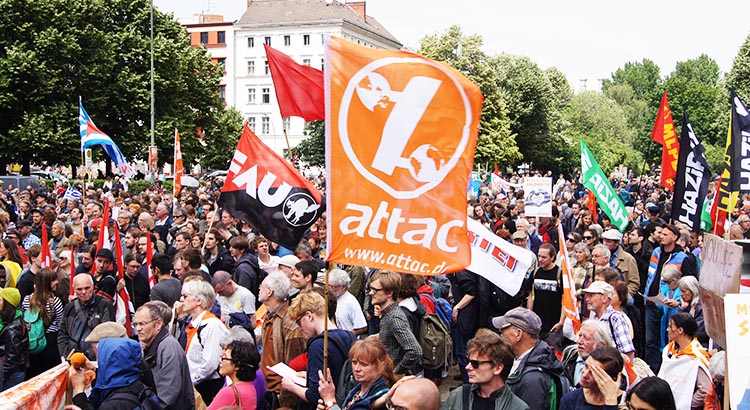
Photo: Attac

The second majority text ‘Social upheavals, fightbacks and alternatives” notes that the struggles by different groups in society for democratic rights, including the ‘global justice’ movement, takes place – “in a situation where an “international workers’ movement” no longer exists.”

It goes on to say that “refusing the consequences of capitalist policies does not automatically provoke an anticapitalist consciousness. The social identity of workers does not create a class identity as such.”  It asks “what is the capacity to include these struggles in a strategic political programme of radical challenge to capitalist society, the oppressions it has created or restructured?”

Again, as in the first document, the text starts from movements outside the main working class movement and considers its needs rather than from the working class itself, its class interests and its struggles.

Here, however, this is not the main point I want to make, for the weakness is less prominent in this text.  The paragraph quoted contains important truths, including that “refusing the consequences of capitalist policies does not automatically provoke an anticapitalist consciousness. The social identity of workers does not create a class identity as such.” (If we interpret the latter as a real socialist consciousness.)

The document correctly notes the numerical increase in the world working class, which rather raises the question how this could have happened without much expanded capital accumulation, and since the first document describes the world situation as one of permanent crisis and is unsure whether we have been living in a long period of stagnation.

Yet, while noting that wages have stagnated in the old industrialised countries it cannot deny that in new areas of production, and especially in China, real wages have increased.  Again, however, we have the curious counter-position of state and corporate power, as if they were in some sort of opposition when it comes to workers’ rights.

And again, it is unclear what processes it thinks are going on. For it states that:

“The overall picture is that of a world undergoing massive changes in many regions with an increase of the number of wageworkers bringing about significant social upheaval. This is happening at a time when economic development is not occurring alongside nation-states developing structures and services able to ensure better living conditions. Exactly the opposite in most cases; we observe a worsening of daily living conditions in many ways, aggravated in many regions by war and climate change.”

Yet it also states that:

“Quantitatively, the working class is constantly growing. It should be noted that its centres of growth have strongly shifted to Asia, probably tomorrow to Africa. In these areas the development of trade-union forces follows numerical growth, the growing social weight of wage workers, lay the bases for class consciousness but in general they do not have the strong political structures that provided a political backbone to the European labour movement, although the contradiction in that model was to often to delegate ‘political’ questions to political parties.”

“Powerful workers’ struggles are still taking place not only in the old industrial countries, in Latin America, but also in South Africa and Sub-Saharan Africa, in Turkey, in the Indian Subcontinent, and in Asia.”

“But in the era of globalization the need for trade unions to take up broader issues including racism, all forms of discrimination and housing has become greater and a spur to radicalization.”

From this it proposes a number of tasks for trade unions, including:

“to take into account the reality of precarisation in all its forms and therefore stimulating and creating the structures to organize all those concerned, in particular by the development of structures beyond enterprises, in the zones of industrial activities, neighbourhoods and localities” and “the imperative need to co-ordinate this organizing on an international scale, relying on the actual networks of the production chains in which the workers are competing against each other. “

It also proposes “the pressing need to create, out of the struggle for rights, a class identity providing resistance movements the programmes necessary to challenge the capitalist structures of society and to carry through a project of overthrowing this system.”

It does not however take on board and develop the remark in the first majority document, that it is necessary “to find more permanent forms of action”, seemingly a recognition that the creation of working class identity, class consciousness and organisation is not simply a result of episodic struggle, and not even of the lower level of continual struggle that is inevitably “reformist” in character, and often too summarily dismissed by ‘revolutionaries.’

Here, it must be noted that trade unions are not a “permanent form of action” in the sense of an international movement, although this is an objective to aim for. As representatives of fragments of the working class, and not the whole, engaged in sectional struggles that can only temporarily push back against the competition of workers as they sell their labour power, they are engaged in “guerrilla fights” as Marx put it, and not against the wages system as such, although they can be schools for such a struggle.

Such a criticism may seem premature and inaccurate, because immediately following the identification of the need for struggle and resistance movements there is a section on just such a mode of self-organisation that may be permanent, one with the potential to advance and secure working class consciousness and organisation – workers’ cooperatives.

The document notes the rise of production cooperatives as part of workers’ and peasants’ resistance to economic crises, and it notes correctly that “these experiences, albeit limited, put forth the question of control, of workers taking back the means of production, and also the choice of production linked to social needs.”  In other words, they provide the material foundation for the working class to appreciate the need for, and their capacity to create, the basis of a new society in opposition to capital and its state.

Unfortunately, the lessons of the experience referred to are not developed, so their role in a transition from capitalism and their potential to form a transformational mechanism to socialism is not appreciated. A different document submitted as part of the debate does however directly address the question and we shall discuss this in a later post.

Instead however, we again have a focus on the tasks of the small revolutionary left, its concerns and its potential for growth, rather than an analysis of the development of the working-class movement as a whole and how Marxists can play a part in this development.

Without this development, not at all reducible to the influence of small groups or to Marxism as a set of ideas or political practice, there is no viable perspective for this Marxism or its adherents.

The failure of such an approach is reflected in the acknowledged frustration of the small revolutionary organisations (SWP, SSP, LCR/NPA) and the organisations of the world justice movement (WSF and ATTAC).  It is noted once more that “Struggles for democracy and social justice as such do not automatically lead to a struggle for the overthrow of the systems of oppression.”

So, it is impossible to understand why in the same section it is stated that “we must address new challenges in the construction of an international revolutionary movement, an anti-capitalist movement based on the defence of rights and social justice.”

The failure of the perspective of attempting to build revolutionary organisations out of struggles for “democracy and justice” is hardly surprising.  In my series of posts on Marx’s alternative to capitalism (starting here) I have begun to point out the contradictions within capitalism out of which its overthrow and replacement can be built.   Such an alternative understanding of Marx and his approach is not the basis of the perspectives put forward by the FI for building a working-class party.

The third majority document addresses the role the Fourth International sees for itself, the tasks it should set itself and is the subject of the next post.

Back to part 1

Forward to part 3

Karl Marx’s alternative to capitalism part 10 – crises and contradictions iV

aaeb3f49f0044521a0b0904c2599b84b_18In 1921 Leon Trotsky argued that “If the further development of productive forces was conceivable within the framework of bourgeois society, then revolution would generally be impossible. But since the further development of the productive forces within the framework of bourgeois society is inconceivable, the basic premise for the revolution is given.”
I will argue against this view but it should not be taken that by this Trotsky believed that any particular country had to have fully developed capitalism before socialist revolution could succeed because obviously his theory of permanent revolution argued precisely that this was not the case. The argument just presented is a view of the world taken as a whole and not any particular country.

In his view capitalism could break at its weakest link but this is not Marx’s theory of the transition to socialism.  For capitalism not only to break but be replaced by socialism it is necessary that capitalism be broken not where it is weakest but where the working class is strongest, and the two are not the same.

The view that the productive forces have to have exhausted themselves has been a default view of much of the Marxist movement since 1938 and the writing of the Transitional Programme, which was called ‘The Death Agony of capitalism and the tasks of the Fourth international’.  Adherence to this view means accepting that we have been living during a period of capitalism’s death agony for the past nearly 80 years.

It is this that justifies the view that objective conditions make the world ripe for socialism and that what faces socialists is a crisis of working class leadership. The task is simply to fight for leadership of the working class as it presents itself; its objective position and situation within society is relevant only in so far as it lends itself to gaining such leadership.  Since capitalist crises cannot be definitively solved by capitalism then such crises provide the opportunity for Marxists to win this leadership.

Those who have read earlier posts in this series will know that I reject the view that the productive forces of capitalism have stagnated.  This view was certainly challenged by the post Second World War economic upturn.  Crisis conditions in the 1970s and 1980s might have revived the view that capitalism was in long term crisis but the period since has seen huge economic growth.

Again the view that capitalism is in crisis might be bolstered by the financial crash in 2008 and the secular stagnation following it that has been posited by some writers but such crises do not amount to the long term crisis of capitalism suggested by Trotsky and secular stagnation has yet to be demonstrated.  If it were, it would still not amount to the long term crisis of capitalism that has been claimed, except that stagnation is not compatible with capitalism and if it existed it would create conditions of crisis.  

In previous posts I noted that capitalism had continued to develop the productive forces over the last century, including the expansion of the working class, its health and education and also its living standards.  Of course this does not mean that the next century will follow the pattern of the last.  This is as unlikely as the twentieth century following the pattern of the 19th, but it is at least necessary to appreciate what has already happened before thinking we are qualified for the much more hazardous task of speculating on what will happen in the future.

Incheon01

A recent article in ‘New Left Review’ notes that:

“Our available economic resources are greater than ever before. Between 1980 and 2011 world GDP per capita (in constant prices and purchasing power parities) increased 1.8 times, the IMF reports. As a comparison, we may remember that between year 1 and 1820 global product per capita is estimated to have increased 1.4 times, and from 1870 to 1913 1.7 times. More reliable are figures for 1950–73, 1.9, and for 1973–2003, 1.6.”

In his book ‘Postcapitalism a Guide to Our Future’ Paul Mason quotes figures that show global GDP per person rising by 162 per cent between 1989 and 2012 and in the developing world by 404 per cent.  It rose by ‘only’ 33 per cent in the 100 years after the ‘discovery’ of the Americas and by 60 per cent in the fifty years after 1820.

Of course, this is not to deny the growth of inequality and ecological threat arising from the capitalist nature of such growth, how could it be otherwise?  Paul Mason notes that while the real incomes of two thirds of the world’s people rose significantly, as did that of the top 1%, the majority of people in America, Japan and Europe had no real increase and some a decline.  As the article in New Left Review notes:

“Furthermore, the conventional norm of progress obscures the unequal distribution of its opportunities. Almost half, 46 per cent, of the world’s income growth between 1988 and 2011 was appropriated by the richest tenth of humanity.  In the US, since the late 1990s, there has been a progressive decoupling of GDP per capita—advancing with short-lived fallbacks—and the family income of four-fifths of the population, which has been stagnating and recently declining, above all from the median and below. The spread of the Anglo-American financial crisis of 2008 has meant a substantial decline in the income share of the bottom 40 per cent in the recession-hit European countries, from Greece and Ireland to the UK and Spain.”

One Marxist[i] makes a persuasive case that the official figures underestimate the growth of specifically capitalist production because they ignore the conversion of the Stalinist states to a new economic system.  These figures treat the production in these states prior to the introduction of capitalism as if it were already capitalist but this ignores the boost to specifically capitalist production of the acquisition of productive forces on the cheap and the availability of huge pools of labour power that can now be exploited to further the accumulation of capital:

“In 1991 the centrally planned economies had a population that was 35 percent of that in the market capitalist economies. The restoration of capitalism in them massively increased the world’s working class that could be exploited by capital, while at the same time the world’s capitalists paid almost nothing to privatize the assets of entire economies. . . .By 2006 China, now the second largest capitalist economy in the world, employed 112 million industrial workers (Bannister 2009), not including millions more in the former USSR and CEE.”

“During the 1990s capitalist production of electricity rose 44 percent, aluminium 45 percent, hydraulic cement 60 percent, steel 39 percent, automobiles 21 percent, and GDP 42 percent, with the rate of increase accelerating the decade after. This is particularly significant as this period extends to 2010 and so includes the period of the credit crunch recession after 2008. The growth of output in the emerging markets has been combined with the accelerated decline of industrial output in the West, but this is a transfer of production, not its disappearance. By 2010 the transition economies as a proportion of total capitalist production produced 29 percent electricity, 52 percent aluminium, 65 percent hydraulic cement, 53 percent steel, 30 percent automobiles, and 26 percent of GDP.”

It is hardly credible that the objective and subjective conditions for socialism could be bifurcated for so long – that the problem is simply one of mis-leadership – while the social and political power of the capitalist class over the working class, effected by the enormous development of capitalism, reflected also in the ideological hold of the former over the latter, can be considered a secondary matter.

That this continuing subordination of workers by capitalism for decades, without challenge in any fundamental respect, could be considered not to have affected the consciousness of new generations of workers, were it true, would prove Marxism false.  The idea that the fundamental problem is simply one of working class leadership is not credible.

Marxists are always keen to assert that they do not seek crises and do not welcome the attacks on workers which large crises inevitably result in, including unemployment, wage cuts and attacks on workers’ democratic rights to organise.  But if crises do provide the opportunity to replace capitalism, and the grounds for socialism already exist, then this would be something of a puzzle.

In part we have already noted the answer – that crises openly express capitalism’s contradictions and posit the need for an alternative.  However, it matters not whether socialists wish or do not wish for crises, capitalism will see to it that they erupt anyway.  It is not workers who create economic crises but the contradictions of the system itself.

Socialists do not welcome crises in themselves because they become opportunities to overthrow capitalism only under certain conditions.  Since capitalism has had many crises and we do not have socialism we can infer that these conditions are rather restrictive, or have been so far.  Is there anything in Marx’s alternative that explains why this has been the case and therefore what might we change to address our failures so far?

An answer to this means going beyond seeing capitalist crises as simply the opportunity to overthrow capitalism without understanding what makes them such an opportunity, as opposed to an opportunity for capitalism to resolve its contradictions at workers’ expense.  The answer does not lie in the illusion that capitalism is a system in permanent crisis or is in an epoch of revolution. Crises there have been and even revolutions but clearly this hasn’t been enough for Marx’s alternative to have flowered.

The last 100 years has witnessed many revolutions.  The most important at the beginning of the last century were carried out under the banner of socialist revolution but they nearly all failed very quickly.  Later revolutions that destroyed capitalism did not usher in socialism or even societies controlled by workers taking decisive steps towards socialism.   The belief was widespread that socialist revolutions would be complemented by national liberation struggles which would lead to democratic revolutions, but again there were numerous democratic revolutions, few overthrew capitalism and none of them brought about socialism.

Since the decline of such struggles the most important revolutions have involved the overthrow of Stalinism and the concomitant reintroduction of capitalism while the Arab Spring has not resulted in any fundamental reordering of society, except in the sense that in some societies it has led to their disordering and collapse.

There have been plenty of revolutions but the changes have been mainly one of political regimes without fundamental changes to class rule, at least in the sense of the working class ruling society.  Such glimpses of a new worker-controlled society have been brief and fleeting.

Marx’s prognostication was that “the bourgeoisie cannot exist without constantly revolutionising the instruments of production, and thereby the relations of production, and with them the whole relations of society. Conservation of the old modes of production in unaltered form, was, on the contrary, the first condition of existence for all earlier industrial classes. Constant revolutionising of production, uninterrupted disturbance of all social conditions, everlasting uncertainty and agitation distinguish the bourgeois epoch from all earlier ones.” 

The history of modern revolutions is testimony to this.  The absence of working class revolution is not.  Ironically, if you seek to reduce Marxism to a task of resolving a crisis of leadership you weaken its explanatory power, its guide to political intervention and its appeal.

Marx was aware that sometimes decades of political development are necessary for a working class to make itself capable of ruling society.  This is true now for reasons that Marx could not be fully aware of.  What he did do however was provide analyses of capitalism that may help socialists appreciate why we have failed so far.

[i] On the Alleged Stagnation of Capitalism, William Jefferies, available on the net.

Back to part 9

Forward to part 11

Does capitalism still have a civilising mission? Marx’s alternative – part 4

huajian-shoe-factoryIn the last post on Marx’s alternative to capitalism I noted that he extolled the achievements of capitalism, without which socialism could not be built.  In the Grundrisse he noted “the great civilizing influence of capital; its production of a stage of society in comparison to which all earlier ones appear as mere local developments of humanity and as nature-idolatry.”

This is very far from the attitude of most Marxists today, who have a tendency to see crisis and decline everywhere.

Perhaps, as might be implied from the quote above, the progressiveness of capitalism is only in relation to previous society, and that today it is a wholly reactionary system from which no development is possible or at least none with any progressive features.  Its replacement must therefore arise from its contradictions and crisis and not from any progressive element within it.

The days of the progressive development of capitalism are over.

The Communist Manifesto is famous for its paean of praise to the wonders of capitalist achievements, and this at a time when capitalism hardy existed on most of the globe – “It has been the first to show what man’s activity can bring about. It has accomplished wonders far surpassing Egyptian pyramids, Roman aqueducts, and Gothic cathedrals; it has conducted expeditions that put in the shade all former Exoduses of nations and crusades . . . The bourgeoisie, during its rule of scarce one hundred years, has created more massive and more colossal productive forces than have all preceding generations together. ”

But perhaps again this praise is purely relative to earlier epochs.  Capitalism has exhausted any progressive content it once may have had.  After all, didn’t Lenin refer to the highest stage of capitalism and did Trotsky not say that:

“the economic prerequisite for the proletarian revolution has already in general achieved the highest point of fruition that can be reached under capitalism. Mankind’s productive forces stagnate. Already new inventions and improvements fail to raise the level of material wealth . . . The objective prerequisites for the proletarian revolution have not only “ripened”; they have begun to get somewhat rotten. Without a socialist revolution, in the next historical period at that, a catastrophe threatens the whole culture of mankind.”

That catastrophe did of course arrive in the shape of the Second World War and the potential for catastrophe undoubtedly continues to exist within capitalism today.  The decline of the United States and the rise of new powers once again raise the spectre of economic competition that may drive rival nation states into war.

A couple of weeks ago I was reading the Guardian review of books and a review of a book by the BBC correspondent Mark Urban, who argued that new powers are developing conventional forces that can begin to rival those of the US. This means that in any conventional conflict the US may be tempted or driven to use nuclear weapons.  It’s not as if they haven’t used them before.

“Now, says Urban, Russia, China and India have such strong conventional forces, and America has cut its forces so much, that in the event of a conflict “the US would be left with the choice of nuclear escalation or backing down”.  He adds: “Against a full-scale invasion of South Korea, the US would have little choice but to go nuclear.” Russia, China, India, Israel, Pakistan, North Korea and some other countries could “mount a credible conventional defence that would leave the United States having to think the unthinkable, with profound implications for the world”.”

While there is a lot more to say about such a scenario the point is that under capitalism humanity has no rational control of its own development and no guarantee against the most irrational acts leading to its destruction.

However the view noted above – that capitalism can no longer be viewed in fundamentally the same way as Marx did in the 19th century is mistaken.

Straight after noting capitalism’s wonders far surpassing the Egyptian pyramids, Roman aqueducts and Gothic cathedrals Marx states that “The bourgeoisie cannot exist without constantly revolutionising the instruments of production, and thereby the relations of production, and with them the whole relations of society. Conservation of the old modes of production in unaltered form, was, on the contrary, the first condition of existence for all earlier industrial classes. Constant revolutionising of production, uninterrupted disturbance of all social conditions, everlasting uncertainty and agitation distinguish the bourgeois epoch from all earlier ones.”

So the development of society continues under capitalism and the imperative to accumulate unpaid labour means the continued development of the forces and relations of production and growth of the working class.  As I will show in the next post this continues to require the phenomenon of the ‘great civilising influence of capital’ because if it did not, the development of capitalism would be away from a possible socialism and not towards it.

A working class more and more exploited and oppressed, more and more demoralised, despite the massively increased social division of labour and the cooperation required for it to function; and despite the undreamed of development of technology, would patently be unable to put itself forward as the new rulers of an even more advanced society.

A purely reactionary system without fundamental contradictions out of which a new society could emerge would not be that investigated by Marx.  A contradiction-ridden system on the other hand will combine development with retrogression, the potential for the new within the embrace of the old.

Crises will occur and must occur in some way if a new society is to be given birth out of the old but the nature of this crisis must be one that allows a new society to fully develop and not simply represent a process of decline of the old.  Under capitalism it is not crisis that create the contradictions of capitalism but crises which are the means of expressing these contradictions and resolving them in whatever way and for whatever period of time.

The importance of acknowledging this is apparent when we consider the ‘new’ phenomenon of anti-capitalism, as if being anti-capitalist is inherently progressive.  In the Communist Manifesto Marx was able to analyse various types of reactionary socialism, and various types of this exist today.  Much of the left is keen to retreat into nationalism and older forms of capitalist development in response to capitalist crises in their latest form, buttressed by the idea that there can be nothing progressive in its current development.

We see this today in much of the left’s opposition to the Euro for example, as if the drachma or punt were some sort of positive alternative.  In Ireland the nationalist and republican tradition has allowed many leftists to seek progress through assertion of a ‘national sovereignty’ that is simply impossible to achieve even if were desirable.

All seem to have forgotten that socialism is not the resistance of the working class to capitalism, which can continue ‘forever’ if it does not involve an alternative, and this alternative is a higher form of society, not a retreat into the past.

In the next post on Marx’s alternative I will look at the evidence that the development of capitalism that Marx thought provides the grounds for socialism continues to exist.

Back to Part 3

Forward to Part 5