The enemies and friends of Palestinian Liberation (1)

The hypocrisy and cynicism of Western imperialism is nauseating.  Biden, Sunak, Macron and Scholtz, not to mention von der Leyen all visited Israel to express their solidarity with the Zionist regime that over the last few decades has made it clear that the political solution these politicians claim to support is dead.  The seizure of land on the West Bank by settlers and killing of those getting in their way destroys any illusions that a two-state solution is remotely being considered.  This, and the increasing Zionist violence inflicted on the Palestinian population, is part of the explanation for the armed action of Hamas.

This was roundly condemned by these leaders whilst Israel had already begun to commit mass murder and destruction in Gaza.  The rest of the world is supposed to be brow-beaten into acceptance of this ethic cleansing through demands that they accept Israel’s ‘right to self-defence’, a right never invoked on behalf of the Palestinians.

As they became aware of mounting horror and opposition to the Zionist regime’s exercise of this ‘self-defence’, they called for humanitarian relief for the imprisoned population in Gaza, with Biden claiming he had won such a concession, before he cleared off back to the US to announce proposals for a $105 billion package of support for Ukraine’s war against Russia and Israel’s mass murder.

The cheque given to Israel, to ensure it could afford its mass killing, was underwritten by endorsement of its murderous siege, with the fig leaf of the opening of the border to Egypt of some relief from the blockade of food, medicine, water and fuel. The population of the north of Gaza was told to move south, as if this was a move to safety and access to humanitarian aid.

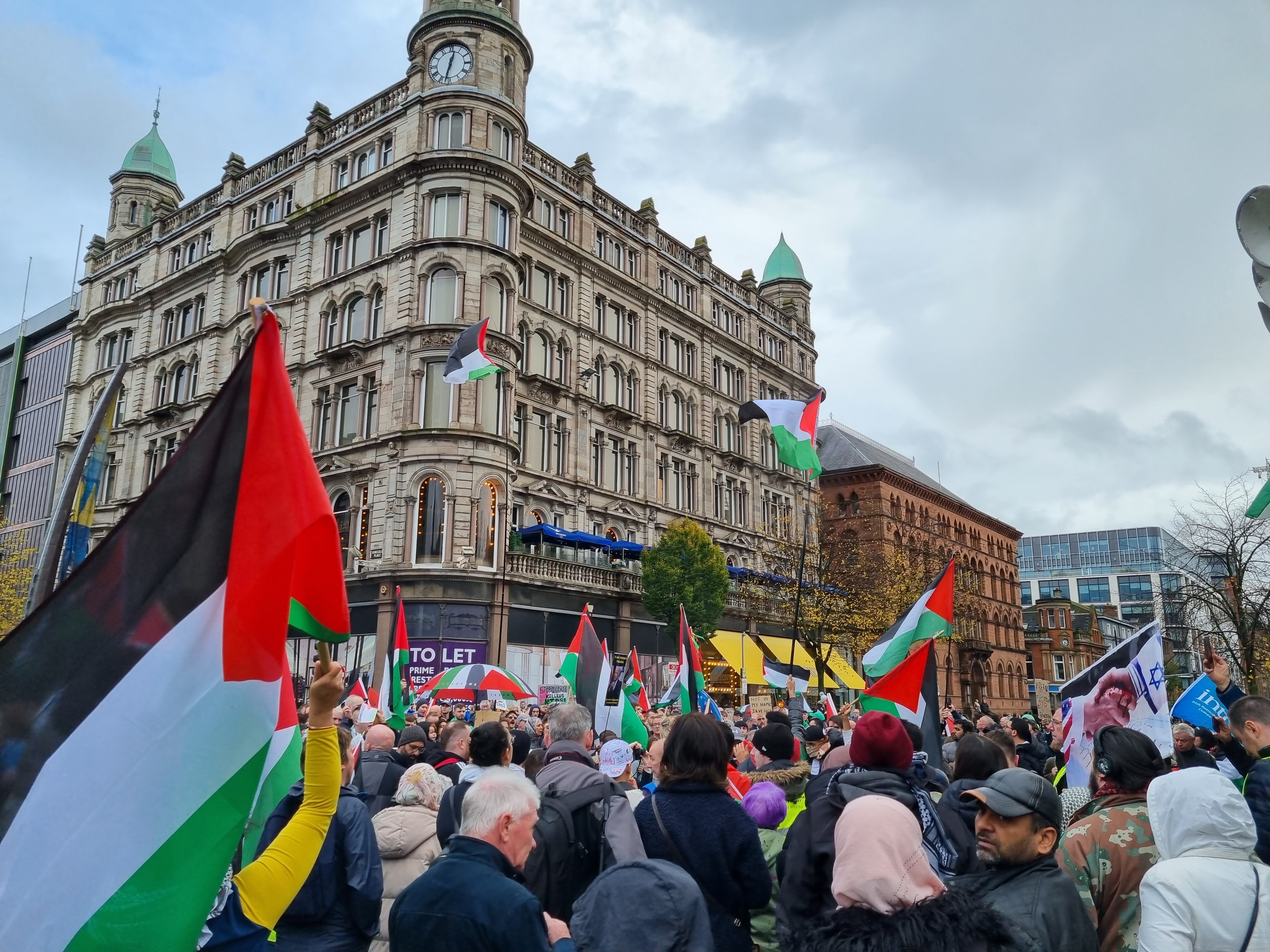
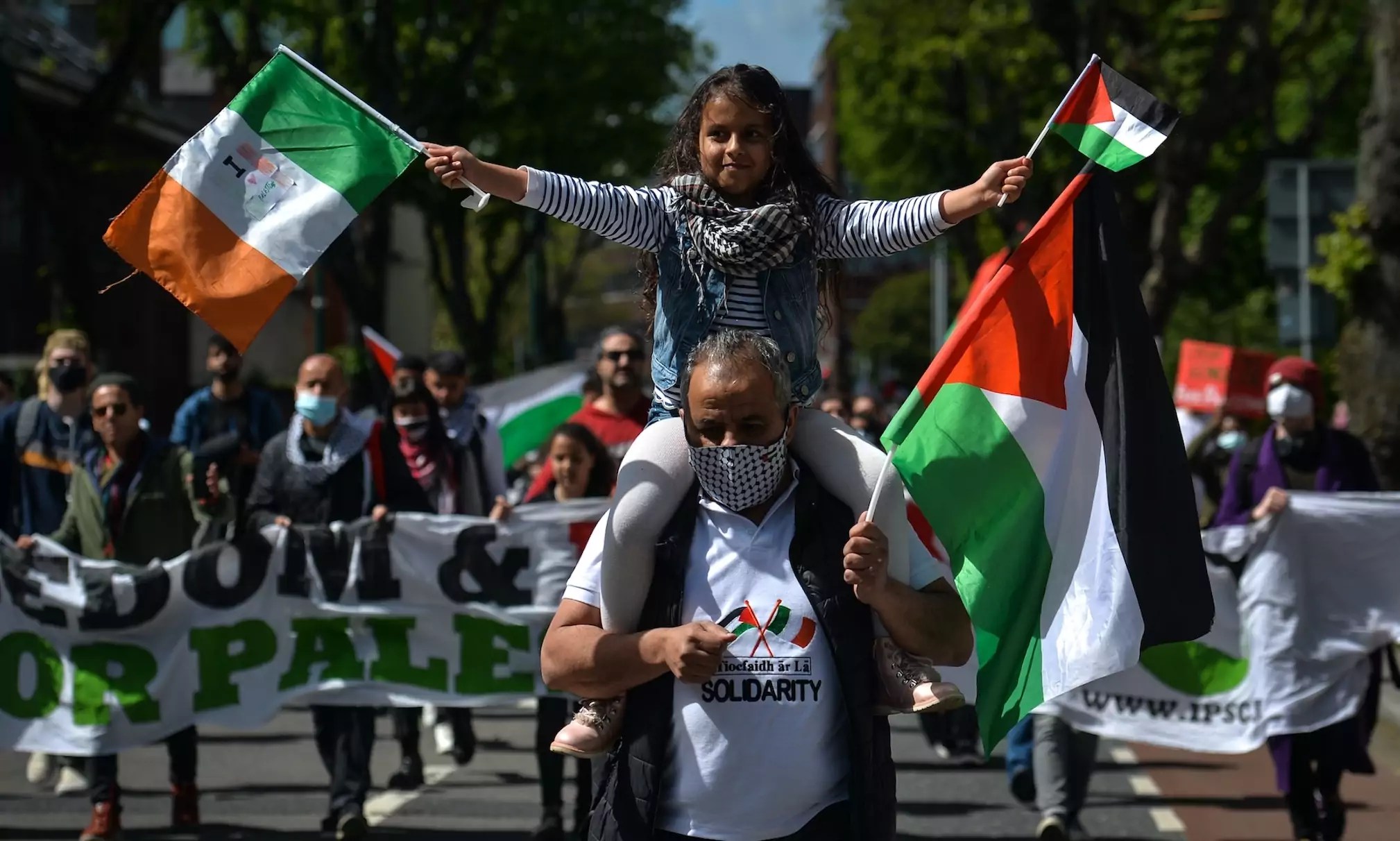
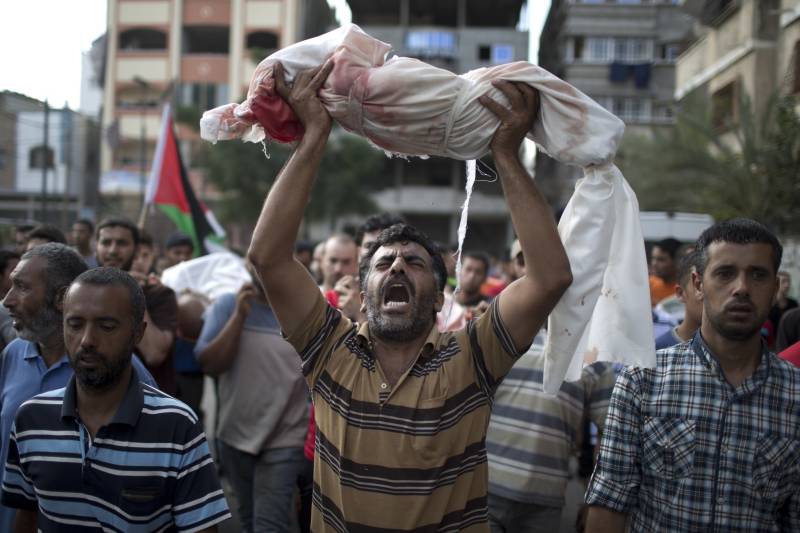
Moving south, they were bombed and have met with such pitiful amounts of help it is cynicism of extraordinary proportions.  The promise of relief by Biden was as much a part of the war on the Palestinians as the endorsement of ethnic cleansing.  The sending of aircraft carriers and other battleships by the US and Britain is a signal that the pogrom being carried out by Israel will receive their protection.  The mass protests, despite the propaganda of the capitalist media and threats of prohibition, demonstrate that in many imperialist countries working class people do not swallow the cynical policies of their leaders.

This demonstrates that the Zionist regime is increasingly no longer regarded as an innocent victim and that many want to express their support for a people subject to unimaginable oppression.  Opposition to the Zionist state is growing in the West but even this short resume of what has happened in the last few weeks reveals a bigger picture.

While the focus of many has understandably been on the immediate death and destruction meted out by the Zionist state, the actions and words of Western imperialism reminds us that the question of Palestine is not only about Palestine.  Israel is a settler colonial state sponsored by western imperialism, although also supported upon its creation by the Soviet Union, a testament to the reactionary nature of Stalinism.

The tyrannical Arab regimes are likewise creations of Western imperialism, which determined the borders of their countries for its own purposes.  Having just read some Marxist analysis of the Palestinian struggle from the early seventies, I was reminded that one such regime turned on the Palestinian movement and crushed it within its borders, in Jordan in 1970.  The recent recognition of Israel by the United Arab Emirates, Sudan, Morocco, and Bahrain, demonstrates again that these regimes are utterly reactionary.  Just before the latest events Israel was in negotiations to normalise relations with Saudi Arabia, which no doubt would have had some empty and worthless gestures towards the Palestinian ‘problem’ as part of the deal.

From the point of view of these regimes the Palestinian people are indeed a problem – that their populations are bitterly opposed to its oppression while they seek to advance their state interests, including through improved relations with the Zionist state.

In the past these Arab states were so weak, venal and corrupt that their subordination to Western imperialism was abject.  Their support for the Palestinians involved sponsoring their organisations as mirror images of themselves, cut down as in Jordan in 1970 when they became too big and powerful.  While these regimes have grown stronger and US imperialism has declined, so increasing their room for manoeuvre in protecting their own interests, these interests do not involve saving the Palestinians.

It is not a coincidence that the major opposition to Israel and immediate potential support to the Palestinians comes from a non-Arab regime–Iran–which is opposed by US imperialism and the Zionist state because it has asserted its own interests against them.  US imperialism has attempted to reverse its decline by provoking conflict, including marshalling its subordinate allies across the world in economic and military conflict with the enemies that might benefit most from its eclipse.

This has involved the proxy war in Ukraine against Russia, further expansion of its military alliance in Europe, and expanding economic sanctions against China.  The assertion of US authority in the Middle East through full commitment to Israel is part of the attempt to protect its imperial role in the region.  The opposition of Iran, the more muted opposition of the Arab regimes, and the increasing role attempted by China are all regional aspects of the ratcheting up of imperialist competition and conflict across the world.  The Palestinians in Gaza are currently in the maelstrom of all this, symbolised and made vital by Biden’s proposal for a $105 billion package to support Ukraine’s war and Israel’s mass murder.

Forward to part 2

The Ukrainian Solidarity Campaign and Palestine- bankrupt opposition to imperialism

How often have we heard from the supporters of Ukraine that we should listen to the words of the Ukrainian left, as if their nationality or proximity to the war privileged their political views and pre-empted our own?  Should we contract-out our politics to every nationality?  What is this other than identity politics gone mad?

The Ukraine Solidarity Campaign (USC) has one such author we should apparently listen to, writing not about Ukraine but about Palestine (is this not a breach of the decree?)  Or do the Ukrainian leftists who support their own state have some special insight into all struggles that claim to be ‘anti-imperialist’?

Let’s look at what this article says: ‘Side with progressive forces in Israel and Palestine for a lasting peace’.

It declares that:

‘On October 7 a new round of the Palestinian-Israeli confrontation began with rocket fire by Hamas. The whole world turned its attention with horror to the atrocities of terrorists against peaceful citizens of Israel and other countries. However, for now, while everyone is debating the need to strike back as hard as possible, progressive forces around the world should focus on a plan to achieve lasting peace.’

Just as the war in Ukraine did not start on 24 February 2022, so did the conflict in Israel and Gaza not start on October 7 2023, as everyone knows, or should know, because it is literally impossible to understand either by reference to these dates, by regarding them as providing the context for comprehension of what is going on.

The whole world did not turn ‘its attention with horror to the atrocities of terrorists against peaceful citizens of Israel and other countries’; for a start the attack by Hamas also included attacks on the Israeli military.  This is not to ignore or excuse or support or defend the killing of Israeli civilians.  Among many people there is an understanding of where these desperate (in every sense of the word) attacks came from.

Neither is ‘everyone . . . debating the need to strike back as hard as possible’.  Certainly not the targets of this ‘strike back’, not those who are genuine socialists, and not those hundreds of millions who understand the circumstances of the Palestinians in Gaza and who sympathise and solidarise with them and their struggle.  Only from the point of view of Zionism and western imperialism is there a debate about how hard to strike back.

‘For now’, the progressive forces around the world should not ‘focus on a plan to achieve lasting peace’ but should focus on how they might stop the pogrom and ethnic cleansing of Gaza that can only entail a murderous catastrophe.  To think that right now we need a plan for lasting peace is to indulge in cynical pretence, putting one’s head down while death is dealt all around.

The article states that ‘Israel has the right to self-defence and can retaliate against terrorists’, while Its concern with Israeli tactics seems mainly to lie in their being counter-productive, not their purpose or consequences. Even the failure of previous negotiations is blamed mainly on the Palestinians.

It declares that ‘the international community should support progressive forces willing to make concessions for the sake of peace’, the same international community that has sat back while Israel has expanded while ensuring the expansion through massive financial and military support.  The same ‘international community’ that any self-regarding socialist would immediately recognise as imperialism.

It states that ‘the international community should promote the creation of new progressive political movements in Palestine that would not involve either the corrupt Fatah or the Iranian-backed Hamas terrorists.’  Imperialism is called upon to intervene to ensure that the Palestinians get the leaders and representation that they deserve – what imperialism thinks is appropriate.

No such exclusions are put on the far right, racist and fascist representatives of the Israeli state.  These so-called ‘new progressive political movements in Palestine’ should then ‘be willing to make concessions for the sake of peace.’  One has to wonder just what more concessions the Palestinians are expected to make to remedy their exile, their poverty, prevent their ethnic cleansing and make themselves acceptable both to imperialism and Zionism. 

What is the point of a solidarity campaign that claims to be anti-imperialist but cannot agree what imperialism is and so cannot agree on when or why or how it should be opposed?

A separate article on the USC site denounces ‘the anti-social ferocity of Ukrainian neo-liberals’ and states that ‘the recent statements of Minister of Social Policy Oksana Zholnovych about “destroying everything social” and “taking Ukrainians out of their comfort zone” have caused significant public outcry and a wave of criticism.’  But this is the same government and state that the Ukraine Solidarity Campaign supports, that defends its right to determine the future of its population!  The State and regime it wants to see armed to the teeth and have its writ run over millions more citizens.

The pro-Israel article is probably inspired by the Alliance for Workers Liberty (AWL) component of the USC, while its Anti-Capitalist Resistance (ACR) ally has stated that ‘The root cause of the violence is the occupation of Palestine by the Israeli state. Palestinians have borne the brunt of the death and destruction of the last 75 years.’  Yet this organisation supports the western powers without which its favourite capitalist state would already have been defeated.  It supports the intervention of these powers that have for the ‘last 75 years’ helped ensure the continuing destruction of the Palestinian people.  It needs the military support of the United States that is also siting off the coast of Gaza. No doubt the AWL, in turn, thinks the ACR is defending reactionary terrorism.

While the pro-imperialism of the AWL is more consistent this hardly makes the inconsistency of the ACR any better and neither is capable of a principled socialist approach.  How they can maintain a united campaign against ‘imperialism’ is not really hard to understand. If articles defending the Zionist state are acceptable for the USC then this is entirely appropriate to the politics of such a campaign and both components.

They deserve each other.

Solidarity with Palestine

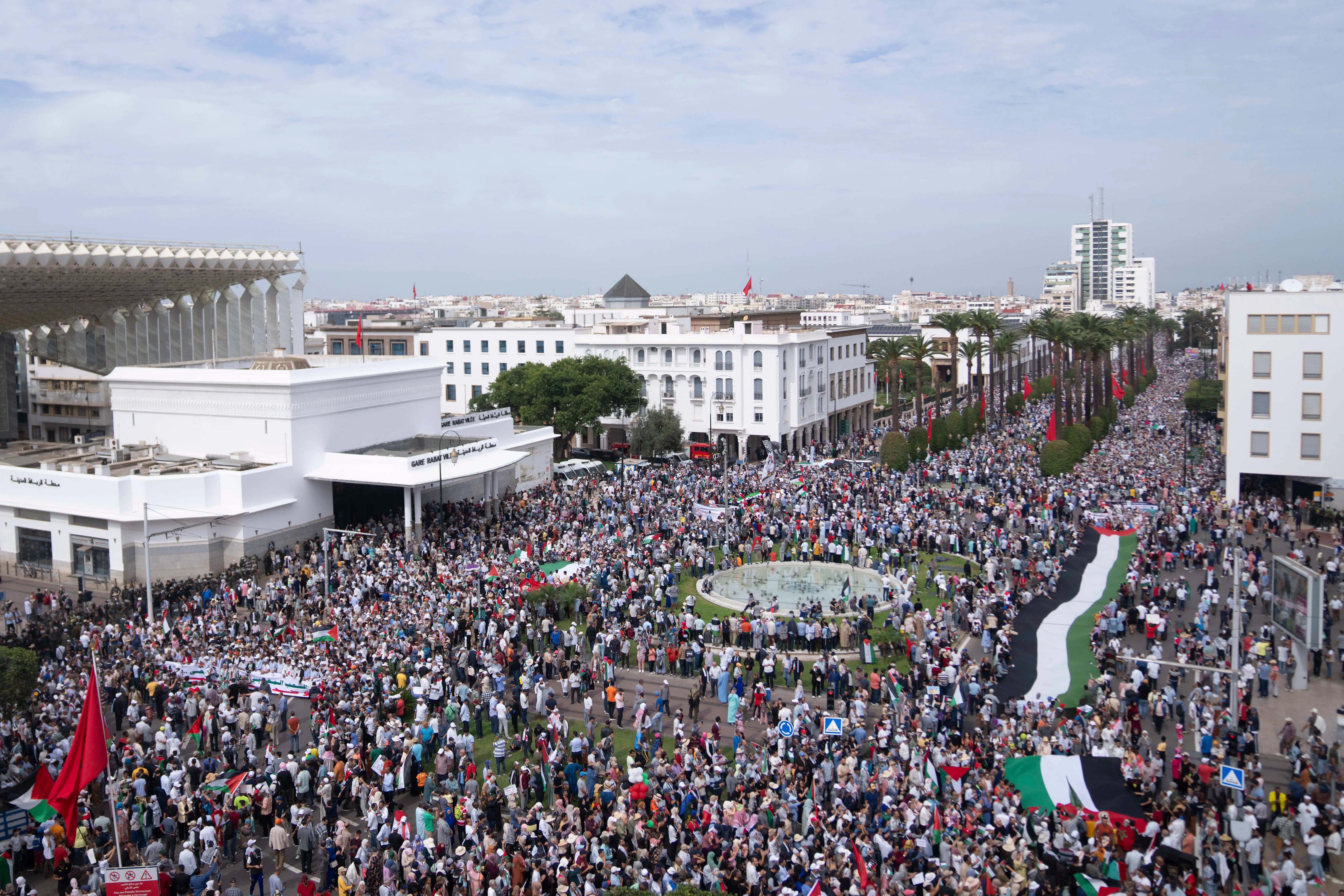
Thousands of Moroccans take part in a protest in solidarity with Palestinians in Gaza, in Rabat, Morocco on October 15, 2023. [Mosa’ab Elshamy/AP Photo]

Immediately after the Hamas attack the political leadership of the Israeli state made it clear that the rules of war were to be ‘abolished’ and their fight was against “human animals.”  The bombing of Gaza and the blockade on fuel and water entering it is a clear war crime, involving collective punishment on a whole population that can have only catastrophic results.

While Netanyahu threatened that “what we will do to our enemies in the coming days will reverberate with them for generations”, Western leaders sanctioned the unfolding ethnic cleansing by endorsing Israel’s ‘right to self-defence’, writing it a blank cheque that would be written in blood.  The language of the West was scarcely less uncompromising than that of Israel itself.

In the last couple of days these western leaders have recovered their composure and have reverted to their customary lies and hypocrisy, still supporting the Israeli offensive but calling for it to respect international law.  In doing so they still stand by the Israeli demand that half the Gaza population move south so that its army can occupy the North. Its fig leaf of concern is expressed in the call for Egypt to open up the border crossing into its territory to allow Palestinians to escape the pogrom.  There is no call for Israel to open up the border crossings into Israel itself, exposing their newly found humanitarianism as a cover for ethnic cleansing.

Their shift to sanctimonious and empty rhetoric from open and eager endorsement of war crimes does not stem from a sudden awareness of the scale of Zionist revenge but from the revulsion of many in the West and in the rest of the world to the Israeli pogrom.  They thought that abhorrence at the Hamas slaughter and the propaganda of the mainstream media would allow them to subdue and intimidate opposition to Israeli revenge, which many understand is simply an extension of the existing policy of destruction of the Palestinian population.

In Britain, Germany and especially France, governments took steps to threaten and ban demonstrations in support of the Palestinian cause, which over the weekend have failed.  Almost the whole spectrum of bourgeois political opinion showed itself out of touch with much of its population – open endorsement of the brutality of the Zionist state was not acceptable.  A too open display of hypocrisy could not be allowed to congeal and become hardened into real comprehension of their rulers’ policy and the bias of its propaganda vehicles.  European workers were already paying for the war against Russia in Ukraine and the promotion of support for the war and sacrifices imposed by it might be further weakened if the Israeli invasion was portrayed as legitimate and ‘good’ while the Russian was indefensible and ‘bad’.

The change of language however has not involved a change in policy, except in one respect.  A further reason for the row back from open endorsement of the Zionist pogrom is the fear expressed by some security figures in the West that the invasion of Gaza is a Hamas trap, one that the Israeli military is not prepared for.  However, the far-right Zionist government has a policy of destroying any threat posed by the Palestinian population and has rejected concessions or even negotiations.  It therefore has its own imperative to destroy all Palestinian independent capacity for resistance and will consider that the history of the Zionist state shows what it can get away with, while its current political credibility and integrity requires its own massive level of retribution.

Western imperialist interests undoubtedly align with the settler colonial Zionist state, but the US political leadership had also thought that it had achieved remarkable stability in the region because it had been making some success of the more open alignment of the reactionary Arab regimes with Israel.  The fear expressed by it now is that the war will escalate and spread if the Zionist state provokes resistance sufficient either to endanger a quick victory, or to encourage or involve other fronts in the war, in Lebanon or Syria for example.

The stability of imperialism in the region, including also of the Zionist state, requires the stability of the reactionary Arab regimes; the too open and violent destruction of the Palestinians in Gaza may provoke their populations to action and weaken the whole authoritarian structure across the Arab world.

The future of the legitimate rights of the Palestinian people does not therefore ultimately rest in the ‘Palestinian resistance’ (by which in today’s context means Hamas), but in the working classes of the whole Arab world plus Iran.  The Arab Spring and the mass demonstrations in Iran show the potential and the reality of their power.  They are the primary force that can destroy the reactionary Arab regimes that base their political stability on the subjugation of their own people and the quiescence and submission of the Palestinian population.

The Palestine solidarity movement should not politically endorse the ‘Palestinian resistance’, as code for Hamas or Fatah, but should oppose their own countries’ protection of the Zionist state and their threats to the Arab populations of other countries.  Not only should it oppose the blockade and invasion, but in the US and Britain it should demand that their escalation of the war-drive, under the hypocrisy of ‘de-escalation’, should be ended and that their war ships get out of the Mediterranean Sea.  Having exposed themselves for their too-open support for Zionist terror it should be understand that their purpose is to further support the Zionist state.

Solidarity with the plight of the Palestinians in Gaza and elsewhere requires support not simply with them, but with the working class in the whole region, the only force which has not collaborated with western imperialism and the Zionist state and which will have to overthrow its own states in the process of overthrowing the Zionist one.

Palestine and Ukraine – in what way are they the same?

The events in Gaza and Israel have driven home lessons that should have been learned long ago.  

The role of the United States and western imperialism, including the EU in joining the suffocation of the Palestinians, has again come to the fore.  Some on the left, who have defended imperialist intervention in Ukraine suddenly find themselves opposed to its role now; but they cannot both support and oppose it at the same time.  Imperialism is not being inconsistent, but this left certainly is, for it cannot will the defeat of imperialism in the Mediterranean while willing its victory in the Black Sea.  Were their actions to have the least practical impact this would be obvious.

One prominent spokesperson has paraded their confusion, writing that:

‘No less unbearable is the precipitation with which Western governments (and a Ukrainian government that ought to know better about the legitimate fight against foreign occupation) have expressed their solidarity with Israel, very much in contrast with their muted reactions to Israel’s brutal onslaughts on the Palestinian population.’

Why, among all the supporters of the Western imperialist alliance and one that formally wants to join NATO – effectively fighting on its behalf, should Ukraine “know better” than supporting Israel? Both countries are effectively tools of the United States, receiving massive amounts of military aid and political support, which is reciprocated. Why would these capitalist allies of the US not see their interests as not only compatible but convergent? After all, the President of Ukraine has said he wishes to model Ukraine on Israel!

Of course it is possible to take one’s cue from the barbarity of the conflicts but, given the censorship of Ukrainian atrocities and highlighting of those of Hamas, we can take our cue from accepting what is presented to us in the West or reject both. Either way we fail to get to grips with the nature of either.

Of course, in the case of the Palestinians there is a context which these leftists employ to explain support for them, even when their struggle is carried out by religious fundamentalists, but this leads to two obvious problems.  First, all the moralistic rhetoric about civilian deaths as illustrative of the nature of the war in Ukraine, and justifying support for it, can hardly be sustained given the killing of civilians by Hamas.  And second, the context of the Russian invasion has to be explained, and not just by the credulous notion that selective ideas of Vladimir Putin are sufficient explanation.  The idea that Ukraine’s potential membership of NATO and growing military cooperation with the US might have had something to do with the invasion has been dismissed by the supporters of Ukraine as if in this particular war western imperialism doesn’t count!

The Ukrainian shelling of Donetsk City has parallels with the Israeli shelling of Gaza City as does the political influence of the far right in both Ukrainian and Israeli politics, despite the ignorant argument that because Zelensky is Jewish he couldn’t possibly entertain and celebrate fascists in the Ukrainian armed forces.  This ignores both Israeli criticism of Zelensky’s whitewash of Ukrainian nationalist participation in the killing of Jews in World War II and the participation of far right/fascist parties in the Israeli government.  The celebration of the fascist Stepan Bandera and his Ukrainian nationalist heroes with a national holiday, street names and iconography, unmissable in Ukraine itself and in photographs of the conflict, are ignored by this à la carte left. ‘Creeping fascism’ is presented as a threat across Europe apart from the country that has armed its fascists to the teeth.

The simple-minded parallel they claim is that both Ukraine and Palestine are oppressed peoples that we should support.  Except Ukraine is an independent capitalist state supported by imperialism; the Palestinians don’t have a state and getting one through a two-state solution is a delusion; many Ukrainians support Russia, including the majority in Crimea–do they not deserve ‘self-determination’? and a solution to the problems facing the Palestinian people must also be a solution for the Jewish people, raising all sorts of questions about ‘self-determination’ as their go-to solution.

If the two situations are so simply similar, why doesn’t the pro-Ukrainian left call on imperialism to arm Hamas?  (After all, Israel itself gave it a helping hand in order to combat the PLO.) Why doesn’t it call on the Palestinians to show solidarity with Ukraine?  Or do such suggestions seem incredible and thus illustrate the difference?

Does it not show that their support for western imperialism is a betrayal of the struggle of the Palestinians?  More importantly, does it not show the incoherence of these social-imperialists – proclaiming socialism in words but unable to coherently oppose imperialism in practice – going so far as to actually support it in Ukraine?

Only a class analysis, and not a moralistic melange that cannot withstand the test of reality, provides a compass through which to orientate through the major events that have carried us through the first decades of the 21st century.  The rotten and degenerated left that supports Ukraine simply doesn’t notice that its ‘socialism’ is irrelevant.  In Ukraine it supports the capitalist Ukrainian state and imperialist support for it under the flag of self-determination, with no role required for an independent working class position.  In Palestine its supports for the Palestinian demand for its own state has again no role for a socialist programme and begs the question why they do not support Hamas like they support the Ukrainian Armed Forces, with its fascist units – the real Red-Brown alliance they continually complain about in others.

In a world increasingly polarised and drifting more and more into conflict these ‘socialists’ will pick and choose which capitalist state or nationalist movement to follow but have lost the ability to distinguish separate working class interests.  Its socialism is an ideal that, while perfect in their own heads, has no grip on reality.

Solidarity with the Palestinian people

“Shock” was the first word in ‘The Economist’ article following the Palestinian armed uprising in Gaza and Israel.  “Hamas must be made to pay for its atrocities” it exclaimed.

‘The Irish Times’ editorialised about the “appalling atrocities committed by Hamas” while stating that Israel is “not known for being proportionate or well-targeted”, which isn’t actually true.  The point of the violence of the Israeli state is complete suppression of the Palestinian population through violence and terror in which routine oppression is merely a background condition.  Its actions are proportionate to this objective and its targets are well suited to its aims.

The immediate question for the BBC was ‘how could Israel have let this happen?’  Not ‘How did it make this happen?’  How did its renowned intelligence services fail to predict it?  Not, how did they not understand that something like this was almost inevitable?

Immediately the viewer and reader is placed in the shoes of the Israeli citizen with the Palestinians as the ‘other’– one element of the stench of hypocrisy that hangs over Western commentary.  No ‘shock’ is ever recorded over the daily humiliation, oppression and murder of Palestinians by the Israeli state.  We never hear that ‘Israel must be made to pay for its atrocities’. In reality, the claimed failures of the Israeli security state to be sufficiently on top of the Palestinian people, and the “shock’’ of the “appalling atrocities committed by Hamas”, presage only more not very “proportionate or well-targeted” attacks on the open prison that is Gaza.

All the handwringing and dismay from imperialist politicians and commentators simply lay the ground for another round of Israeli terror, accompanied by sanctimonious and ineffectual declarations of ‘lack of proportionality’ and ‘targeting errors’– by those who have supported the Zionist State and its previous many ‘errors’ and ‘lack of proportion’.  The response by this state will be vicious and widespread but the media will not record this as the inevitable intensification of an existing policy that they have previously sanitised, by a state based on sectarian exclusivity and suppression of a whole people that is treated as almost less than human.  It will be considered only as unfortunate, not least for the democratic pretensions of the sectarian and racist state itself.

The US sponsor of the Israeli state, and its imperialist policing role in the region, has said it will send a carrier strike group in solidarity.  This too is a signal that the Israeli state can take the same response as the US did to what it calls its 9/11 – widespread demonisation of everyone it considers its enemy and inflicting overwhelming power against them.

The disparity of forces between the Israeli state, backed by imperialism, and Hamas and the Palestinian population means that a veritable massacre is inevitable.  Whatever about the audacity and bravery of those Palestinians who have joined Hamas and shaken the arrogance of the Israeli state, they cannot win.  It has been speculated that the uprising is a result not only of the growing desperation of the Palestinian people faced with increased dispossession and repression, but is also aimed at thwarting the moves to normalise relations between the Israeli state and some Arab regimes, particularly Saudi Arabia.  

However, whatever difficulties the uprising will create for this process, Saudi Arabia will not protect the Palestinian people from the Israeli onslaught. Saudi Arabia has interests separate and opposed to the creation of a democratic state, one that could promise an end to the oppression of the Palestinian people and of the deepening sectarian reaction among the Jewish population.

This population must learn that freedom and democracy for the Jewish people cannot be created by a state structured on imprisonment and oppression of the Palestinians.  The shift to extreme reaction and racism, including fascist-type figures in the government, is not accidental but the logic of an exclusionary state that will oppress not only those it seeks to exclude but police and repress democratic voices within. 

The first task for socialists across the world is to demonstrate against the mounting Israeli pogrom and show solidarity with the Palestinian people.  The uprising cannot succeed but its power will ultimately derive not from its temporary military successes but from the confidence given to the Palestinian people, exposure of the causes of the uprising and demonstration of the impossibility of peace or security in the region built upon Palestinian suppression.

This is the task of those seeking democratic advances in the region; not reliance on reactionary Arab regimes that have time and time again revealed themselves to be enemies of their own people never mind also of the Palestinians.  At some stage, when Israel has completed its immediate retaliation, the call will go up for negotiations, negotiation’s that have previously covered up for continued implementation of a settler colonial solution.

Solidarity must oppose the continued imposition of this ‘solution’ and argue for a democratic and secular state that can freely include Palestinian and Jewish populations.   This can only arise from opposition to Zionism and the Zionist state, which manifest the racist policy that justifies and implements Palestinian oppression.  Neither can it come from the reactionary Arab states or from Iran, which promote a politicised Islam in various forms in order to oppress their own people.  This is also true for the fundamentalist forces within the Palestinian people themselves: support for the democratic rights of the Palestinian people does not require that we endorse or support reactionary forces within them.

Neither Zionism or Islamism can unite the Jewish and Palestinian people, which cannot be done through the chimera of a separate state for both – the two state solution – but can ultimately only be achieved by the resurgence of a working class movement across the region.

The first step to this is opposition to the repression of the Israeli state, most immediately its mounting all-out war on the population of Gaza.  The Jewish population of Israel must be addressed by pointing to the results of years of repression by the Zionist state that has failed to protect them but has become more and more undemocratic within.  They cannot oppose the slide to authoritarian rule within the Israeli state while supporting it against the Palestinian people.

Irish neutrality and Left confusion

Much of the Irish Left seems to have a strange fascination with the Irish State’s declared policy of neutrality, wanting to defend it while also seeming to deny that it actually exists.

A report of a recent meeting in Belfast on the Socialist Democracy website records the confusion.  It was organised by the Communist Party of Ireland calling for neutrality to be put into the constitution.  Not all the speakers appear to have agreed.

‘Vijay Prashad pointed out that Ireland had only “nominal neutrality” and ‘Patricia McKenna made a similar point about the nominal nature of Irish neutrality . . . A campaign to include neutrality in the constitution would have no effect.’  The Socialist Democracy speaker stated that currently ‘essentially Ireland was acting as part of NATO.’  However, the article asserted that ‘even if the CPI’s campaign is restricted to neutrality, it would be a step forward from the silence and submission in the face of the open integration to NATO, and opportunities will arise to argue for an anti-imperialist campaign led by the working class.’

This ambiguity, if not confusion, also appeared in a statement the organisation put out earlier.  It stated that ‘neutrality is not enough!’, implying that it existed.  It argued that ‘political groups are right to petition for the retention of neutrality and we support these campaigns and petitions’, at the same time as saying that ‘simply setting the bar around the issue of neutrality is to chase a chimaera’, and that such campaigns are ‘not enough. Ireland is not a neutral country.’

The confusion is not confined to this organisation.  A good article in the ‘Weekly Worker’ pointed out – ‘what are so-called socialists doing upholding the foreign policy of their ‘own’ bourgeois state?’ It references the People before Profit TD Richard Boyd Barrett who, in his own article, argues that:

‘the Irish political establishment, and especially Fine Gael, have been trying, stealthily, to undermine Irish neutrality for many decades. And in practice they have succeeded in ensuring that in terms of actual policy Ireland has always operated firmly in the camp of US imperialism.’

However, he too argues that the present policy should be defended: ‘There are also strong positive reasons for defending Irish neutrality’, he says. And argues for ‘the real potential that lies in Irish neutrality if we defend it and make real use of it’, such as expelling the Saudi and Russian ambassadors.  He argues that this ‘would send an immensely powerful statement against imperialist occupation and oppression round the world.’  A more striking and powerful statement would be the expulsion of the US and Ukrainian ambassadors, but he doesn’t argue that!

He says that not only does neutrality exist, but that it should be defended, and takes to task those that deny both:

‘There is a kind of weary cynical argument you sometimes hear on the left which runs, “Irish neutrality has already been so eroded that it is not worth defending any more”. But this misses the point. Even the fig leaf of neutrality that still exists does constrain our political establishment to some degree, which is why they would like to get rid of it. Moreover, a successful people power campaign to defend it would offer the potential to make the neutrality much more real.’

However, such an argument isn’t cynical but starts from reality, and since when did socialists defend fig leaves?  Do we not call them out for the lies and hypocrisy they are?  Is the socialist argument that we should make the Irish State ‘really’ neutral?

In principle, socialists are not neutral between the various capitalist powers and their variable alliances – we oppose all of them, whether bundled up under US leadership in NATO or the alliance of Russia with China.  These are all components of the world imperialist system and to fall into supporting one against the other is to betray the working class not only of the countries supported but the interest of the working class of the world as a whole.  

Opposition to neutrality is therefore derived from our not being neutral to the capitalist state within our own countries. Not wishing to take sides in the wars between them is a result of this opposition to all of them and does not entail a policy of neutrality but of seeking to turn wars between them into a class war against them–all of them.

Opposition to joining NATO has been conflated with support for the Irish State’s claim of neutrality as if this was genuine and as if, if it were, we should support it.  Of course, it would be better if it did have some more substance but it doesn’t and we should not pretend that it does; just as, while it is also better that the Irish State is not a formal member of NATO, we should not defend a policy of neutrality that does not even make a claim to political neutrality.  And we should beware of formalities: Ukraine is not a formal member of NATO but is fighting the biggest war in Europe since World War II against Russia on its behalf.

We should support the majority of people in the State who oppose NATO membership but explain why it is that this alliance should itself be opposed. This includes its provocations leading to the Russian invasion of Ukraine, with all its horrific consequences for the Ukrainian people; a result of their political leadership walking them into the war through advancing the cause of NATO membership.  Such membership is not a guarantee of security but signs a country up to its policy of defence of US hegemony, leading recently to wars in Iraq, Afghanistan, and Libya.

We are opposed to Irish soldiers fighting imperialist wars not because we have any illusion that the Irish State is not also part of the world imperialist system.  It is a large tax haven for mainly US multinationals and the home of opaque financial flows in the International Financial Services Centre in Dublin.  It is also the site of a lot of US direct investment.  To think that this State could be ‘really’ neutral, as People before Profit argues, is to believe that the interests of the Irish capitalist state can align or be compatible with neutrality, and that ‘real’ neutrality would be accepted by the United States and the rest of Western imperialism.

For Socialist Democracy the Irish State ‘is a satrap of imperialism. The current drive to militarisation is not a spontaneous decision by the Irish government, but is the result of demands by the US’; it argues that ‘the fight against military adventures is also a fight for our own self-determination. How can we mobilise around claims for self-determination in other lands while ignoring the continued British military presence in Ireland . . .’

In reality the interests of the Irish capitalist state and of Irish capitalism are fully subordinated to Western imperialism and both have as much ‘self-determination’ as any capitalist state in Ireland will ever achieve.  The addition of the Northern six counties will not change these fundamentals.  The problem isn’t mobilising around ‘self determination for the Irish people’ but building an international workers’ movement to overthrow capitalism and create new states based on the working class.

The organisation complains that in the meeting its contribution was not accepted – ‘the issue of class did not arise’ – but pretending that the question of imperialism is one of self-determination is misleading on the same point.  Defeat of imperialism in Ireland is co-terminus with overthrowing the Irish capitalist state and this requires a working class movement under the banner of socialism and not appeals to ‘the Irish people’ to determine its own future. Neither do appeals to ‘people power’ by People before Profit represent any class alternative, but a populist cry that deliberately avoids the question of class.

This is why it is wrong to absolve the Irish bourgeoisie of responsibility for the drive to NATO membership by saying that ‘the current drive to militarisation is not a spontaneous decision by the Irish government, but is the result of demands by the US.’  The Irish capitalist class is not being forced against its interests to pursue NATO membership and imperialism is not simply some foreign domination.

The Socialist Democracy web site quotes another speaker at the CPI meeting approvingly:‘Fearghal MacBhloscaidh made an important point when he pointed out that the battle against colonialism had led to a current of assimilation and a current for democracy. Modern Ireland was not based on the democratic impulse but on the counterrevolution that came to the fore after the war of independence.’

A similar, though not identical, idea is advanced by People before Profit in Boyd Barrett’s article:‘Ireland’s neutrality is a legacy of the Irish Revolution of the struggle against the British Empire, which made the new nation reject the idea of lining up with an empire. ‘For neither King nor Kaiser,’ as James Connolly and the Citizen Army put it in 1916. Fine Gael was born out of the counter revolution which aimed in the Civil War to crush the Irish Revolution. Visceral hatred of Irish republicanism and all it stood for, including Irish neutrality, is in their political DNA.’

It is true that ‘Ireland’s neutrality is a legacy of the Irish Revolution of the struggle against the British Empire’ but the Irish revolution was not led by James Connolly and the Citizen Army.  It was not led by the working class and labour was infamously told to wait.  The leadership of the Irish revolution was bourgeois and the revolution was a bourgeois revolution.  In other words, it was not an anti-capitalist revolution but an ‘anti-imperialist’ one that was anti-Empire but pro-capitalist.  Its objective was the creation of a separate capitalist state and this was as true of the ‘revolution’ as of the ‘counter-revolution’ on which so much is blamed, without thinking what difference victory for the anti-Treaty side would have made?

In fact we already know the answer to this because the leadership of the anti-Treaty revolutionaries came into government a decade later and nothing fundamentally changed.  Ignoring this is to ignore the class nature that opposition to imperialism must take now, as it needed to do in the Irish revolution of a hundred years ago but failed to do so.  The task is not to complete the Irish Revolution but to make a completely new one. 

So it is true that ‘Ireland’s neutrality is a legacy of the Irish Revolution . . .’ but the limitations and nature of that revolution, compounded but not radically changed by the ‘counter-revolution’, are reflected in the current policy of ‘neutrality’, with its bourgeois character and its sterile protection against capitalist war.

Some on the left think that the Irish State can have a neutral foreign policy, but it can no more do that than have a neutral domestic policy.  Since some of the left have abandoned Marxism this is indeed the road they are following.  Fine words about Marx in print and a thoroughly reformist practice in the Dáil; or if you are from a Stalinist background, belief that there is a progressive Irish bourgeoisie, or section of it, ready to declare neutrality.

But if you can’t see the policy or progressive bourgeoisie, it’s because they’re not there.

Irish neutrality does not exist and since the class war is international it cannot exist.

Trusting the State (4) – Irish ‘neutrality’

The neutrality of the Irish state, that most of its people support, is a myth.  The Irish government has repeatedly stated that the state is militarily neutral but not politically.  Since its armed forces are tiny it might be said that its military neutrality doesn’t matter but its politics does.  It is also often said that its policy of neutrality is whatever its government decides it is.

Already the so-called policy of neutrality is variously referred to as ‘not clear’ and ‘flexible’, while the anti-communism of the cold war period was clear, and before that its neutrality in the Second World War was flexible in favour of the Allied powers.  Before that, the sympathies of Catholic Ireland with the nationalist and fascist forces of Franco was widespread.

At the minute the Government hides behind a ‘triple lock’ which mandates that more than twelve members of the armed forces can be sent overseas on operations only if the operation has been approved by the UN, the Government, and a resolution of Dáil Éireann.  It is now complaining about “the illegal and brutal full scale invasion of Ukraine by a permanent member of the UN Security Council”, and that because of the Russian and Chinese veto on the Council no sanction on Russia can be approved.  No such calls were made when the US or British engaged in recent “illegal and brutal” invasions, and the contrast with the approach of other countries such as India and South Africa at the recent G20 meeting is glaring.

The political practice of the Irish state has been to allow US troops to stop-over at Shannon airport on their way to its various wars and to have a deal with the British Royal Air Force to police its airspace. It has refused to assert its sovereignty by checking suspected US rendition flights and has always made clear its support for ‘the West’.  To think that a state so dependent on US investment and financial flows, plus its integration into the European Union, would be in any meaningful way neutral in the conflicts these various states are involved in is for the birds.

The claim to any sort of neutrality is not only bogus but also hypocritical and malevolent.  Hypocritical, because in the Irish State’s recent application to join the UN Security Council it made much of its non-membership of NATO while flying kites domestically in order to facilitate the first steps to joining it.  Leo Varadkar stated that trading on its former status as a colony had helped it gather support for Ukraine and oppose ‘Russian imperialism’.  The level of hypocrisy would be astonishing were it not so common; it claimed its privileged victim status in alliance with all the Western powers that are members of NATO, are former colonial powers, and currently comprise the biggest imperialist alliance in the world. All very ‘anti-imperialist’.

It is malevolent because it has combined lying with efforts to support the war in as strong a way as it can, without eliciting opposition from its own people.  So, it has ignored its own housing and homeless problem by welcoming one of the highest levels of Ukrainian refugees in order to demonstrate its political support.  Should anyone fall for the idea that this is the expression of some sort of (welcome) humanitarian concern, the previous and continuing policy on asylum seekers of direct provision should be noted, as should the second class status applied to refugees who aren’t Ukrainian.  Even with regard to Ukrainian refugees, Varadkar has made it clear on a number of occasions that while the door is open there’s nowhere to stay: the not so subtle message is ‘stay away’.

Implementation of the welcome has therefore stumbled from crisis measure to crisis measure with an eagerness the state did not previously display.  The self-image of ‘Cead Mile fáilte’ (“a hundred thousand welcomes”) does not withstand historical examination, including the referendum on the right of children born in Ireland to citizenship, which was targeted at excluding the children of non-EU nationals born in the Irish State.

The recent government sponsored ‘Consultative Forum on International Security Policy’, which was no more than an obvious attempt to advance the cause of NATO membership, majored on the threats to Irish security, while commentary has often focused on the vulnerability of undersea cabling off the Irish coast linking the US to Europe.  No one was so impolitic at this Forum to mention the threat to underwater infrastructure from the Americans, responsible for blowing up the new Nordstream gas pipeline to Germany.

The deceitful nature of the Forum was indirectly exposed by the Dame of the British Empire who was invited to oversee the proceedings.  She remarked that “I really don’t know any other country where they’ve done something like this, really tried to engage the entire population in an open conversation about a county’s role in the world, – national security is variably restricted to small groups of senior officials and decision makers.”

In fact, the Irish State is no different in this respect from other capitalist states, as the example of US military flights through Shannon airport demonstrates, and now the support given to Ukraine.  The Forum was not an exercise in conversing with the people of Ireland but an occasion to lecture them about the necessity to get on board with the rest of the West, led by the US, in its increasing polarisation of the world and aggression against its competitors – Russia and China.

The Irish government claimed that its support for Ukraine was only going to involve provision of ‘non-lethal’ training to its armed forces, which included training in clearing mines and equipping it with two de-mining vehicles. Its ministers repeatedly emphasised the humanitarian nature of the training being provided. This claim was already something of a joke, given that clearing minefields was a crucial element of the Ukrainian offensive in which its armed forces have been thrown into a headlong assault against long-prepared Russian defences, only to be slaughtered in their tens of thousands.  All for the sake of complying with the United States and the Zelensky regime, with the miserable result of the uncertain capture of small settlements that have been utterly destroyed in the process. Lives exchanged for a few kilometres of bloody ruins.

The revelation that the ‘non-lethal’ training also includes weapons training and military tactics has exposed the government as liars.  Even the correspondent from the rabidly pro-war ‘Irish Times’ was compelled to admit that this was ‘a significant departure from the Government’s public position that Ireland is providing only non-lethal support.  Weapons training was not included in public announcements by the Government of the Defence Forces participation in the EU training mission. It contrasts with a statement by Tánaiste and Minister for Defence Micheál Martin earlier this year that the training would be in “non-lethal” areas.’

There was no reference to weapons training in any Government statements in the Dáil during debates on Irish involvement, yet in July the Cabinet had authorised this extension of support.  Just like other capitalist states, in Ireland “national security is variably restricted to small groups of senior officials and decision makers.”  The policy of neutrality is indeed whatever the government decides it is.  

The Department of Defence stated that the training presented “no conflict” with Irish military neutrality and denied any attempt to mislead the public on the nature of the training. It also said the training previously announced, which did not include any mention of weapons training, “was always intended to be indicative rather than exhaustive”.  It was, it said, only a “modest step-up”.  

What this “modest step-up” demonstrates is that the Irish State, through its participation in the EU’s Military Assistance Mission Ukraine (Eumam), is participating in a proxy war against Russia. It therefore also appropriates its own share of responsibility for its horrific results.

Back to part 3

An exchange of views on ‘Public Sector’ vs ‘Private Sector’

The comment below to a previous post is almost perfect in illustrating the illusions that exist on the role of the state and for which the series of posts were written.  It is therefore worthwhile bringing greater attention to it along with my response:

=====================================

I would have reservations about what you say about the State and capital relationship. Both sides of the equation seem to be too general, categories that are not specific to time and place. I find the categories of the public sector versus the private sector a little more specific. The key thing here is that there has occurred over the last thirty years a major transformation in the relation between the two sectors. In short hand, there really is no public sector to talk about in the way we once did. One should preface talk about the public sector with the phrase ‘so called public sector’. The public sector has been taken over by the private sector yet throws over this capture an appearance of being in the hands of and being managed in the interest of the public. 

When you use the public health service it is easy to believe that you are being served by what used to be known as the public sector, when in fact your are not, most of the services are provided to the hospital you are using by many private companies. This is just one example of many. It is interesting to see how in Britain many of what you would once have thought of as classic public services are in fact in the hands of private companies like SERCO.

I read the policy documents of the World Economic Forum and everything is dressed up in the clothes of Public Private Partnerships, something designed to deceive. What we mostly end up with, are private companies extracting money from what used to be called the Public Purse. Even the Dole broadly defined is operated by private companies pretending they are public bodies.

In a nut shell it is important to keep up with changes that have only recently occurred, over the last 30 years, not to get stuck using doctrines about State and Capital that are so universal that they pass over the particularities that now prevail. 

RTE was once upon a time a part of the public sector, yet the funding came from both the licence fee and income raised from commercials. A model I have to admit I never liked, when I watch it I can’t stop moaning about the deluge of commercials, I have to sit through, more frequent than the those you get with British commercial television, four breaks for ads every hour. So the public broadcaster always had one foot in the commercial private sector. I wonder if State capitalism ever actually existed in the Republic of Ireland. When I travel from the North to the South I am struck by how more commercial the South seems to be, maybe this is too is deceptive.

=================================================

You write that the categories of State and Capital “are not specific to time and place” and that “the categories of the public sector versus the private sector [are] a little more specific”, and that the public sector gives “an appearance of and being managed in the interest of the public.” Of course, the opposite is the case.

“Public” and “private” in these contexts are empty abstractions designed precisely to obfuscate the real situation and to give appearances that essentially deceive.  So-called public sector organisations are presented as if they serve the public but experience illustrates otherwise, as the posts on RTE demonstrate.  The reformist left pretends that failures are due to the corruption of ‘public’ sector ownership by ‘private’ interests but the ‘public’ (however understood) does not own or control it; as we have seen from their sale and from the complete and utter lack of democracy and accountability in their operation.

Even ‘private ownership’ is no longer dominated by single ‘private’ capitalists but by collective pools of capital, including pension funds of workers, as well as pools of money of separate capitalist companies and ultra-rich individuals. Capital is being socialised but is still capital, so operates according to the laws set out by Marx, while the state is not the depository of the ’public’ or general interest but of the interests of the capitalist class as a whole.  Again as set out by Marx.

It is a body separate and above society, which, while it rests on society, has its own interests that are intimately tied to the capitalist system and to various fractions of the capitalist class or to individual capitalists.  Precisely in what way permits greater specification of their forms that are “specific to time and place”, which you see as the shortcoming of these categories.  The general abstractions of ‘public’ and ‘private’ go nowhere, while the Marxist categories of ‘state’ and ‘capital’ have engendered whole libraries of analysis and empirical studies.

As I wrote on Facebook about the controversy at RTÉ – ‘it wasn’t commercial interests that decided to pay one presenter over €500,000 per year. It wasn’t they who doctored the accounts to hide this. It wasn’t they who cut other RTÉ workers’ salaries and conditions, and it wasn’t these interests who wasted millions by, for example, buying thousands of euros worth of flip flops on ‘barter accounts’. So what is it with “public service broadcasting” that requires so much forgiveness and support?’

Illusions in the ‘public sector’ are deep.  Consider these facts:

During the Covid-19 lockdown everyone was invited to clap for the NHS in the North and in Britain when it had closed its doors to other services, with lasting effects we still suffer from, while it spent billions of pounds on useless equipment from the cronies of the Tory Party.  Everyone now complains that they struggle to get a GP appointment, and that the service is crumbling, while more and more are signing up for private healthcare if they can afford it.  If the ‘public’ sector really was there to serve the public none of this would be happening.  If it really belonged to ‘the public’ it could be stopped but it can’t in its present form of state ownership.

The NHS is a bureaucratic monster.  We recently learned of the neonatal nurse, Lucy Letby, who murdered at least seven infants and attempted to murder at least six others in her care between June 2015 and June 2016. The worst serial killers in British history have been ‘public sector’ employees paid to care for the public.  It would be possible to write these off as tragic anomalies were it not for the fact that such scandals are exposed on a regular basis and are certain to recur.  Only when workers and patients have the power to control and make accountable these services will this change, and this will only happen when these services are removed from bureaucratic state control.

You write that “most of the services are provided to the hospital you are using by many private companies” but this has always been the case. One of my first jobs was processing invoices from these companies in the NHS, from medical devices to food to pest control.  The use of agency staff, employed indirectly through private companies, has certainly increased, but this is because the terms and conditions are better in some ways so workers such as nurses would rather work for an agency.  In the last year millions of ‘public sector’ workers have gone on strike to get higher wages in defence of living standards ravaged by inflation, in the teeth of opposition by their state employers.  Many workers in the private sector have already achieved higher pay increases without even having to go on strike.

You are correct to say that many previous state services have been privatised and often this leads to attacks on workers’ terms and conditions as well as deterioration in services.  This often obscures the poor services previously provided under state ownership, as evidenced by telecoms in the South of Ireland.  Much of the left opposed the creation of a single water authority in the Irish State, forgetting the failure of the previous mode of state ownership.

While it is correct to oppose privatisation it is no alternative to champion ownership by the state.  The use of the term Public Private Partnerships, which you state is “something designed to deceive” is only true in one sense, for those with the illusion that state ownership is on behalf of the public.  The purpose of the capitalist state is to protect capitalist ownership of the means of production, which is a sort of partnership.  The use of the term Public Private Partnership is therefore not “something designed to deceive” but is actually a more accurate description of the relationship between State and Capital.

The alternative is workers’ ownership and not the belief that capitalist state ownership can be made democratic.  This, of course, does not prevent us furthering any democratic changes that are possible without illusion that they are adequate or any sort of solution.

Trusting the State (3) – giving us the ‘right’ to housing

Queuing to look at one rental property in Dublin; pic Conor Finn, Sky News

Ireland suffered effective bankruptcy in 2007-08 through a property boom funded by a massive expansion of credit and crisis of overproduction, illustrated by employment in construction falling from 232,600 in in the last quarter of 2007 to 133,200 in the last quarter of 2017, a fall of 42.7%.  Yet the drop was even more precipitous than this: from 236,800 in 2007 to 83,400 in 2012, that is, by 65 per cent.  Almost one in every two workers who lost their jobs in the Irish state in the five years from 2007 to 2012 had previously been employed in construction.

The sector went from10.7 % of GDP in 2006 to 1.1% in 2011; going from the sixth largest share to the lowest in a group of around 50 countries during this period. The index of the value of residential construction fell from 751.7 In 2006 to 57.9 in 2012 while the index of non-residential construction fell from 115 to 73.59.  The growth in the stock of housing plummeted:

From an unsustainable boom to a collapse and again rapid growth, the boom-slump-boom Irish economy now has capacity constraints only partly made up by immigration, leading to a new housing crisis in which not enough houses are being built, house prices have become extortionate again, and not enough properties are available for rental.  To rub it in in, some of the partly finished houses from the boom were left to rot or demolished while the quality of much of what was built has become, or is becoming, uninhabitable because of poor materials or dangerous construction.  The banks that workers bailed out in the 2008 crisis are back in profit, having involved themselves in new rip-off scandals, and now criticised for pitiful savings rates while borrowing costs for its customers increase.  Despite their profits today their massive losses carried forward are set off against taxes, not a facility available to the working class.

The housing crisis dovetails with other aspects of the malfunctioning of Irish society including health and education.  More than 830,000 patients are on hospital waiting lists while staff vacancies are unfiled, including senior medical staff, while there are hundreds of teaching vacancies in schools.  Doctors, who in their career development will work for a year or two in Australia, aren’t coming back because they can’t afford houses in the areas they want to live.  Executives in US multinationals complain that housing is an issue for their recruitment of staff, thus raising the potential of lost foreign direct investment.

It is tempting to say that only Ireland could go from bankruptcy to growth of 26% in 2015 (and over 12% in 2022), and in some ways this is not just another example of the contradictions of capitalism in general but does speak to the particular character of the Irish variety.  Infamously, the Irish GDP figure is often ridiculed, and no longer accurately reflects real domestic economic activity; so although it has been boosted massively by US multinationals’ direct investment, it also reflects the massive impact of transfer of assets and production from elsewhere so that they can be taxed in the Irish State.  This has resulted in a massive growth in corporation tax receipts and its concentration in a few multinational companies, with around 60% of receipts come from only ten companies.

What the Celtic Tiger boom shows, and the vertiginous climb out of the following slump, is that even in good times capitalism is a problem and does not discard its contradictions.  The traditional Left alternative of spending more money by taxing the rich is not cutting to the root of the problems exposed, which arise from the contradiction of the development of productive forces coming up against the relations of production, which produce crises of overproduction and credit booms and slumps.

The unplanned and uneven development of these forces produces shiny new multinational offices beside small terraced houses that cost a fortune because not enough new housing has been built–in a city like Dublin that has witnessed an abundance of high cranes over its skyline for years.

The Government of the Irish State thus has a housing crisis and a surfeit of revenue.  Calls by opposition parties to solve the problem by spending more money and taxing the rich doesn’t recognise that this is not the problem.  The Irish state finds it both difficult and easy to spend money.  In the first three months of 2023 spending on housing was €80m behind budget, while spending on the new national children’s hospital has ballooned from a budget of €650m to an estimate of over €2bn, although nobody knows how much it will eventually actually cost or when it will be finished, being already years behind schedule.

The ability of capitalist states to waste money, which goes inevitably into the pockets of private capitalists, is not confined to Ireland, but the Irish state does seem to be good at it.  However, spending money to build houses requires workers to build them, land to build them on, and raw materials with which to build them.

Many workers and their skills have been lost following the Celtic Tiger collapse, as we have seen, and unemployment is low, falling from over 16% in 2012 to just over 4% now.  Land is privately owned and hoarded, and raw material costs have increased worldwide due to general inflation caused by monetary policies to protect the asset values of the world’s ruling class and the dislocation of supply caused by Covid lockdowns and sanctions arising from the war in Ukraine.  The Left, or some of it, thinks printing money is a solution, supported even stricter lockdowns, and supports western powers sanctions–so is in no position to parade its solutions.

In so far as it does, it calls upon the state to take direct action to build houses and acquire land.  The capacity constraints mentioned remain as does the record of failure of the Irish state.  The state itself is aware of this and the government in office has taken a host of initiatives to boost the housing market, mostly with the effect of increasing prices and relying on the private sector.  In turn, many private capitalists have suffered, as is the norm, from the workings of their own market.

Out of all this the governing parties decided that they wanted a Housing Commission to advise it on what it should do, including proposals for a constitutional referendum on housing, so that it to be some sort of right that people could refer to.   Not surprisingly, this has proven a problem.

It appears that there can be two approaches to putting such a right into the constitution.  First, it could be a statement of aspiration, which would involve more perspiration in writing it than any effective action arising out of it.  The second is the establishment of some legally enforceable obligation on the state, which the state fears will open it up to multiple legal challenges with all the horrific costs that this would entail.  Less money to spend on housing would result, they claim.

And here we come to the Karl Marx bit.  Famously, he said that ‘Right can never be higher than the economic structure of society and its cultural development conditioned thereby.’  In other words, if there aren’t the resources to build more houses the establishment of some ‘right’ to one will make no difference.  As one right-wing commentator rightly said, a referendum ‘won’t lay a single brick.’

As Marx also said: 

‘Right, by its very nature, can consist only in the application of an equal standard; but unequal individuals (and they would not be different individuals if they were not unequal) are measurable only by an equal standard insofar as they are brought under an equal point of view, are taken from one definite side only . . . one worker is married, another is not; one has more children than another, and so on and so forth. . . . To avoid all these defects, right, instead of being equal, would have to be unequal.’

So, to whom would a right to housing apply?  Everyone 18 and over, asylum seekers and refugees?  What sort of housing would a right entail – apartment, detached, terraced; where would it be sited and of what size?  And at what cost? Who would decide all this and what effective remedies would there be for non-compliance with any determined right?

It can be no surprise that Sinn Fein (paywall) fully supports a referendum, and no surprise what its reasons are.  Its housing spokesperson advances it because it ‘would restore trust in politics’ and would ‘put in place a basic floor of protection’, and ‘require the State, in its decisions and policies, to reasonably protect that right’; allowing ‘the courts to take the right into account where the State failed, manifestly to vindicate the right.’

However, just as a referendum will not lay a single brick, neither will any judge or judicial decision.  As if in recognition of this, the Sinn Fein author, Eoin Ó Broin, endorses the view that “its primary effect may actually be in the sphere of politics, administration and policy’, but doesn’t explain how the current forces prompting action we have noted above are less compelling now.  As for ‘restoring faith in politics’, the story of failure and ‘success’ set out above shows that faith in existing politics and the state is something to be overcome, not strengthened.

At the end of his piece the impotence of a constitutional right is acknowledged and then this acknowledgement denied–even on paper Sinn Fein can talk out of both sides of its mouth at the same time: ‘a constitutional right to housing will not, in and of itself, fix our broken housing system.  It would, however, place a firm legal obligation on the current and all future governments to realise that right through its laws, policies and budgets.’

The toothless nature of aspirations enshrined in the Irish constitution have been evidenced before: in its previous Articles 2 and 3, which stated that ‘The national territory consists of the whole island of Ireland, its islands and the territorial seas.’ And that ‘Pending the re-integration of the national territory, and without prejudice to the right of the parliament and government established by this constitution to exercise jurisdiction over the whole territory, the laws enacted by the parliament shall have the like area and extent of application as the laws of Saorstát Éireann and the like extra-territorial effect.’  Far from advancing the claimed sacred goal of national reunification the articles became an alibi for not doing anything remotely effective, until eventually they were overturned for something else that isn’t working.

A more recent example illustrates the feebleness of expecting economic and social ‘rights’ to mean anything. A few weeks ago the Ombudsman for Children criticised the state for “profound violation of children’s rights”, so that the Health Service Executive (HSE) had “seriously failed in its duty to uphold the rights of children to the best possible healthcare”.  “The examples of rights being ignored are numerous” he said, in a criticism that covered 20 years.

In reply, the HSE said that it had ‘prioritised targeted improvements and investment over recent years.”  It couldn’t even be bothered to explain or exculpate itself from the many previous years of failure, never mind guarantee future satisfaction of children’s healthcare needs.  Trusting the state or the constitution to deliver social and economic rights, that cannot even be precisely defined, is to trust the state and constitution that protects and legitimises the social and economic system that ensures that they are both needed and cannot be delivered.

Back to part 2

Forward to part 4

Trusting the State (2) – “RTÉ for the people”

PA Images

People before Profit (PbP) wants an “RTÉ for the people”, but just as the name ‘People before Profit’ invites the question–what people?– so does this new sort of RTÉ.  The elision of class in the PbP name pops up here again, where ‘the people’ doesn’t actually mean every person but perhaps only some, perhaps the poor, those not paid enough, or those considered to be suffering or illegitimately aggrieved.

PbP wants “genuine public service broadcasting [which] is more important than ever. But instead of being a valued public broadcaster, RTÉ has been undermined by underfunding by successive governments and by the deeply corrosive effects of advertising and sponsorships.”

But what is this ‘public service broadcasting’ that must be made “genuine”?  What service is being provided, by whom and to whom?

In so far as it shapes, and purposively shapes, social and political views, the service provided is the view of the Irish state.  This is most obvious when it openly decides to censor alternatives, as in Section 31 of the Broadcasting Authority Act 1960 , which allowed the relevant Minister to direct RTÉ “not to broadcast any matter, or any matter of any particular class”. In 1971 the first such directive was issued to direct RTÉ not to broadcast “any matter that could be calculated to promote the aims or activities of any organisation which engages in, promotes, encourages or advocates the attaining of any particular objective by violent means”. A year later the entire RTÉ Authority was removed over a report on an interview with the then leader of the Provisional IRA, with this censorship remaining in place until 1994. 

‘Public service broadcasting’ is supposedly provided for public benefit rather than to serve purely commercial interests, but this entails the common misconception–that socialists are supposed to disavow–that the state can in some way represent the interests of society as a whole.  And just as society is to be considered as a whole, and not one divided by classes with separate and antagonistic interests, so apparently we also have a classless ‘public’ just waiting to be served.  Hence the burial of the concept of class entailed in supporting ‘public service broadcasting’.

An undifferentiated public is supposed to be serviced by a state that can faithfully represent its interests as against the private interests of “advertising and sponsorships” and of “social media companies owned by billionaires”.   However, while it is one thing to oppose privatisation it is quite another to defend state ownership, although PbP gets it even more wrong!  It not only supports state ownership but wants to see it massively extended. 

It proposes “investment in a comprehensive national public media service, incorporating RTÉ and other public service media e.g. print, local radio, production companies, digital media, etc”, plus “annual public funding . . . increased to €500m, with guaranteed multi-annual funding to enable it to properly fulfil its public service broadcasting remit.”  It wants “an additional fund . . . [to] be made available to respond to the long-standing lack of investment in RTÉ and to rapidly up-grade its equipment and technology”, on top of the revenue increase of over 40 per cent.

But, and there is a but, People before Profit only propose this on certain conditions: that pay caps should be applied to the few high-earners; that “proper” pay and conditions should apply to all other workers; that there should be an end to low pay, to bogus self-employment and precarious contracts; and that there should be mandatory trade union recognition and democratisation of RTÉ.  And who should introduce this?

Well, presumably it is the proprietors who will ensure the introduction of “genuine public service broadcasting”.  Who else could fulfil these conditions but its owners–the Irish state?  So bang goes another principle of socialism–that “the emancipation of the working class is to be conquered by the working class itself”. ‘Proper’ pay, greater equality of income, working conditions, union recognition, and a say over the running of the company are all to be provided for workers by the state.

How do we know this is what is meant? Well, all the additional investment is to come through state taxation: “€500m through a 1% tax on all Information & communications companies” and “a further €500m through an additional 1.25% Big Tech Tax on the largest ICT companies.”  

Democratisation is to come from “replacement of the current Board with a Board representative of RTÉ workers and civil society”; “the board should not be dominated by people with private industry backgrounds”; there should be “development of additional mechanisms for democratic workers and public input into programming decisions”; and “Board members should be subject to recall.”  But who appoints the Board and who would have the power of recall, and recall before whom?  Will the capitalist state institute some form of workers’ control; and if it did–how would this be workers control?

These pick and mix proposals have been made up as its authors went along: who is in “civil society”–the province of private interests–but not “people with private industry backgrounds”, and what exactly are the “additional mechanisms for democratic workers and public input”?

It’s as if PbP had never heard of Karl Marx’s strident opposition to relying on the state to support working class encroachment on capitalist ownership.  It’s as if in the 19th century he anticipated the People before Profit proposals in his ‘Critique of the Gotha Programme’; were we not already aware that such rubbish has been part of the left for over 150 years and addressed here before in a number of posts.

It’s as if this Left has no idea of what an alternative programme would look like, a question they might find easier to answer if they first asked themselves who they are talking to–who they are addressing their programme to, who is it for?  Not the government sitting opposite them in the Dáil during fine speeches; not to a disembodied electorate–seeking votes to save their seats at the next election; and not potential allies like Sinn Fein with whom they want to be beside in the next government.

A socialist programme is addressed to the workers – this is what is meant by ‘the emancipation of the working classes must be conquered by the working classes themselves’. This means that ‘proper’ pay and conditions can only be won by the workers themselves, and only made permanent through their own ruling of society.  That union recognition is most powerful if achieved by the workers themselves–thus strengthening the possibility of avoiding a union sweet-heart deal with the employer, and some control over the union organisation itself. Only by doing it themselves will workers learn that the state broadcaster is not ‘theirs’ and will only be theirs if they take it over themselves, which is only likely and possible in a struggle to take over the running of the rest of society as well.  That is, only under socialism, which is why we fight for it, because working people’s control over their own lives will only occur upon assertion of their interests as a class and their creation of a new social and economic system, called socialism.

So, when PbP states that “ICTU and the NUJ, in their submissions to the Future of Media Commission, both called for a “‘windfall tax’ on the major digital platforms to help support public interest and public service media”, they should demand that they not implore the state to do what it has already rejected, but that they put forward and implement their own alternative. That is, workers media that give a platform to working class organisations through the skills and effort of media and other workers, and one not strangled by the bureaucrats who run trade unions that make their existing media so boring and irrelevant most workers don’t bother with it (which is certainly my experience).

PbP rightly observe that RTÉ “is a microcosm of the unjust class society we live in”, but instead of pointing the way to how it might be overcome it feeds illusions in the state that exists to defend it.  In the next post we will look at another current exercise that does the same thing.

Back to part 1

Forward to part 3