The Irish government report on how the state handled the Covid-19 pandemic is due to report at the end of the year, seven years after it reportedly arrived in Ireland. The delay says a lot, as was the original announcement of the review by the government – that the review was to have a “no-blame” approach and would “not be a UK-style” inquiry. It would not have statutory powers and would be an “evaluation” on the grounds that anything greater would drag on for years. This was not an empty threat given the many previous tribunals of inquiry held by the state, but it rather loses conviction when it took so long to establish in the first place.
Scepticism over its role was heightened by it rejecting the stronger powers of the UK inquiry, but since this failed to question the basic approach to the pandemic adopted by the British government these in themselves would not have promised a full reckoning. A spokesperson for a patient advocate group stated that ‘the Evaluation model protects policies and decision makers from any scrutiny at all’. We shall see.
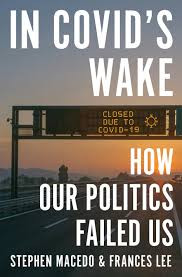
Two liberal (Democratic Party-type) US academics have published a new book that has much wider relevance than the US, including why it is important that we do not just forget about the whole thing. The book, not surprisingly, is controversial as the consensus it critiques has, also not surprisingly, not gone away. The authors have responded to some criticism here.
It is said that the past is another country but since almost all other countries had the same experience this doesn’t displace it safely to the past, not least because its impact is still with us, never mind the possibility of any repetition.
From the point of view of this blog the focus is on what the book implies for an evaluation of the approach taken by much of the left. Those who have read the coverage during the pandemic will know that it was severely critical of the groupthink that overtook the left and was very much a minority, but not idiosyncratic, view. The Left’s groupthink showed it incapable of challenging the politics of the state and mainstream bourgeois opinion across the world, putting forward a policy–‘Zero Covid’–that was actually much worse.
The suddenness and severity of actions taken by states meant that ‘just a few weeks after the lockdowns spread from China to Italy and elsewhere, 3.9 billion people–half the world’s population–were living under some form of quarantine.’ (In Covid’s Wake, p 3) What was also sudden was the adoption of the policy of lockdown that justified this approach. Called “following the science”, it was adopted by overturning the science as it had previously been accepted and became the club to silence and stigmatise those who challenged or even questioned it. The Left consensus simply adopted a more extreme version of this predominant approach.
Several non-pharmaceutical interventions (NPIs), including “contact tracing, quarantine of exposed individuals, entry and exit screening, [and] border closure” were “not recommended in any circumstances” in a World Health Organisation’s (WHO) assessment in November 2019 of NPI use in a respiratory pandemic. Quarantine of individuals–never mind whole populations–was “not recommended because there is no obvious rationale for this measure in most Member States.” Contact tracing was considered some help in “isolated communities” in the “very early stages of a pandemic.” (In Covid’s Wake, p 29) Other assessments also questioned the use of NPIs, including after reviewing the experience of the 1918 Spanish flu pandemic.
This meant that when China introduced lockdown “public health experts in the United States and elsewhere responded with shock and disbelief”. (In Covid’s Wake, p 50). Dire predictions from Imperial College in London and China’s draconian embrace of lockdown were the occasion for a complete change of approach by the WHO so that now there was no alternative to unprecedented restrictions on freedom of movement backed by massive social surveillance.
Previously inconceivable restrictions became moral imperatives supported by governments, health bureaucracies, health academics and the mainstream media; plus the majority of the left for whom the unprecedented was not unprecedented enough and the draconian not sufficiently draconian. That China’s apparent success kept on being implemented until its population started revolting was all in the future. The WHO’s mission to China found that it provided “vital lessons for the global response” and its measures were the only “proven to interrupt or minimize transmission”, while early predictions were made that it would succeed within three months. (In Covid’s Wake, p 56 &58)
The book records how dubious this claim must have been, including the knowledge that pandemics proceed in waves; millions of people had escaped lockdown in Wuhan, and there could be no confidence in the effect lockdown would have against the progress of a novel virus. The WHO made matters worse by stating that “globally, about 3.4% of reported Covid-19 cases have died”, although it could not know how many people had been infected so could not say what percentage of them had died. Without acting to implement stringent NPIs the modellers of Imperial College predicted “approximately 500,000 deaths” in the UK “and 2.2M million in the US”, along with the collapse of heath systems. “Suppression” of the virus was the only “viable strategy”, with China again held up as the exemplar. (In Covid’s Wake, p 63 &64)
If this didn’t scare you, or rather ‘convince’ you, this might be because you might have known of Imperial College modellers’ previous poor record. In 2006 it had predicted “catastrophe”, ‘forecasting 150 million deaths around the world’ as a result of the outbreak of avian flu. Nevertheless, the book’s authors note that Imperial College Covid projections ‘captured the headlines and grabbed the attention of Covid policymakers, including President Donald Trump.’ (In Covid’s Wake, p 51)
Given the forces ranged against any possible dissent it is not surprising that the ‘global suspension of basic liberties was undertaken with widespread public support.’ This was despite the book stating that ‘it is important not to ascribe to policymakers’ views more coherence than they possessed with respect to the goals of the policies they pursued. To some extent, policymakers failed to reckon with the choices between flattening the curve, attempting to contain the disease and eliminate it entirely, or suppressing the total number of infections over the whole course pf the pandemic.’ (In Covid’s Wake, p 67)
In my own city of Belfast, the local hospital was converted into a ‘Nightingale Hospital’ for Covid-19 patients and apparently more or less closed for most of everything else. While claiming that Covid-19 would close it if it was not protected, it partially closed itself. Cancer patients could die but no Covid-19 patient could be refused. Yet even this stupidity did not give pause for thought that this whole policy was the latest example of the ‘madness of crowds.’ Moral panics demand that doubters are immoral and with so much mainstream opinion on-side it is easy to excuse the left who supported it, except it was a failure; they demanded even more of the same, and they ignored, when they weren’t denouncing, alternative voices.
 Sráid Marx