In the previous post I argued that the leadership of the trade unions were unable and unwilling to challenge austerity because it would involve a political challenge to the state it had decades of ingratiating itself with it as its ‘social partner’. However, I also noted that ‘the undeveloped and inadequate political consciousness of the working class itself [was] also a major factor’ in the union movement being unable to successfully resist austerity.
The socialist critique of the bureaucratic leadership of the trade unions is not that its passivity never reflects the views of its members but that the occasions in which members are prepared to take action are often betrayed and their passivity reinforced through ensuing demoralisation.
Protests and demonstrations (called by trade unions early in the economic crisis and also later) are only useful in so far as they are necessary steps to more effective action: by rallying the troops and persuading others that there are alternative courses of action and the means to achieve them. Otherwise, they are what they are defined as, simply public expressions of objection, disapproval, or dissent, and public exhibitions of the attitude of a group toward an issue.
There is currently no other rival union leadership that believes in independent working class politics that is separate from and opposed to the state and seeks to increase the class’s political consciousness. Bureaucratic organisation stifles any democratic control that might permit episodic bouts of struggle to advance and accumulate an understanding of class politics. Lack of democracy and low participation are both causes and effects of political weakness.
Both the leadership and membership are wedded to the view that fundamental change can come only through the state as the only (legitimate) agent capable of achieving it. All sections of ‘the left’, from Sinn Fein to supposed ‘Trotskyists’, have a political programme that hold that achievement of governmental office will enact this social transformation, and campaign on this basis. How a capitalist state will permit this is never explained.
Of course, People before Profit and Socialist Party pay obeisance to the view that the capitalist state will have to be overthrown but this plays a role analogous to republicans’ view that the legitimate government of Ireland resides within the IRA.
During the crisis there was little to no awareness of the possibility of an independent working class political force as more than perhaps a vehicle to pressurise the state, or with a view to having its representatives occupy positions in its parliament so that they could legislate sought after policies and adopt necessary measures.
This reflects the widespread support for the democratic credentials of the state and its political system, further legitimised by the country’s colonial history and the struggle against it. This gives the nationalism that is the express ideology of almost all political parties a progressive veneer and a reactionary essence.
Accompanying this is an acute awareness of the weakness of the small Irish state and its dependence on US investment and EU membership, where most power resides in the much larger European states. There are some illusions in the independent sovereignty of the state but also awareness of its constraints. When the Irish state became bankrupt the view that it could not resist the demands of the EU and US that it bailout the banks was reluctantly accepted because there appeared no alternative.
When your politics is based on winning concessions from the state, and/or the perspective of being the official government of the state, it is difficult to present these as possible when that state is bankrupt and your proposed actions are opposed by much more powerful states. Not only does it look unconvincing, it actually is. Hence the comment in the book, in relation to the Dáil, of the ‘futility of marching to an institution that was taking its own marching orders from elsewhere.’
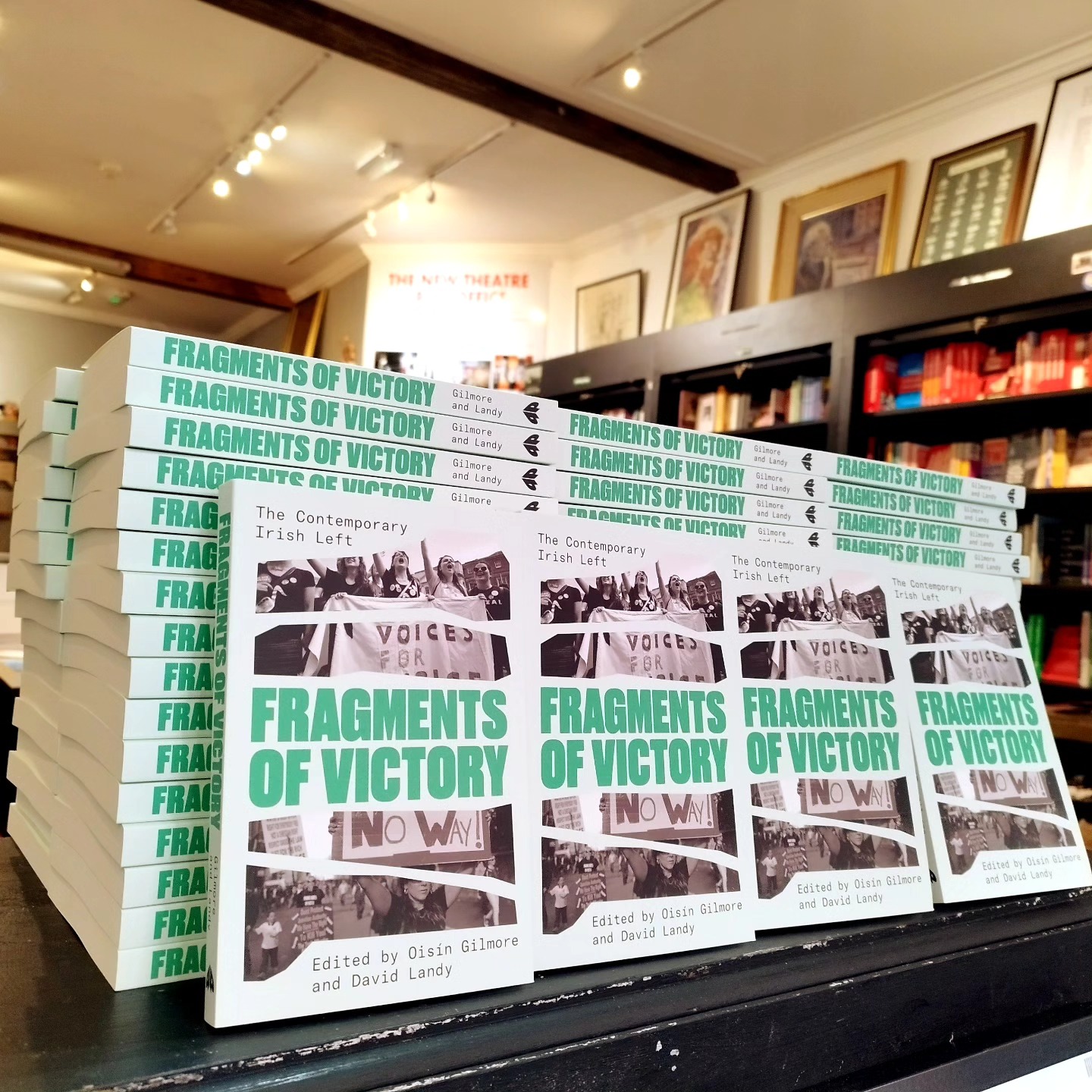
One contributor to Fragments, writing about the trade union input into the one anti-austerity campaign that was successful – against water charges – reports that ‘political economy training . . . was the most impactful part of the campaign’. (p57) Except this training appears to have been peddling the same mistaken conception that state ownership is the answer that the whole crisis, and the response to it from the Irish state, should have utterly dispelled.
This campaign morphed into the Rights2Change movement that on paper united much of the left and some trade unions. Its programme of rights, which went beyond the question of water, made sense only if the state had an obligation to satisfy them, and it didn’t begin to address the claims by the government about the lack of state resources to do so. A programme based on the supposed moral obligations of the state was as weak as the commitment of the various organisations to the project. It demonstrated only that this spectrum of organisations was united in illusions in, and subservience to, the capitalist state.
Two aspects mentioned in the book illustrate these weaknesses: ‘throughout the period of Right2Water’s existence, nobody was working on the campaign full time. The bulk of the work on the union side was done by two or three trade union officials who also had their day jobs.’ (p61)
As to the unions role as a ‘pillar’ of the campaign, it was to ‘bring organisational skills . . . politically neutral; provide economic and political research; have activists in workplaces all over the country and bring financial assistance.’ (p 55) Nothing about workers action in the workplace and what sort of action its ‘activists’ should fight for.
The role of political parties was equally somnolent – to ‘bring political knowledge; an ability to raise issues in the Dail and have activists in communities all over Ireland.’ (p55) Again, without an acceptance that political debate over aims and strategy was absolutely required, as opposed to already accepted, there was no specifically political input sanctioned for political parties.
Like so many left campaigns, broadness was confused for depth, and political shallowness for agreement and unity. One ridiculous outcome was that at one demonstration ‘we ended up with 36 speakers or acts.’ (p53) One unambiguously positive legacy of the campaign claimed by the writer is that the ‘unions and progressive political forces were in place to prevent the movement from being co-opted by the far right.’ (p60). Not a high bar.
If the original platform for the campaign was weak (that water was a human right), there remained differences on appropriate tactics, so it could be no surprise that this attempt at turning a ‘mass movements’ into a’ story of mass organisation’ rather than simply mass mobilisation’ was a failure (p180-1 &182). This meant that it was ‘large but ephemeral’, ‘failed to lay deep social roots’, ‘failed to identify an avenue through which society might be changed, and given this, . . . failed to develop a mass political consciousness around the capitalist nature of our society or around what needs to be done to change it.’ (p183)
Sowing illusions in the state and failing to educate those mobilised on its unreformable class nature is guaranteed not to ‘develop a mass political consciousness around the capitalist nature of our society.’ The major success of resistance to austerity set out in the book came nowhere near this because it didn’t try, and it didn’t try because the left didn’t know what this would have to involve.
Back to part 3
 Sráid Marx