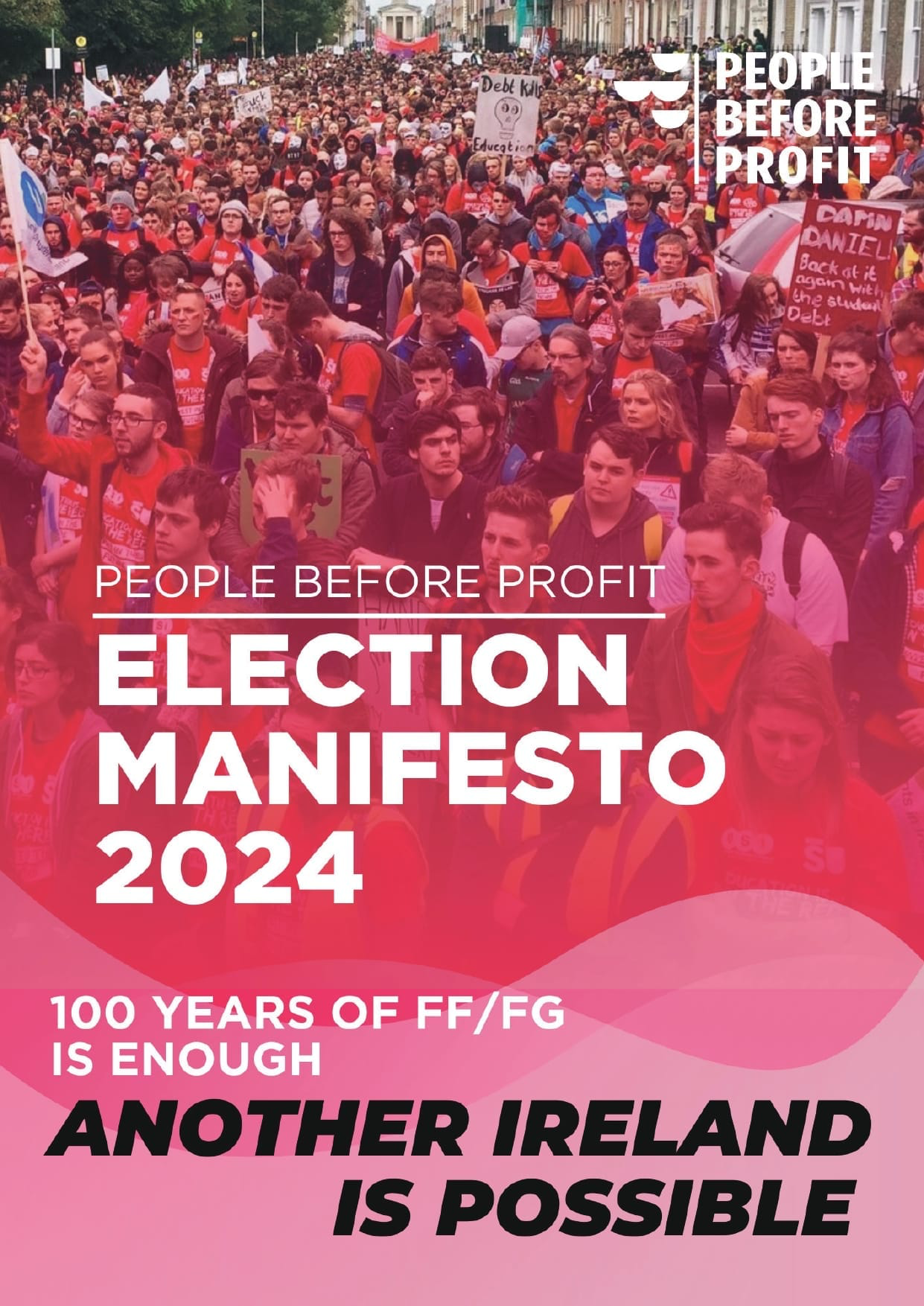
The substitution of ‘the people’ for the working class as the subject of struggle is presented In Ireland, in an almost classic case, by the People before Profit organisation, whose reformist politics are based on actions demanded from the Irish capitalist state. While ‘people’ are to come ‘before profit’, ‘people’ replaces the working class, while coming before profit still leaves profit in place. And anyway, aren’t capitalists people as well?
This precept fails to bring to the fore the ‘property question’, demanded by Marx in the Communist Manifesto, whereby the profit of capital arising from exploitation of the working class is not de-prioritised but abolished!
It might be argued ‘what’s in a name’, were it not for the fact that the name was deliberated on and selected precisely in order to avoid clearer identification with the working class and socialism. Presumably because reference to ‘the people’ is more readily acceptable; postponing the task of raising awareness of the paramount role of class and denying the centrality previously accorded to it by anyone calling themselves Marxist. In asserting the priority of the people, and so rejecting the primacy of class, the organisation is setting an example to be followed, not one to be excused or ignored.
Failure to root socialist politics in the material reality of the working class leaves it rootless and prey to the material reality of other forces – we have already pointed to the role of the state in the political alternative offered by People before Profit – but the ideologies encompassing this are many. Nationalism and racism require denial of the separate political interests of the working class – socialism is international while racism denies working class unity. It is precisely class interest that is the alternative to these reactionary programmes, not acceptance of the prior interests of an undifferentiated people.
It is possible to fill this missing foundation with moral claims to ‘humanity’ which bases internationalism on ‘human rights’; the ‘self-determination of (capitalist) states’, or protection of minorities based simply on their being a minority. Similarly, it is possible to oppose racism based on human rights, ‘diversity’, ‘inclusion’ and opposition to ‘hate’, but these are even more vague and useless than the concept of ‘the people’. Their employment by many on the left, tellingly often paraded under the banner of a ‘social justice’ movement, is testament to a collapse into liberal (i.e. bourgeois) politics compared to which the 19th century republicanism we have been examining in the previous posts looks positively revolutionary.
If class is not primary and immediately necessary in order to take forward a movement and programme what is opened up is the intrusion of a wide variety of identity politics that makes nationality, race, or sex etc. the primary means of securing freedom from oppression. This in turn can lead to ‘intersectional’ coalitions that further divide while pretending to unify.
It leads to rejection of the view that the working class is the only social force able to create a new society and which alone can unite the oppressed through the abolition of class. It thereby simply becomes one segment of society with no reason to prioritise its role more than any other. Petty bourgeois ideas of individual subjective identity flourish where the nebulous abstraction of ‘people’ becomes the source of power to change the world. With this view of politics the numerous instantiations of the people come to substitute for the working class, which in turn leads to the search for a mechanism for them to do so, and which is invariably found to be the state.
In 1849 Marx criticised the naive belief in a single “will of the entire people” rather than that of a singular ruling class (or grouping of classes) that might represent its own interest as that of society as a whole, or at least of its large majority:
‘For the National-Zeitung there exists one will of the entire people, which is not the sum of contradictory wills but a united and fixed will. How is that?
That is—the will of the majority.
And what is the will of the majority?
It is the will which emerges out of the interests, life situation, and conditions of existence of the majority.
In order to have one and the same will, the members of the majority must therefore have the same interests, the same life situation, the same conditions of existence, or must be temporarily linked together in their interests, their life situation, their conditions of existence.
In plain words: the will of the people, the will of the majority, is not the will of separate estates and classes but of one single class, and of those classes and fragments of classes that are socially—i.e., industrially and commercially—subordinated to this ruling class.
“What should we say to that?” Is the will of the entire people the will of the ruling class?’
(Marx, Marx and Engels Collected Works Vol 8 p272, Articles from the Neue Rheinische Zeitung)
Marx, in The Civil War in France, noted that the Paris Commune ‘was the first revolution in which the working class was openly acknowledged as the only class capable of social initiative, even by the great bulk of the Paris middle class—shopkeepers, tradesmen, merchants—the wealthy capitalists alone excepted. The Commune had saved them by a sagacious settlement of that ever-recurring cause of dispute among the middle classes themselves—the debtor and creditor accounts.’
It was necessary then (as it is now) for the working class to be the ‘universal’ class and to represent the needs of a society oppressed by the prevailing system: ‘For the first time in history the petty and moyenne middle class has openly rallied round the workmen’s Revolution, and proclaimed it as the only means of their own salvation and that of France!.’ (Marx, The Civil War in France, Marx and Engels Collected Works Vol. 22 p336 & 496)
This was not something that Marx learned only from the Commune but was something strikingly demonstrated by it, particularly the need to win the majority of the population that was then composed of peasants. How this need is addressed today depends on the particular class composition of society, but this requires that the idea of a unified people is abandoned and the various classes and their interests identified. In relation to the peasantry, for example, it did not mean strengthening or enlarging their individual property, while a programme based on the demands of ‘the people’ would leave this wide open.
In the writings through which he and Engels formulated their particular politics, The German Ideology, he argued that ‘For each new class which puts itself in the place of one ruling before it, is compelled, merely in order to carry through its aim, to represent its interest as the common interest of all the members of society, that is, expressed in ideal form: it has to give its ideas the form of universality, and represent them as the only rational, universally valid ones.’ For the working class, this is realised through the abolition of all classes, including itself.
Marx identified this early in his political development (in 1843) before becoming a ‘Marxist’ and expressed himself in the language of the philosophy of the time: ‘No class of civil society can play this role without arousing a moment of enthusiasm in itself and in the masses, a moment in which it fraternises and merges with society in general, becomes confused with it and is perceived and acknowledged as its general representative, a moment in which its claims and rights are truly the claims and rights of society itself, a moment in which it is truly the social head and the social heart.’ (Marx, Introduction to A Contribution to the Critique of Hegel’s Philosophy of Right)
For this to happen the working class must win others as allies to its programme. This can only be done if, in the words of The Communist Manifesto, socialists ‘disdain to conceal their views and aims.’ It will not be done by pretending that its views are those of an amorphous ‘people’. You can only rally others to your flag if it is your flag.
Back to part 66
Forward to part 68
 Sráid Marx