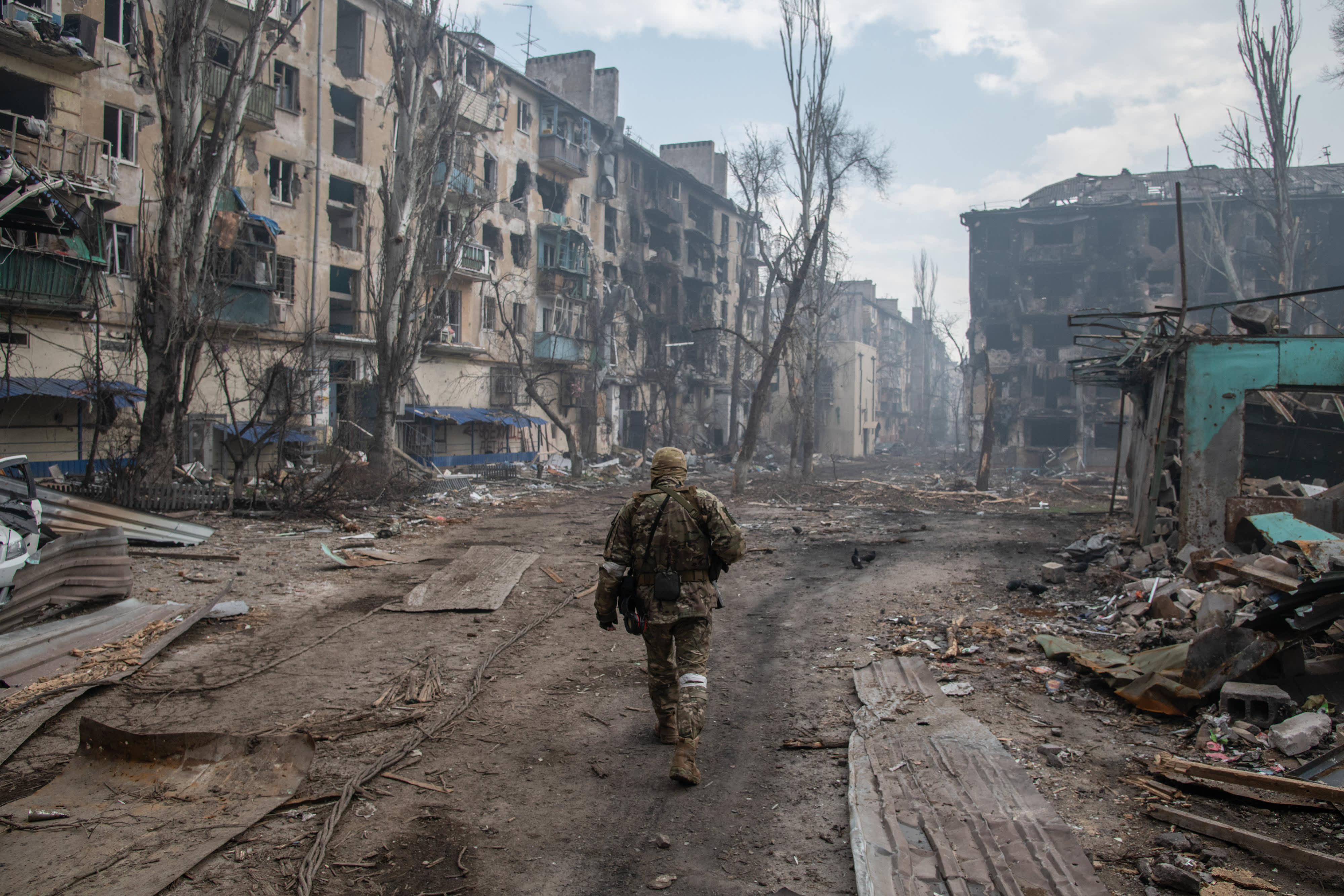
A Russian soldier walks in the rubble in Mariupol’s eastern side, where fierce fighting takes place between Russian and pro-Russia forces and Ukraine on March 15, 2022.
Maximilian Clarke | SOPA Images | Lightrocket | Getty Images
This is a joint statement, by the authors of Sráid Marx and Boffy’s Blog, on the global crisis of Marxism, which has become manifest in the collapse of many “Marxist” organisations into social-imperialism, in relation to the Ukraine-Russia War. Those organisations have abandoned the independent third camp of the international proletariat, and, instead, lined up behind one of the contending imperialist camps of NATO/Ukraine or Russia/China. They have sought to place the world labour movement back to the position prior to World War I (WWI), which led to the split in the Second International and formation of the Third International, although such a development is not possible, today, if only because no real International exists, making the situation similar to that prior to Marx and Engels establishing the First International.
This crisis of Marxism has been a long time coming. Its roots lie in the nature of what passed for Marxism in the post-war period, a ‘Marxism’ that was, in fact, a form of petty-bourgeois socialism, manifest in its attitude to the state as the means of historical change, rather than the independent self-activity, and self-government of the working-class, and, concomitantly, in its attitude to the national question and nation state. Both of us, with a combined experience of nearly a century in the labour movement, were recruited, in our youth, into different Trotskyist organisations – the International Marxist Group (IMG)/Peoples Democracy in Ireland, and International Communist League (I-CL), respectively – of which we were members for many years, and yet, freed from the barriers to critical thinking imposed by membership of such sects, we have, independently of each other, arrived at almost identical conclusions about the nature of the Left, and on the critical issues of the day for the labour movement.
We have set out below a statement on the fundamental issues we believe lie behind the recent failure of many groups and individuals to develop an independent working class position on the war in Ukraine, and how this very open betrayal is a result of previous errors now compounded into an outright defence of the capitalist state. While both of us have been activists in Western Europe, and our arguments are derived directly from this experience, the issues raised are relevant to Marxists everywhere and the experience of others across the world will confirm this experience and the lessons drawn that we have set out below.
The State
This ‘Marxism’ is fundamentally distinguished from other forms of socialism by its attitude to the state. Not only did Marx and Engels talk about the state withering away under communism, both were intensely hostile to the capitalist state, as the state of the class enemy. In “State and Revolution”, Lenin points out that Marx’s attitude to it was the same as the anarchists.
“… it was Marx who taught that the proletariat cannot simply win state power in the sense that the old state apparatus passes into new hands, but must smash this apparatus, must break it and replace it by a new one.”
It is only in this latter sense that Marxists differ from the anarchists, i.e. in the need for the proletariat, after it has become the ruling-class, to establish its own semi-state, to put down any slave-holder revolt by the bourgeoisie. The idea that Marxists can call upon the existing capitalist state to act in its interest is, then, absurd. That opportunist attitude to the state was promoted by the Lassalleans, and Fabians, in Marx and Engel’s generation, and, as Hal Draper sets out, in The Two Souls of Socialism, became the ideology of The Second International. Marx opposed it in The Critique of The Gotha Programme, and Engels followed that with many letters, and also in his own Critique of The Erfurt Programme, in which he opposed the idea of a welfare state, National Insurance, and other forms of “state socialism”.
As Lenin says,
“Far from inculcating in the workers’ minds the idea that the time is nearing when they must act to smash the old state machine, replace it by a new one, and in this way make their political rule the foundation for the socialist reorganization of society, they have actually preached to the masses the very opposite and have depicted the “conquest of power” in a way that has left thousands of loopholes for opportunism.”
(ibid)
Stalinism adopted this opportunist attitude to the state. In the post-war period, it was taken on by organisations claiming the mantle of Trotskyism. In Britain, for example, the Revolutionary Socialist League, better known as The Militant Tendency, talked about a Labour Government nationalising the 200 top monopolies, but all these organisations raised demands for the capitalist state to nationalise this or that industry, usually to avoid bankruptcy, and they continue to do so. Even more ludicrously, they combine these utopian demands to the capitalist state with the further demand that it also then grant, to the workers in the industry, “workers’ control”, as though such a request would ever likely succeed, other than in conditions of dual power in society, i.e. conditions in which workers have established their own alternative centres of power, in the form of workers’ councils, enabling them to impose workers’ control, arms in hand.
What such demands also illustrate is a dangerous failure to distinguish the difference between government and state. Governments of different complexions come and go at frequent intervals, as does the bourgeois political regime, appearing as either “democracy” or “fascism”, which are simply masks which the bourgeoisie adopt according to their needs, but the state itself remains as the real power in society, permanently organised as the defender of the ruling class, including against the government if required.
Authentic Marxism, therefore, rejects these opportunist appeals to the state to act in the interests of the working-class. Our method is that of the self-activity and self-government of the working-class, which must organise itself to become the ruling class, and, in so doing, bring about its own liberation. We look to the advice of Marx and Engels and The First International to develop its own cooperative production, rather than to the capitalist state and we advise it, at all times, to take its own initiative in addressing its needs within capitalism. This includes organising its own social insurance, to cover unemployment, sickness and retirement, rather than relying upon the vagaries of state provision, which is geared to the fluctuating interests of capital, and its economic cycles, not the interests of workers.
Of course, as Marx sets out in Political Indifferentism, if the capitalist state does provide such services, we do not advocate a sectarian boycott of them, out of a sense of purity. As Marx sets out in The Poverty of Philosophy, what makes the working-class the agent of progressive historical change is precisely its struggle against the conditions imposed upon it, which results from the limits of capitalism, and to breach those limits by replacing capitalism. Capitalism is progressive in developing the forces of production, via the accumulation of capital. This has led it to maximise the exploitation of labour/rate of surplus value but does not mean that we advocate no resistance to its demands for wage cuts, or lower conditions. We point to the limited ability of capitalism to maximise the rate of surplus value, and so develop productive forces, as well as the limited ability of workers to raise wages, within the constraints of capitalism, and consequently, the need to abolish the wages system itself.
Nor do we advocate a boycott of socialised healthcare, education and social care systems, but point out their limited capitalist nature, the lack of democratic control and so on. We oppose any regression to less mature capitalist forms of private provision, not by defending the existing state forms, but by arguing the need to move forward to new forms directly owned and controlled by workers themselves. Whilst we offer support to workers’ struggles for improvements in existing provision, and for democratic control, we do so all the better to demonstrate to workers that so long as capitalism exists, no such permanent improvement and no real democratic control is possible.
All large scale industrial capital is now, socialised capital, be it state capital or that of corporations, and so properly the collective property of the “associated producers”, as Marx describes it in Capital III. Unlike the socialised capital of worker cooperatives, it is not, however, under the control of the associated producers, of the working class, but of shareholders and their Directors. Short of a revolutionary situation, and condition of dual power, workers cannot force the state to concede control over that capital to them. Even the social-democratic measures, such as those in Germany, providing for “co-determination” of enterprises, are a sham that retains control for shareholders, and simply incorporate the workers in the process of their own exploitation.
Similarly, we do not support the sham of bourgeois-democracy, which is merely a facade for the social dictatorship of the bourgeoisie, and its state, a facade they will drop in favour of fascism if their rule is challenged by workers. We defend the democratic rights afforded to workers – to organise and to advance their class interests – but we do not confuse defence of those rights, which the working class can use, with defence of the bourgeois democratic state that continually seeks to limit, erode and threaten them outright.
We recognise, however, that millions of workers do continue to harbour illusions in bourgeois democracy, and, so long as they do, we must try to break them from it. That is not done by a sectarian abstention, but by utilising it, and demanding it be consistent democracy. For example, abolition of Monarchy and hereditary positions and titles, election of judges and military top brass, abolition of the standing army, and creation of a popular militia under democratic control. We support the workers in any such mobilisation and demands for consistent democracy, but we offer support only as the means of demonstrating the limits to such democracy and the possibility of a higher alternative, so enabling them to shed their illusions in that democracy.
The means by which we seek to mobilise the workers, in all such struggles, are not those of bourgeois society, but those of the encroaching socialist society of the future. We advocate the creation of workplace committees of workers that extend across the limited boundaries of existing trades unions; we advocate, as and when the conditions permit, the linking up of such committees into elected workers’ councils, and the joining together of this network of workers councils on a national and international basis. We reject the idea of reliance on the capitalist state and its police to “maintain order”, or of its military to provide defence of workers, and instead look to democratically controlled Workers’ Defence Squads and Workers Militia to defend workers’ interests, including against the armies of foreign powers, terrorists and so on.
The National Question and The Nation State
The opportunist view of the state differs from the Marxist view, by presenting the state as some kind of non-class, supra-class, or class neutral body, standing above society, whereas Marxists define it as what it is, the state of the bourgeois ruling class. The opportunist view of the state is a petty-bourgeois view, reflecting the social position of the petty-bourgeoisie as an intermediate class, standing between the bourgeoisie and the proletariat, and which sees its role as mediating between these two great class camps.
It denies the class division of society. The symbol of this denial is the use of phrases such as “the nation”,“society”, “the people” and so on, which subsume the antagonistic classes, in each society, into one “nation”, and then transforms the state into being the state of “the nation”, or “the people”, rather than of the ruling class. This used to be the ABC of Marxism, and yet the Ukraine-Russia War, has seen a large part of the Left collapse into these opportunist and nationalist, as opposed to socialist, ideas.
The logic of this opportunist position flows inevitably from their view of the state as the agent of social change, as against the role of the working-class itself. It is necessarily a petty-bourgeois, nationalist view, as against a proletarian, internationalist view. It demurs from class struggle, in order to privilege and promote the combined interests of all classes within the nation, as a “national interest”, which necessarily sets that “national interest” against the “national interest” of other nations. The interests of workers of different nations are, thereby, brought into an antagonistic relation with each other, rather than with their own ruling class. Again, this used to be the ABC of Marxism, symbolised by Marx’s statement that the workers have no country, and appeal, in The Communist Manifesto, “Workers of The World Unite”.
In WWI, the opportunists in the Second International, continued to repeat these statements, but only as mantras, whilst, in practice, abandoning class struggle, and lining up under the banner of their particular capitalist state, in alliance with their own bourgeoisie. This characterises the positions of much of the Left, in relation to the Ukraine-Russia war, whether they have lined up in support of the camp of NATO/Ukraine on the one side, or Russia/China on the other, under claims of an “anti-imperialist” struggle, or war of national independence/national self-determination.
Marx argued that the workers of no nation could themselves be free, whilst that nation held others in chains. That is why it is the duty of socialists, in each nation, to oppose their own ruling class in its attempts to colonise, occupy, or in any other way oppress other nations. While the formation of nation states was historically progressive, as it was necessary for the free development of capitalist production and its development of the productive forces, the subsequent destruction of nation states, and formation into multinational states, is also historically progressive, for the same reason. But, just as Marxists’ recognition of the historically progressive role of capitalism, in developing the productive forces, which involves it exploiting workers, does not require us to acquiesce in that exploitation, so too the historically progressive role of imperialism, in demolishing the nation state, and national borders, does not require us to acquiesce in its methods of achieving that goal. (See: Trotsky – The Programme of Peace).
In both cases, we seek to achieve historically progressive goals, but without the limitations that capitalism imposes on their achievement, by moving beyond capitalism/imperialism to international socialism and communism. The struggle against militarism and imperialist war is fundamental to presenting the case, and mobilising that struggle for, the overthrow of capitalism, and its replacement by international socialism. We carry out these struggles on the basis of the political and organisational independence of workers from the bourgeoisie and its state, on the basis of Permanent Revolution. (See Marx’s Address to the Communist League, 1850)
This was the basis of the position set forward by Lenin in relation to The National Question. The task of Marxists, in oppressor states, is to oppose that oppression by their own ruling class and to emphasise the right to free secession, whilst the task of Marxists in oppressed states is also to oppose their own ruling class, pointing to its exploitation of the workers, and unreliable and duplicitous nature, and emphasising not the right to free secession, but the right to voluntary association. It is what determines the Marxist position of opposing, for example, Scottish nationalism, Brexit, or other such forms of separatism across the globe. As Lenin put it, we are in favour of the self-determination of workers, not the self-determination of nations.
In 1917, following the February Revolution, in Russia, the Mensheviks, and some of the Bolsheviks, such as Stalin, Kamenev and Zinoviev, also changed their position of opposing the war, and argued that the Russian state had become “revolutionary democratic”, i.e. a non-class state, overseeing a non-class form of democracy. Lenin vehemently opposed that social-patriotism, and threatened to split the party unless it was rejected. However, this position was never abandoned by Stalin, who resumed it after Lenin’s death, making it the foundation of his strategy of the Popular Front, applied in relation to national liberation struggles, for example “the bloc of four classes”, in China, in 1925-7, and in opposing fascism, as applied in France (1934-9), and in Spain (1934-6), and subsequently, in Stalinism’s collapse into what Trotsky called “communo-patriotism” in WWII.
In the post-war period, it was not only social-democrats, reformists and Stalinists that adopted this class collaborationist Popular Front approach. In place of the Marxist principle of the self-determination of the working-class, the petty-bourgeois Left, including those that described themselves as “Trotskyist”, threw themselves into supporting struggles for national self-determination and did so, not on the basis of simply opposing the role of their own ruling-class, but of actively supporting the bourgeois and petty-bourgeois nationalist forces engaged in those struggles.
Indeed, not only were the forces involved the bourgeois class enemy of the proletariat, but, in many cases, as in, for example, Korea, Vietnam, Algeria and so on, they were aggressively anti-working-class forces with which Marxists should have had no truck whatsoever, and against which Marxists should have been warning the workers, and against which they should have been aiding workers to defend themselves. (See: The Theses On The National and Colonial Questions). Again, the petty-bourgeois socialists had adopted the mantra of “My enemy’s enemy is my friend”, identifying imperialism as the enemy, and so the bourgeois and petty-bourgeois nationalists fighting that imperialism, as their friend. This was even the case where these forces violently suppressed Trotskyists within their own country. Today these forces have presided over or opened the door not to workers’ power but to capitalism.
This was never the position of Marxism, as set out, for example, in the Comintern’s Theses On The National and Colonial Questions. It is a perversion of that position introduced by Stalinism, and later adopted by the petty-bourgeois Left, in part under pressure from Stalinism, but also from peer pressure in the petty-bourgeois, student milieu in which it became embedded, and from which came much of the movement in support of these national liberation struggles, and from which it sought to recruit new members. In line with the principles of Permanent Revolution, first set out by Marx in his 1850 Address, not only was it necessary to ensure the political and organisational independence of the proletariat, and to arm it to defend itself against the national bourgeoisie, but, in so far as the proletariat was led to form any temporary tactical alliance with the peasantry and petty-bourgeoisie, it was on the basis of an alliance with those masses, and not with the parties representing those classes, and certainly not with the bourgeois state.
“Lenin, it is understood, recognized the necessity of a temporary alliance with the bourgeois-democratic movement, but he understood by this, of course, not an alliance with the bourgeois parties, duping and betraying the petty-bourgeois revolutionary democracy (the peasants and the small city folk), but an alliance with the organizations and groupings of the masses themselves – against the national bourgeoisie.”
(Trotsky – Problems of The Chinese Revolution)
This is in stark contrast to the position of the Left, in all national liberation struggles, in the post-war period, and in its position in relation, now, to the Ukraine-Russia war.
The Russia-Ukraine War
Like WWI, the Russia-Ukraine war has become an acid test of the Left. As with WWI, most of that Left has failed the test. That the Left social-democrats, the reformist socialists, and Stalinists should fail only repeats their failures going back to WWI, but for those that claim the mantle of Trotskyism to fail it indicates the crisis of Marxism, and that the nature of that Left, as described above, is actually petty-bourgeois.
It is no surprise that those that have collapsed into becoming cheerleaders for one or other of the two contending imperialist camps have done so by using the arguments that opportunists used in WWI, and in WWII, based upon arguments of national self-determination, and “anti-imperialism”. But, nor is it a surprise that the Stop The War Coalition, which opposes the war on both sides, does so not on the basis of Marxism and Leninism, and the principles of class struggle and revolutionary defeatism, but on the basis of opportunism and social-pacifism.
The Marxist position is not only that the war is reactionary on both sides, and so we oppose the war; it is also a recognition that such wars are not inexplicable events, or caused by fascist megalomaniacs, but flow from the nature of imperialism, its drive to create a global single market, dictated by the needs of large-scale capital itself. It is inevitably led to do this by the violent competition of nation states (and alliances of such states), each seeking to assert their dominant position in any new international formation. Simply appealing for peace is therefore utopian, and ultimately reactionary, just as much as appealing for capitalist enterprises to stop competing against each other or forming larger monopolies and cartels.
We do not argue for an end to capitalist competition or monopolies, but for workers to take over those monopolies, and, thereby, to be able to replace competition with increasing cooperation between them, as part of a planned organisation of production and distribution. That is the real basis of class struggle, not economistic, distributional struggles for higher wages within a continuation of capitalism. Similarly, we do not argue for an end to wars between capitalist states, or the destruction of nation states and formation of larger multinational states, such as the EU, as part of forming a world state, but for workers to overthrow the existing capitalist states and establish workers’ states, as the only permanent means of ending wars, and rationally constructing a single global state, based upon voluntarily association. That is the basis of class struggle at an international level, of the concept of revolutionary defeatism, as against utopian demands for peace, the demands of social-pacifism.
The Marxist position of revolutionary-defeatism, in relation to the Russia-Ukraine War, as with any such war, is not simply about opposing the war, but about explaining to workers that these wars are fought using their blood, but not for their interests, and that they will continue to suck their blood so long as capitalism continues to exist. In the same way that Marxists intervene in strikes to explain that workers will continue to have to strike for decent wages, so long as capitalism exists, and that such strikes will not, ultimately, prevent their condition in relation to capital deteriorating; so they intervene in imperialist wars to explain that they will continue so long as capitalism/imperialism exists, and so the answer is not a utopian demand for peace, but a class struggle for the overthrow of capitalism/imperialism itself, to turn the imperialist war into civil war!
In the post-war period, the petty-bourgeois Left became engrossed in the rash of “anti-imperialist” and national liberation struggles that erupted as the old European colonial empires collapsed, in part under pressure from US imperialism that sought to break open all of the monopolies and protected markets of those colonial empires, in order to give free access to US multinational corporations to exploit vast reserves of labour. At the same time, Stalinism encouraged the development of support for such movements, as agents of the global strategic interests of the USSR, in competition with US imperialism. As in China, in 1925-7, it sought to ally itself with the national bourgeoisie, and subordinate the interests of workers and poor peasants in these former colonies to that of the national bourgeoisie, which it sought to draw into its orbit, as symbolised by the Third World Movement. This same, class collaborationist, Popular Front approach, was adopted by the Stalinists in the formation of the various Solidarity campaigns established to support these “anti-imperialist”, national liberation struggles.
Whilst the “Trotskyist” Left continued to repeat the mantra of opposition to Popular Fronts, in practice, and seeing large numbers of students drawn to the campaigns of solidarity with this or that national liberation movement, nearly all of which were bourgeois in nature, and many of which were particularly authoritarian and anti-working-class, as with the Algerian NLF and Viet Cong, it joined in, and promoted these kinds of cross-class, popular frontist organisations. It did so for fear of isolation and losing out in the potential for expanding its contact lists of possible new members in its rivalry with competing sects.
The Ukraine Solidarity Committee is just the latest in a long list of such cross-class, Popular Frontist organisations that throws their support behind, and so acts as useful idiots for, some reactionary national bourgeoisie, which is the enemy of the workers of the given state. In the past, these Popular Front organisations often gave a pass to the USSR and its allies, whereas, today, the USC gives a pass to, and allies with, NATO imperialism and its associates in the EU, G7 and so on. On the other side, those social-imperialists that have thrown themselves into a cross-class alliance in support of Putin’s Russia and Xi’s China, on the basis that they are being threatened by NATO/US imperialism, are simply the mirror image of the USC.
What Is To Be Done?
As two individuals, we do not suffer the hubris of thinking that we have the answers to this modern crisis of Marxism, but we do believe that such a crisis exists when self-proclaimed Marxists openly support one capitalist state in war against another, each backed by one or the other of the two largest capitalist states in the world A similar condition exists today as that in the early days of Marxism, with only a handful of authentic Marxists, amidst a sea of petty-bourgeois sects that portray themselves as Marxists while peddling reformist programmes; a still not insignificant number of Stalinists and other Left reformists; and with mass workers parties that have reverted to being simply openly bourgeois parties, much as with the British Liberals and German Democrats of 1848.
Indeed, the British Labour Party, under Starmer, has declined even more than that, becoming dominated by the reactionary, petty-bourgeois nationalism promulgated by the Tory party. Yet, in the absence of mass socialist workers parties, the working-class continues to engage in its own struggles, for increased wages to counter inflation, for example, but also to look to these bourgeois workers’ parties (or simple bourgeois parties) as their political representatives, and Marxists cannot ignore this reality. Our task is to work alongside the working-class, in and out of struggle, and break it from the current delusions in those parties, and in bourgeois-democracy itself.
Appeals to create yet another Marxist sect, or to create some new Workers Party have proven to be pointless. Engels advised US socialists to work with the existing workers parties, and, likewise, prior to the creation of the Labour Party, advised Eleanor Marx and her associates to work with the Liberal Clubs, rather than the existing sects such as the SDF or ILP. As he noted, in 1848, he and Marx and their supporters had joined the German Democrats, and operated inside it, as its organised Left-Wing.
Our fundamental principle, as set out by Marx in his 1850 Address, is to maintain the political and organisational independence of the working-class as it seeks its self-emancipation. But, as Marx and Engels showed, that is not incompatible with working inside existing mass workers parties. Whether that is done openly or covertly is only a question of tactics, determined by what is possible at the given time. The existence of the Internet to produce online publications and networks makes that much easier today than it was even 25 years ago.
In the 1930’s, when the forces congregating around him and his supporters were very small, Trotsky advised them to join the various socialist parties, so as to operate within them, as an organised Left-Wing, and, thereby, to begin to build the required numbers for the creation of new mass revolutionary parties. It was the formation of an undeclared United Front with those rank and file workers. It is again forced upon us given the tiny forces of authentic Marxism. Our goal is not some Quixotic attempt to capture those parties, but simply to build the required numbers of authentic Marxists to be able to create effective revolutionary workers parties as alternatives to them, and, then, to move from an undeclared United Front with the rank and file of those parties to an open and declared proposal for a United Front, exposing the leaders of those parties and drawing ever larger numbers of workers to the banner of international socialism.
That is in the future, but the first step is to establish a network of authentic Marxists, much as Marx and Engels did with the Communist Correspondence Committees, and as Lenin and Plekhanov did with the Marxist discussion circles that over time laid the basis for the creation of the RSDLP.
If you are in agreement with the principles set out above, in this joint statement, whether you are an individual or organisation, we ask you to contact either of the authors via the comments sections of these statements on our respective blogs. If you have a social media presence, then give us the details so that we can share it with our readers, and we would ask that you do the same, for everyone else as part of an expanding global network of authentic Marxists, each supporting, in whatever way they can, the work of the others, and facilitating a discussion and development of authentic Marxist ideas.
 Sráid Marx
There is a lot to respond to there, and to deal with Hal Draper’s paper on Lenin and Revolutionary Defeatism would take even longer. I would suggest, however, reading Lenin’s argument itself on revolutionary defeatism – https://www.marxists.org/archive/lenin/works/1915/jul/26.htm.
What is important to understand, here, in relation also to Draper’s argument, is being in favour of the defeat of your own government by whom? Lenin’s argument, when he says that Marxists are actively in favour of the defeat of their own government in war time, does not at all mean they are in favour of its defeat by the enemy! See his comments in relation to the Franco-Prussian War and defeat of the Parisian Workers by Bismark. Lenin’s argument is simply that we do not change our position in relation to our own government in war to that which it is in peace. If we are in favour of the defeat of our own bourgeois government in peace-time, we continue to be in favour of its defeat in war-time too, not by undertaking sabotage, or by assisting the enemy, as some kind of “lesser-evil”, but by our own continued revolutionary action against it.
Note, Lenin’s comments in relation to that, and the question of the workers in the different countries uniting to bring about the defeat of all of these governments. That is relevant to the Ukraine-Russia War, because the social-imperialists, like Kautsky et al, described by Lenin, reject the idea that our position should be to unite the workers of the different combatant countries, as impossible. Because they consider that impossible, and because they prioritise the rights of nations over the rights of workers, they are left only able to call on workers to subordinate their interests, as part of a national “bloc of four classes” headed by the bourgeoisie and its state.
I will try to respond to other points if I have time.
‘If you are in agreement with the principles set out above’. Have the authors stated openly and clearly what those Marxist principles are? Reading the above I find two statements suggestive of something that could be said to sound like a ruling principle. The most important one is the principle of the political independence of the working class. The second one is suggestive and more derivative of the workers being an international class, stated in the negative of not being nationalist. There is also a strong hint of a near sounding principle, the phrase revolutionary defeatism is mentioned in the context of the current European war.
When Marxists speak about principles and the importance of having them they immediately seem to disavow them by speaking of the necessity of using them in clever or even cunning tactical ways. Yet tactics are in themselves often suggestive of hypocrisy and deception not to say cover words for betrayal of the motivated principles. It is thought proper that the man of principle should always be obvious and uncompromising about acting on principle, perhaps historical figures such as Jesus sticking with the principle of non violence on the occasion of his arrest by Roman solders, or like Socrates respecting and obeying of the Athenian laws that asked for his execution, or even Sir Thomas More refusing to disavow is moral conscience as presented in the stage play A man for All Seasons. In short a person of principle wears them always on his sleeve.
Here is the problem, the movement back and forth between principles and tactics is a cause of uncertainty and distrust not just for those who profess an interest in socialist party politics. My personal observation covering the Republican politics of Sinn Fein is that their peace process tactics utterly abolished their motivating principles. And one can make this into a broadly verified generalisation in the context of the history of communism.
Mixed up with your espousal of Marxist principles there is also the suggestion that it is a requirement to be able to leave them behind in participating in institutions like trades unions and labour type political parties and maybe bourgeois parliaments, presumably in a very tactical way, as the scaffold supports the condemned man. This might even be conducted in secret and undercover. It is not easy to preserve your ‘authentic principles’ while acting inauthentic in public for the sake of the tactics. The very term tactics is suggestive of great flexibility, of freedom from the binding constraint of principles. Maybe Marxism needs to split the difference between principles and tactics more thoughtfully than what has so far been achieved. The critic might argue with some justification that the supposed Marxists principles are in fact nothing of the kind, they are no more than weighing room scales. When Lenin calls Marxism the ideology of the working class he seems to be admitting that all Marxist principles are subject to ideological encroachment.
‘ The murder of Lumumba was described by a Communist official as a reprehensible murder by which he implied that there can be irreprehensible murders, like the murder of Nagy’.
Finally two question for you. Concerning the term revolutionary defeatism
which is invoked above. You readily quote Hal Draper’s ‘two souls of socialism’ favourably, it was important in recovering the Marxist principle of the political independence of the working class. A good principle that got lost in the preference for tactics. I recently read another essay by Hal Draper called the ‘myth of Lenin’s revolutionary defeatism.’ What is Draper saying in this document, and do you agree with what he says? Is revolutionary defeatism a new principle of Marxism or is it a clever tactic that every communist official can use and abuse as they see fit.
Second, the policy relating to participation in bourgeois parliaments is left hanging in that you say that millions of workers continue to harbour illusions in it, and so we must try to break them from their illusions. In its place you speak in favour of a more consistent ‘consistent democracy’ of a ‘higher alternative’. There is little assessment of how versions of the new soviet democracy have fared in the past, why did the emergent soviet democracy disappear so readily, without this account workers are sure to stick with what they already have won, the bourgeois parliaments.
You ask whether we have set out clearly what the Marxist principles are that we are asking readers whether they agree with. Fair point. As with Marx’s definition of historical materialism, however, as Engels describes, it is often only possible to do in long form, as with its application in The Eighteenth Brumaire, rather than in short one liners that are open to interpretation and misuse. But, let me try to do so in the time I have available, and maybe Joe could supplement it.
1. Marxists objectives are determined by a scientific method of analysing the evolution of social organisms, not on the basis of achieving moral goals or imperatives. We do not confuse the scientific terms “progressive” and “reactionary” with the moral terms “good” and “bad”. My current series on “The Poverty of Philosophy”, illustrates that. It is where Draper is wrong, inevitably, having adopted the ideas of the petty-bourgeois Third Camp of Burnham and Shactman. It leads him, like them, and like the moral socialists of the USC etc., into “lesser-evilism”, of picking a side on the basis of which is less bad, whereas the method of Marx, Engels, Lenin and Trotsky was to identify the working-class as the agent of change, and only pick its side. If others happen to be marching in the same direction so be it, but we are not their friends or subordinate to their interests.
2. The agent of change is the working-class, not the state. The capitalist state is our main enemy, as the concentrated, organised force of our class enemy, the bourgeoisie. If that state provides things we can use, we will use them, but simultaneously advising workers not to rely on them, to form their own alternatives, and to smash that state. Only after the workers become ruling class can they look to a state as representative of its class interest, but that state is not the existing state. It is a new state they create having smashed the existing one, and it is a different kind of state, based upon their own self-organisation and self government, via direct workers democracy. It is a state with a use by date, determined by the length of time required to suppress any potential for counter-revolution by the bourgeoisie.
3. We do not choose to support any given development, such as the creation of the nation state, in the abstract, but concretely. What was once progressive, in the 18th and 19th century, is now reactionary, in the age of imperialism. History has moved on, material conditions have changed. Our position is determined by the interests of the working class, as agent of change, from capitalism to international socialism. It was not possible to identify the working-class as that agent before it existed, which is why the earlier socialists were moralists and utopians. In the 18th century, the working-class was still a small minority, the peasantry and petty-bourgeois forming the mass of society. You could not scientifically, at that point argue, its necessary to create nation states, so that capitalism develops, so that an industrial proletariat develops, which is the agent of historical change, unless you had a crystal ball to see the future.
You could, however, if you had been able to develop Marx’s theory at that point, have been able to identify the development of capitalism itself as a progressive development, and, thereby, have been an advocate of it, and to have seen the role of creating the nation state as a means of facilitating its development. As a bourgeois revolutionary, you could advocate American Independence, for example.
As Lenin set out long ago, that period of history has long past, and what was once revolutionary is now reactionary. As proletarian revolutionaries, not, now, bourgeois revolutionaries, our goal is not bourgeois national revolutions, but international socialist revolution. We support the self-determination of workers, not nations. In the age of imperialism, unless we proceed on that basis, we end up with reactionary, and potentially disastrous results. Some examples,
The Balkan Wars began as national liberation wars against the Ottoman Empire, but as Trotsky describes, turned into the bases of the imperialist war of 1914-1918, the greatest slaughter of workers in history, and a massive set back to human social development. As Joe related in a previous post, Jim Denham had asked him whether Irish workers had any interest in Irish independence from Britain, but fails to ask concretely, independence on what basis? Were, for example, Vietnamese workers interested in independence from the French colonial oppression, and subsequent US neo-colonialism, of course, but why would they then seek to replace that with the oppression – potentially more brutal and effective oppression – of the Vietnamese Stalinists? Were Algerian workers interested in liberation from French colonialism, certainly, but they were also interested in not jumping from that frying pan into the fire of oppression at the hands of the NLF. Were Iranian workers interested in overthrowing the Shah, in 1979, as the tool of US imperialism, of course, but they were similarly interested in not replacing his oppression with the even more brutal, and reactionary oppression of Khomeini and the mullahs.
Moral socialists acting on the basis of “my enemy’s enemy is my friend” have fallen into this trap repeatedly, and its to be seen in Draper’s piece you cite, which is a Proudhonist, rather than Marxist method. It seeks to pick a side to support, whereas the only side we pick is that of the working-class, as the scientifically identified agent of social change, from capitalism to socialism.
You say,
“When Marxists speak about principles and the importance of having them they immediately seem to disavow them by speaking of the necessity of using them in clever or even cunning tactical ways. Yet tactics are in themselves often suggestive of hypocrisy and deception not to say cover words for betrayal of the motivated principles.”
For a Marxist to respond to this charge, you would need to given an example of it, rather than simply assert it. The examples you give of tactics subverting principles are all of people/organisations that are not Marxists.
You say that taking part in trades unions, bourgeois parties, and parliaments involves abandoning principles in favour of tactics, and involves dishonesty to do so.
“It is not easy to preserve your ‘authentic principles’ while acting inauthentic in public for the sake of the tactics.”
But that is not what Marxists do. Marx made no secret about his attitude to trades unions, for example, as set out at the end of Value, Price and Profit. He didn’t argue for his supporters to join trades unions and hide their light under a bushel, but to do so precisely in order to set out to the members of those trades unions why their current approach would fail, and what they needed to do to change that. Lenin in Left-wing Communism did not propose that Marxists should participate in parliamentary elections and pretend to be advocates of bourgeois-democracy, but should stand in those elections as a means of gaining an audience for revolutionary ideas, for their attack on bourgeois-democracy, and so on.
The approach of joining unions or bourgeois parties, or taking part in elections, whilst hiding your politics, simply in order to gain popularity, win votes and so on, is absolutely not the method of the Marxist but of the petty-bourgeois opportunist.
I have replied earlier to the error contained in Draper’s article on revolutionary defeatism. I think a lot of what has been said can be summarised in the comments from Trotsky to some of his US supporters, a similar thing applies with Marx’s comments in The Poverty of Philosophy, in relation to slavery, and Proudhon’s moralistic approach to it.
“We must of course fight against the war not only “until the very last moment” but during the war itself when it begins. We must however give to our fight against the war its fully revolutionary sense, opposing and pitilessly denouncing pacifism. The very simple and very great idea of our fight against the war is: we are against the war but we will have the war if we are incapable of overthrowing the capitalists.”
(Trotsky – On Conscription)
“Our agitation in connection with the war must be as uncompromising in relation to the pacifists as to the imperialists.
This war is not our war, the responsibility for it lies squarely on the Capitalists. But, so long as we are still not strong enough to overthrow them and must fight in the ranks of their army, we are obliged to learn to use arms as well as possible….
Just as every worker, exploited by the Capitalists, seeks to learn as well as possible the production techniques, so every proletarian soldier in the imperialist army must learn as well as possible the art of war so as to be able, when the conditions change to apply it in the interests of the working class.
We are not pacifists. No we are revolutionaries. And we know what lies ahead for us.”
See: Writings 1939-40 pp104-5.
“In the union I can say I am for the Fourth International. I am against War. But, I am with you. I will not sabotage the war. I will be the best soldier just as I was the best and most skilled worker in the factory. At the same time, I will try to convince you that we should change our society.”
(ibid pp 253-8)
Note, here, that Trotsky’s comment “I will not sabotage the war”, is fully consistent with revolutionary defeatism. He is not saying, I will work to sabotage the war, so that the enemy wins, which is also the implication of the method of “My enemy’s enemy is my friend” of allying with the Viet Cong against US imperialism, the NLF against French colonialism, the KMT against British and other colonialism, Zelensky against Putin and so on, but of continuing to work for the defeat of the bourgeois government and state, DESPITE the fact of war, and potential that, in so doing, that may facilitate the war effort of the enemies of that state. I will set this out in detail in my series on Lessons of the Chinese Revolution. For example, Stalin adopted the same petty-bourgeois nationalist approach as the USC, today. He argued that the bourgeois KMT represented all of Chinese society, all of its classes, which, according to Bukharin had been fused together by the fact of imperialism, and the national struggle against it.
On that basis, Stalin painted the KMT in rosy colours, as the USC does today with Zelensky’s corrupt, anti-working-class regime. He armed the KMT, just as today the USC argue for arming Zelensky’s corrupt regime. He told the Chinese communists to join the KMT and subordinate themselves to it, and argued against the Chinese workers and peasants creating soviets or independently arming themselves on the basis that to do so would break their alliance with the KMT. The USC not only prettify the Ukrainian regime and the oligarchy, but effectively undermine the class struggle in Ukraine, and potential for joining the struggle of Ukrainian and Russian workers, by making the locus of their activity the national struggle not the class struggle. Stalin continued to do that right up to a week before Chiang kai Shek and the KMT took all those weapons provided by the USSR, and used them to launch the coup in Shanghai and slaughter thousands of those worker-communists that Stalin had betrayed by telling them to ally with and subordinate themselves to the KMT, and the Chinese national bourgeoisie. Its a story that has been repeated in almost every national struggle where the interests of workers have been subordinated to those of the national bourgeoisie/petty bourgeoisie, Ireland included.
Just as Marxists are not hippy drop-outs from capitalism, and have to go to work, thereby accepting the reality of he existence of capitalism and its exploitation, but in doing so, we work for its overthrow, so too the tactics employed during a war are fully consistent with and determined by that same principle of continuing to seek the overthrow of that capitalism. So, all of the measures that Trotsky puts forward in relation to such a war seek to emphasise and defend the class interest of workers. He writes,
“We must oppose sending untrained boys into battle. The Trade Unions not only must protect the workers in peaceful times and protect their industrial skill, but they must now demand the possibility of learning the military art from the state.”
“For instance, in the Trade Unions we can argue like this: ‘I am a socialist and you are a patriot. Good. We will discuss this difference between us. But, we should agree that the workers be trained at Government expense to become military experts. Schools should be set up in connection with the trade unions – at government expense but under the control of the trade unions.’ This kind of approach would give us access to the workers, who are 95 to 98% patriotic even at the present time.”
“But, we place our whole agitation on a class basis. We are against the bourgeois officers who treat you like cattle, who use you for cannon-fodder. We are concerned for the deaths of the workers, unlike the bourgeois officers. We want workers officers.”
And,
“The workers should not fear arms; on the contrary they should learn to use them. Revolutionists no more separate themselves from the people during war than in peace. A Bolshevik strives to become not only the best trade unionist but also the best soldier.”
See: Proletarian Military Policy
He elaborates in his article, “On The Question of Workers Self Defence”
“We Bolsheviks also want to defend democracy, but not the kind that is run by the sixty uncrowned kings. (NB. Trotsky was writing to his US supporters, and this reference is to the 60 top financial families) First, let’s sweep our democracy clean of capitalist magnates, then we will defend it to the last drop of blood. Are you, who are not Bolsheviks, really ready to defend this democracy? But, you must at least, be able to the best of your ability to defend it so as not to be a blind instrument in the hands of the sixty families and the bourgeois officers devoted to them. The working class must learn military affairs in order to advance the largest possible number of officers from its own ranks.
We must demand that the state, which tomorrow will ask for the workers’ blood, today give the workers the opportunity to master military technique in the best possible way in order to achieve the military objectives with the minimum expenditure of human lives.
To accomplish that, a regular army and barracks by themselves are not enough. Workers must have the opportunity to get military training at their factories, plants and mines at specified times, while being paid by the Capitalists. If the workers are destined to give their lives, the bourgeois patriots can at least make a small material sacrifice.
The state must issue a rifle to every worker capable of bearing arms and set up rifle and artillery ranges for military training purposes in places accessible to the workers.
Our agitation in connection with the war must be as uncompromising in relation to the pacifists as to the imperialists.
This war is not our war, the responsibility for it lies squarely on the Capitalists. But, so long as we are still not strong enough to overthrow them and must fight in the ranks of their army, we are obliged to learn to use arms as well as possible….
Just as every worker, exploited by the Capitalists, seeks to learn as well as possible the production techniques, so every proletarian soldier in the imperialist army must learn as well as possible the art of war so as to be able, when the conditions change to apply it in the interests of the working class.
We are not pacifists. No we are revolutionaries. And we know what lies ahead for us.”
See: Writings 1939-40 pp104-5.
You are correct to identify the two key Marxist principles put forward in the statement as the ‘principle of the political independence of the working class’ and of ‘the workers being an international class’. You are also correct to say that application of these in the current war involves the policy of revolutionary defeatism and Arthur has explained what this is. I have also written an article explaining this in simple terms in relation to the war in Ukraine, which will be published soon, as will some posts I’m writing on the nature of permanent revolution that are relevant.
The relationship between principles and tactics is a difficult one that can best be discussed concretely as tactics arise from the circumstances of a situation. This does not mean that we cannot generalise, and Marxist analysis points out how universal principles arise out of particular circumstances and can guide the elaboration of tactics. That is why I have been keen to take up arguments on the left in support of Ukraine that appear very concrete and supposedly give rise to practical action. This, for example, was the approach taken by some Irish leftists taken up in series of posts beginning with this one (https://irishmarxism.net/2022/04/28/the-war-in-ukraine-and-the-politics-of-evasion-1-of-2/ ). In this pro-Ukraine article ‘It asks us to imagine that ‘A Russian convoy is approaching your town’ and asks what we would do – fight back or say “No. Don’t escalate. It will lead to more war horror. And potentially nuclear war.”
Opportunism in tactics that lead inevitably to betrayal of principle is almost inevitably dressed up in moral terms but often starts with appeals to ‘practicality’ that have nothing to do with putting the politics of the working class into practice. Again this often comes from seeking to advance ‘solutions’ that are not working class solutions but rely on the capitalist state doing the right thing, because of ‘pressure’ from the working class or some left campaign or other.
The principle of working class independence–its self-emancipation–is dropped in favour of action by the capitalist state, forgetting altogether the class nature of this state. Instead capturing governmental office become the route to workers’ advance rather than the advance of the organisation of the workers themselves. Instead of elections being measurements of the strength of the working class movement, and opportunities to advance a socialist programme, they become mechanisms to determine what will gain most votes and elect most representatives. This is in turn relegates the working class to one of putting pressure on the government or state. We regularly hear of ‘a crisis of working class representation’ when the problem is of organisation, mobilisation and class consciousness.
You will be aware of this surrender of principle on the alter of ‘clever tactics’ that is currently being proposed by People before Profit (PbP) and its proposals for the formation of a ‘left government’ in the next general election in the Irish State. This, as I have argued before, can only be realistic if Sinn Fein is to be included in the project as part of ‘the left’. This is not credible, which is why it is not proposed as a ‘socialist government’. While it is possible to employ the term ‘left’, in terms of its relative meaning, to mean almost anything you want it to mean, stretching the proposal to the project of a ‘socialist’ government is impossible because PbP considers itself the socialists, and they are too small to define the character off any possible new administration.
This brings me to another source of opportunist tactics, which is the failure to look reality in the face and accept that the strength of Marxist politics relies on the strength of the working class. Small left sects have resolved solution to the historic failure of revolutionary leadership to themselves, and their own success, and therefore cannot accept their weakness. This problem becomes worse when they actually have some electoral success, as PbP have done. This is why they inevitably split when they do.
However, their relatively minor success is not a reflection of the growth in organisation and consciousness of the Irish working class, and this simply exposes their weakness that they seek to remedy, not through the long slog of developing this organisation and consciousness, but utopian plans to get a ‘left’ government with Sinn Fein that will implement socialist measures. Such short cuts always lead to taking wrong turns.
They feel the pressure to come up with solutions that are only those of the working class if the class itself fights for them; and they fear irrelevance, which they seek to avoid either in submergence into reformist organisation and political practice or ultra-left illusion. Support for either Ukraine or Russia is a form of substitution of the working class by a capitalist state, justified either on the grounds of ‘self-determination’ or ‘anti-imperialism’.
For part of the left, this idea that the problem of the correct revolutionary leadership can be solved relatively quickly arises because the working class is considered to be objectively revolutionary already. They repeat the words of Trotsky that ‘The historical crisis of mankind is reduced to the crisis of the revolutionary leadership’. But there are today no mass working class parties worthy of the name whose leaderships are misleading millions of workers demanding socialism. The betrayals of social democracy and Stalinism in the first half of the 20th century have not been overcome. The tendency to substitutionism of the party for the class becomes almost absolute when small left organisations see themselves as the vanguard of a non-revolutionary working class.
This failure of means to deliver ends always leads to the ends being redefined to involve a surrender of principle; the example of Sinn Fein is a good one, even if this is by a petty bourgeois organisation. In their case the armed struggle became isolated and effectively defeated. In the case of much of the left it is their tiny size, class composition, isolation from the working class, and Platonic attachment to revolutionary ideals that cannot be reconciled to their political practice. Wrong ideas play a part in leading to this and are always a result, and left support for Ukraine and western imperialism, or Russia and China, are pretty dire results.
The outcome is a what is now termed a clusterfuck–of bad ideas and rotten practice, full of contradictions and incoherence, with genuflections to Marx and invocation of petty-bourgeois morality, all departing very far from Marxist principles and tactics appropriate to them.
“For part of the left, this idea that the problem of the correct revolutionary leadership can be solved relatively quickly arises because the working class is considered to be objectively revolutionary already.”
This is a great point. It also arises in Trotsky’s analysis, at the time, of the principles and tactics of Stalin/Bukharin in the Chinese Revolution, of 1925-7. It will be several weeks before I get to it, in my posts on The Chinese Revolution, so let me summarise it, now.
Having betrayed the Chinese workers and poor peasants between 1925-7, by telling them to subordinate their interests and independent organisation to the Chinese national bourgeoisie, and its party, the KMT, which resulted in the coup of Chinag Kai Shek, in Shanghai in April 1927, and murder of thousands of Chinese worker-communists, the Stalinists/Comintern tried to cover their errors/betrayal.
First, they claimed that they knew all along that the Chinese bourgeoisie/KMT would betray the revolution, and this was all “part of the plan”, in the long game. This is the meaning of the same phrases today, by Stalin/Bukharin’s equivalents, such as Jim Denham, who tell workers that the capitalist state/imperialism is their defender and furthering their interests, but the tag on, as Trotsky describes such elements always do, the comment “of course we know they are only doing this for their own interest”, as though that justifies their capitulation to them, and failure to organise workers against them, here and now.
Second, they tried to justify this by again, simply lying. They lied about the nature of the KMT in order to justify their alliance with it, just as the social-imperialists lie today about the corrupt, anti-working-class nature of Zelensky’s regime to justify their alliance with it (and about the nature of NATO), then, after the coup, they lied about having told these original lies, denying that the KMT had been admitted into the Comintern and so on, and also lied about their preparation for such a coup. They also lied about the consequences. They even claimed that after the coup, membership of the Communist Party had risen significantly, as though that was ever likely to be true, but even if it was, as if the coup had somehow been a good thing, part of the plan all along, that it was necessary to wait for the bourgeoisie to betray them, as part of the plan to undermine the KMT, and split the workers and peasants from it! This same kind of logic is used by those who argue the need to elect Labour governments, or their international equivalents, so that they can then betray workers interests, and then be exposed in front of the workers, as though workers haven’t had a century of exposure to such betrayals, and as though Starmer is not already betraying workers interests long before forming a government!!!
But, Trotsky describes the way Bukharin then bowdlerised the theory of permanent revolution to fit this narrative. That bowdlerisation involved transforming permanent revolution from being a continuous process driven by that very independent political and military organisation of the workers, in the bourgeois-national revolution, so as to fight against the betrayal of the bourgeoisie/petty-bourgeoisie, and to continually fight for its own interests against the bourgeoisie, to make the revolution permanent, as had happened in Russia in 1917, into a sterile abstraction. The Bukharinist theory simply said, as you described above, the proletariat is objectively revolutionary, we are in an era of social revolutions, and so every defeat is simply an ebb in that revolutionary tide. On this basis, they could justify their betrayal, and claim it was just a matter of waiting for that ebb to end, and a new upsurge to arise.
Of course, as Trotsky says, and as you have set out, objectively and abstractly its true that the proletariat is a revolutionary class, and we do live in an age of socialist revolution, but that is a purely abstract and meaningless concept when dealing with the concrete reality, and he tactics required to deal with it. It takes the lives of workers as meaningless, reducing them to pawns in some “clever” long-term strategy, much as the WWI generals were prepared to sacrifice them in millions, in a war of attrition. There is a great difference between recognising the objective, but abstract reality of he revolutionary nature of the class, and of the era, as against the actual consciousness of the class, here, and now, and how that is affected by defeats, and even more betrayals, as well, therefore, as whether a current period is characterised by being one of revolutionary ebb or flow.
When, Trotsky noted that the consequence of the coup and betrayals was that the CCP had lost its worker members, and support amongst the workers, the Stalinists called him and his supporters a defeatist, not in the sense of “revolutionary defeatism”, but in the sense of having given up on the Chinese Revolution. As he describes, this was nonsense, but, it was necessary to tell the truth that the revolutionary period itself had ended, and so, possibility of actual permanent revolution, at that time was lost. It would again require building up the Chinese labour movement, and workers’ consciousness, ready for a new upsurge at some point in the future. In 1985, there were those who similarly refused to accept that the British working-class had suffered a major betrayal and defeat, or even accept that the NUM had lost.
On the basis that the Stalinists/Bukharinsts argued that this was all part of the plan, and that the upward revolutionary wave was merely in ebb, they looked to the next “lesser-evil” to catch a ride on, which was the Left KMT of Wang Chin Wei. But, the same betrayal and defeat resulted. Again, the Stalinists said it was all part of the plan, leaving the door open for the workers and peasants to now carry the process of permanent revolution forward. Except the workers had deserted them, and the peasants had their own class interests to serve. So, now, arose the process of trying to kick the new revolutionary wave into action, as well as measures aimed simply as stunts to bolster the credentials of the CCP. They organised the Canton uprising, which given the actual conditions of counter-revolution, not revolution, was doomed from the start and resulted in another defeat. It was followed by the turn away from proletarian revolution based on the industrial working-class, based in the urban areas, to petty-bourgeois, peasant war, and guerillaism, which characterised a lot of the petty-bourgeois, nationalist movements after that, from Maoism, to Guevarrism and so on. The same underlying sentiment was what led the Stalinists into the disaster of the Third Period.
In essence the petty-bourgeois nationalist “Left” has operated on a variation of these two tactics of Stalinism/Maoism ever since of opportunist Popular Fronts with the bourgeoisie/petty bourgeoisie, and when depression sets in following the inevitable failure of those alliances, periods of ultra-leftism and sectarianism.