The summary conclusions in the previous post raise a host of questions about the struggle against austerity following the crash of the Celtic Tiger: the lack of permanent organisation; the lack of working class consciousness and awareness of its specific political interests; lack of credible political programme and the inability to ‘articulate a viable alternative’; reliance on electoralism and thus on Sinn Fein, and lack of clarity on ‘the long-term goal of socialism’.
This is quite a list, and it is to the book’s credit that they are recognised. What is also recognised, more by implication than by explicit critique, is that this is the result of the conscious approach taken by ‘the left’, which the book sees as one of failure qualified by some success. It also implies that the answer to overall failure is not simply more and better activity. For the left however, it is the roller-coaster of activity that is consciously seen as necessary to keep the show on the road.
If we briefly look at these issues, the first question is why ‘mass movements were less a story of mass organisation than mass mobilisation’ and were ‘large but ephemeral’. These mobilisations were campaigns so were inevitably time limited and impermanent. The issue is why they were temporary when their object of attack – austerity – had not been defeated and why the permanent organisations that did exist failed to keep the campaign going?
The second question is posed mainly to the trade unions and particularly ICTU, which called initial demonstrations and then left the stage. Two further questions then arise – why did they do so and why were they able to get away with it?
The first answer is that since 1987 the trade unions have seen the state as a ‘social partner’ and very definitely not an antagonist – never mind enemy, and conducted themselves as partners in not opposing austerity itself but only seeking to modify its implementation. This to be done in the normal way of partners, through lobbying and negotiation.
The decline in strike activity and union density during the period of partnership was therefore not simply a result of economic conditions because they improved dramatically in the 1990s, at first rather slowly in terms of employment and then rapidly. In 1986, just before the first deal, there were 309,198 days ‘lost’ in strikes and in 2007, just before the crash, a total of 6,038 days. By 2022 this had fallen even further to 5,256 while union density declined from 46 per cent in 1994 to 30 per cent in 2007.
Economic power and state revenue shifted to foreign multinationals that unions largely failed to organize, resulting in many skilled, educated, and younger workers being excluded. One of the early results of partnership was the 1990 Industrial Relations Act that made illegal a strike unconnected to a ‘legitimate’ trade dispute, which successfully thwarted solidarity action – one of the very purposes of a trade union movement. ‘Partnership’ also did not prevent the bosses refusing to recognise or negotiate with trade unions
Since the crisis was one of solvency of the state, arising from it guaranteeing the deposits and liabilities of the banks that it could not itself finance, the response was cuts in state services and the pay of public sector staff. The initial ICTU response was therefore a public sector strike that recognised its weakness in the private sector. Bourgeois politicians and its media made hay with accusations about the privileges of these workers that sought to divide private sector workers from those working for the state, which the unions had themselves done little to prevent through their failure to organise across the whole working class.
Private sector workers were met by a withdrawal of their bosses from the social partnership arrangements, one result of which was their repudiation of sectoral pay arrangements. This demonstration of the hollowness of partnership with the state and bosses, both of whom had withdrawn, did not prevent the unions going into another deal in 2010, the Croke Park Agreement, which gave way to Croke Park 2 as more cuts were sought. When the proposals for it were initially rejected by a large majority of members the union leaders were able to manoeuvre ultimate acceptance by warning of the consequences of rejection while providing no strategy for fighting for its members decision.
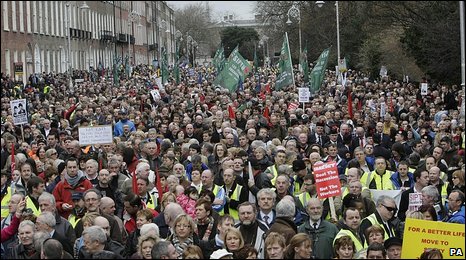
‘Mass mobilisation’ was not therefore meant to involve ‘mass organisation’ but dependence on the trade union’s own bureaucratic organisation. Its purpose was to assist union leaders’ lobbying with some pressure from below that was to be applied to the government while releasing it from the working class, amounting to simply blowing off steam. By February 2013 ICTU speakers at one of their demonstrations gave over the stage to musicians before many marchers had arrived at the finish in order to avoid being heckled. They avoided it afterwards by not having any demonstrations at all.
Mobilisation wasn’t mean to be permanent, and it wasn’t meant to be an alternative to social partnership and the union bureaucrcay. Although it was formally dissolved by the state it never ended given the objectives and strategy of the trade union leaders who simply pursued it unofficially, originally pushing the idea that the Labour Party in government might mitigate the worst effects of austerity.
The trade union movement, through its bureaucracy, is wedded to the state. Most of its members are in state employment and the state facilitates its organisation through facilitating membership subscriptions, while the share of members in the private sector has declined. The alternative offered by the trade union leaders was therefore the Labour party in government; rises in taxation instead of expenditure cuts, and ‘sharing the burden’ rather than its repudiation. While the unions’ organisational weakness was material, they were partly responsible for this themselves, and while this weakness was also the basis of political passivity and failure, this too was partly their leaders’ own responsibility.
If we look to answer the questions about the lack of permanent working class self-organisation and failure to maintain mobilisation against austerity, we need to look at the prior commitment to social partnership and dependence on the state, which itself had become dependent on the Troika of the European Commission, European Central Bank (ECB) and the International Monetary Fund (IMF). The unions were, and are, not the expression of the self-organisation of the working class and for this their leadership is partly responsible, with the undeveloped and inadequate political consciousness of the working class itself also a major factor. While in times of social peace the union leaders can represent the passivity of the membership, in times of heightened political awareness and activity they consciously act to limit this independent action and the possibility and potential for advancing political consciousness.
Had there been any permanent opposition to social partnership within the trade union movement prior to the crisis it might have presented a starting point to build an alternative to the union bureaucrats. Any opposition however was generally of a temporary campaigning character while the bona fides of the bureaucrats became generally accepted. No independent political alternative was built within the trade unions, reflecting the political weakness of the left outside it.
In these circumstance the bureaucracy was able to mobilise spontaneous anger, demoralise it and then dump it, getting away with it primarily because the politics of the union movement went unchallenged. This in turn partly reflected the political weakness of the left.
Back to part 2
Forward to part 4
 Sráid Marx