Credit: Julian Simmonds for The Telegraph
Western imperialism can keep providing war materiel for years, at greater or lesser amounts as it rebuilds its stocks and rearms, while continuing to encourage the Ukrainian state to hold out for maximalist demands it calls ‘justice’ but which promises only continued war. This is called ‘fighting to the last Ukrainian’. However, the problem with this is obvious – you eventually get to the last Ukrainian.
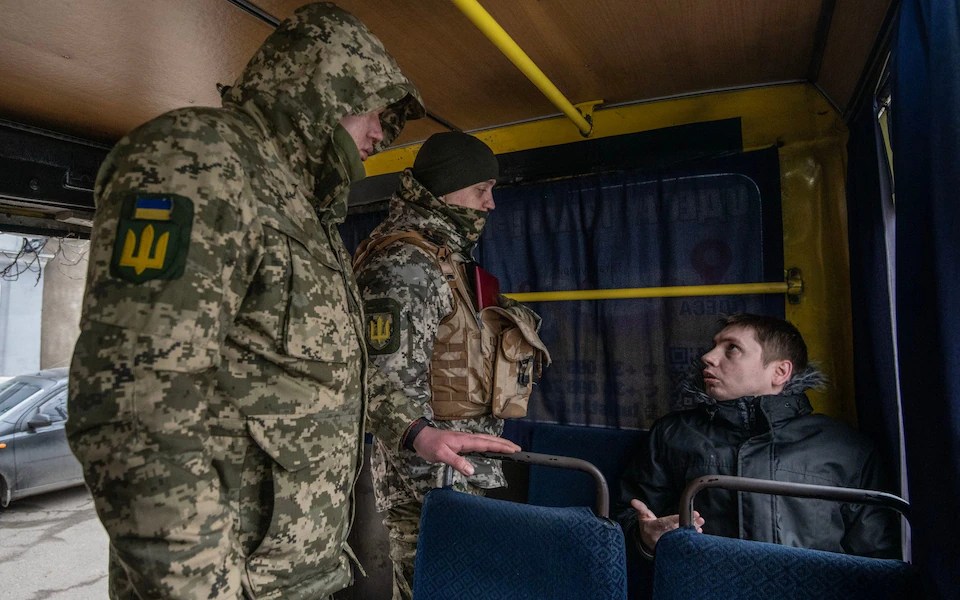
This is obviously not in the interests of the Ukrainian state, so if Western imperialism risks uncontrollable war if it further escalates its intervention, Ukraine risks complete devastation if it continues on its present course. Equally obviously, the war will not reach this stage because there will be too many Ukrainians who will have no intention of joining the queue to be the last one to die. We already see this in the numbers of especially young men getting out of the country; in the number avoiding military recruitment and coming into conflict with the military recruiters, and the massively increased desertions from the army.
More and more Western politicians are calling for the age of mobilisation of men to be reduced from 25 to 18, which has been resisted by the Zelensky regime. He claims that he needs more weapons for any mobilisation while the warmongers in the West say that more troops are necessary to wield them. Zelensky is acutely aware of the unpopularity of sending Ukraine’s youngest generation to their death: the previous mobilisation was not completely successful while the very need for another is proof of the massive number already killed.

The underlying problem is that Ukraine has relatively few under-25s due to the sharp decrease in birthrates in the 1990s, a consequence of the shock of the collapse of the Soviet Union and introduction of capitalism. If all the other cohorts of men have been exhausted, the mobilisation of the youngest does not promise victory but future demographic collapse, caused by death and absence of the most fertile cohorts of the population. Volodymyr Ishchenko, quoted in the previous post states that ‘according to the latest UN forecast, by the end of the century, the Ukrainian population is going to decrease to 15 million from the 52 million that Ukraine had in 1992 after the disintegration of USSR. This is not even the most pessimistic scenario.’ Demographic forecasts are uncertain but the probability of a greater number of war casualties than that admitted by the Ukrainian state makes it more likely the most pessimistic forecasts are the more accurate.

So what are we to make then of the repeated calls of the pro-war left that we should recognise Ukrainian ‘agency’? What agency? That of the Zelensky regime? Does this left support his current refusal to draft the youngest or will it support his change of mind, or will it support whatever the regime decides to do, whatever that is? In the latter case the demand for support for Ukrainian agency is actually a demand to deny one’s own; in the case of another mobilisation, to surrender it to the demands of Western imperialism.
In defending Ukrainian agency, this left in reality denies the agency of Western imperialism – of its own ruling class and its state. In this, the supporters of Ukraine and its Western sponsors make the same error (if you can call it that) as the supporters of Russia – they identify the interests of the working class with that of their state. One or other of these states become the defender of the working class on the world stage, which condemns the working class of their particular saviour to complete subordination.
The consequence is that the working class is no longer a world class and socialism is no longer international, having in effect been subordinated to one or other nationalism. Hence the prominence of ‘self-determination’ in the discourse of each – a nationalist demand unrelated to the policy of Lenin but a declaration of support to already independent capitalist states in an inter-imperialist war.
Volodymyr Ishchenko has interesting things to say about the power of this nationalism in Ukraine. He.states that ’There are multiple indications that the enthusiasm of 2022 was pretty fragile, and it is not the first time that we see this kind of dynamic. After the 2004 Orange revolution and the EuroMaidan revolution of 2014, people have had high expectations that quickly gave way to disappointment. A similar dynamic happened after the election of Zelensky in 2019 and then in 2022. One of the lines of interpretation is that those events were the manifestation of the rise of the Ukrainian Nation, according to a very linear teleological dynamic, as an ultimate culmination of the national liberation struggle.’
He goes on to say – ‘the actual desire to sacrifice oneself for the state is very low’, introducing the key missing element by noting that ‘the class issue is very important because conscripts will come primarily from the lower classes, from the villages. Mainly, from among the poor people who could not bribe the recruitment officers . . . It is really difficult to argue that the war is still a kind of “people’s war” if the majority of Ukrainian men actually do not want to fight.’
Of the role of the working class, which is the agency that should concern socialists, he is much more honest than the pro-war left that avoids it – by substituting the agency of the state for it – ‘The working class cannot play a role in the current situation. The labor movement in Ukraine was weak well before the war. The last really massive political strike was by Donbas miners in 1993. They demanded the autonomy of Donbas and closer relations with Russia, ironically.’ So much for a Ukrainian take on Ukrainian agency.
In the previous episodes in 2004 and 2014 the Ukrainian people were lied to by all factions of the oligarchy and their foreign backers with the result that the drive towards NATO precipitated the current invasion. Ukraine is losing and the longer the war continues the greater the loss – this is reality and not the bellicose propaganda of the British, whether from Starmer on his visit to Kyiv or from that county’s pro-war leftists. Just as it was Boris Johnson who helped torpedo the early Istanbul negotiations that might had ended the war, so has Starmer turned up to make nonsensical promises of a 100 year partnership and £3bn a year in military aid “for as long as it takes.” As a practised purveyor of untruth, we can be confident that this is another lie.
Russia too has good reason to seek an end to the conflict but too little reason to permit it to involve Western troops in unoccupied Ukraine, which would be both a permanent threat to it and incentive to whatever reactionary regime surfaces in Ukraine to provoke another war. In such a case Western troops would immediately be involved, triggering a European-wide war that would quickly involve the US in defence of its European imperialist vassals.
Russia is also suffering from sanctions and the freezing of its assets, including $300bn in the EU, even if it has surprised the West by not collapsing and continuing to grow its economy. However it is suffering from high inflation and high interest rates, which will hamper further growth. It has survived as well as it has by measures it took following the first Western sanctions in 2014, which have involved increased state direction of the economy and diversification of markets, especially for its energy exports, some of which still go to the West through third parties such as India..
The change in the distribution of available productive resources through increased arms production creates its own disproportions. The part of constant capital – machinery, materials etc and labour power used to produce commodities the use value of which does not make possible either the reconstitution of this constant capital or the reconstitution of labour-power can slow down or even lead to the contraction of the economy’s reproduction if it leads to a reduced amount of this constant capital and labour-power.
It is thus not in the interests of any of the parties that the war continue indefinitely. Its continuation promises a military defeat for Ukraine and thus for its Western imperialist sponsors that only unacceptable escalation could avoid at unpredictable cost for all involved. Russia has interests to defend that the war damages, including its economy, and it is undoubtedly suffering significant losses, whatever its supporters on social media in the West like to pretend.
In all this the party with most interest in ending the war is the working class, particularly the sons and daughters of the working class dying and suffering as a result of it. A working class organised to demand and compel an end to it should be the object of the socialist movement across the world. Unfortunately too many on the left are tied to supporting either Ukraine and its imperialist allies or Russia, and are therefore also tied to whatever deal eventuates from their eventual negotiations, the terms of which will be determined by the interests of the respective capitalist states.
Back to part 1
 Sráid Marx