

It might be asked how gender identity ideology, and the movement it represents, have been successful, despite its contradictions and impossible claims – claims by men to women’s rights while erasing the very meaning of woman; and claims to the ability to change one’s sex while denying the biological and binary nature of it and its basis in human reproduction.
There are various strands to the answer that have been touched upon in previous posts. Undue discrimination and prejudice evoke sympathy and support, and it is particularly popular among the young, who feel much less need to ask themselves how and why this issue has arisen and dominates certain milieus. Almost by definition they have less sensitivity to historical experience and awareness. Their need for some historical validation – on the grounds that gender identity is innate – is shown by the attempts to read the modern idea of gender identity back into history, even if this results in yet more unsupported claims.
In the past week four ‘non-binary’ girls tried to disrupt a gay, lesbian and bi-sexual conference in London by releasing insects into the venue. Their youth obviously permitted their oblivion to the irony of attacking the conference while claiming to be part of a wider LGBTQ+ movement – in doing so exposing their cannibalism of the original LGB and the incompatibility of their ideology with these original struggles.
It was also yet another demonstration that the T in the assortment of letters is interested solely in itself and is prepared to shaft its presumptive allies in pursuit of its own claims. The young have had no experience of the struggle for gay and lesbian rights in many countries, or the experience of PRIDE marches not being huge parades that include numerous corporate sponsors; but rather, marginal demonstrations viewed by many with prejudicial revulsion and contempt. But then, if men can aggressively and menacingly confront feminists while demanding that they be considered women, there would seem to be no set of circumstances for some in which gender ideology can be seen for what it is.
Defenders of women’s rights, and of reality itself, have thus found it necessary to explain how this modern and reactionary phenomenon has risen to such prominence.
As befits her occupation as a philosopher, Kathleen Stock in her book Material Girls, sets out ‘a brief history of Gender Identity’ in terms of the development of its ideas: from Simone de Beauvoir’s “one is not born, but rather becomes a woman”; through biological sex being “a continuum” and Judith Butler’s ‘gender as performance’; to the invention of the concept of TERF and the explosion of gender identities.
Helen Joyce, as a journalist, goes for ‘a brief history of transexuality’ in her book Trans, looking at the story of the medical and psychological treatment of what became transgender status. Jane Clare Jones, in her essay on ‘the history of sex’ in the book Sex and Gender, looks at the ‘intellectual development and cogency of the sex-denialist ideas’ and identifies ‘the emergence of the contemporary trans movement to the early 1990s on both sides of the Atlantic through a blend of legal activism and academic theorisation.’
The periodisation of the movement to the 1990s helps understanding of the grounds upon which gender ideology has been able to drive its anti-woman and irrational claims into society. Most obviously through the state and its various bureaucracies – especially health – and through NGOs, which are more and more reflections of the interests of the state despite their name. These often act as its conscience that the state can either ignore – if it is criticised – or hold up as justification for interventions if it is another rival state that is criticised
Legal changes supported by the gender identity movement have often been made surreptitiously, with little debate and without widespread public knowledge, as in Ireland, Denmark, Australia and Iceland. No women’s organisations were included in the parliamentary enquiry by the UK Women and Equalities Committee in 2015 which led to consultation on changes to the UK Gender Recognition Act (2004), or for legislating for Gender self-identification in New Zealand.
The state has bought into and imposed gender identity ideology, from the local hospital and school, all the way up to the European Court of Human Rights and United Nations. Sanctioning by such bodies has been seen as proof that the ideology and its claims are progressive by a left that has identified these bureaucracies as progressive, just as this left has more and more taken on the identity of an NGO rather than of a revolutionary working class organisation. Law firms, prisons, sports organisations, religious and medical institutions, all normalise the abnormal so that we have ‘normal’ organisations claiming to believe in the preposterous.
It is rarely, if ever, noted by this left that the movement and ideology draws support from prominent capitalists, their corporate executives; bourgeois political parties, governments and state bureaucracies, and the NGOs they finance. Some of these come together in the Gates, Soros and Ford foundations, which have committed $2.62bn to support self-identification. (Women’s Rights, Gender Wrongs p187). And we haven’t even mentioned the fashionable philosophical and political ideologies pumped out of universities that give it the thinnest of veneers of intellectual legitimacy.
A small number of billionaires have played an outsized role in promoting the ideology and using their enormous wealth to fund the transgender movement through their own political organisations and corporations. More important than the financing going directly to trans organisations is the money invested in health and pharmaceutical corporations in order to cater for the fact that many who undergo surgical and medical interventions can become lifetime patients. The ideology has a growing material basis in the profitability of transgender medicine, especially in the US.
This is another difference between gay men and lesbians, who do not require medical or surgical intervention, and some who buy into gender identity and become lifelong patients, and especially in the US – lifelong paying customers. For young people it can begin with puberty blockers, opposite-sex hormones, radical removal of healthy tissue, the addition of false secondary sex characteristics, and also the potential for repeated treatment to deal with the deleterious side-effects and consequences of these interventions. In this respect, yet another difference between LGB and T.
Transgender health treatment has entailed creation of a medical-industrial complex with, for example, thousands of gender clinics around the world to deliver and support it, which also play a role in adding important ideological defences for it. One writer gives the example of one billionaire sponsor of the ideology, Jennifer Pritzker:
‘Once a family man and a decorated member of the armed forces, Jennifer Pritzker now identifies as transgender. He has made transgenderism a high note in philanthropic funding through his Tawani Foundation. He is one of the largest contributors to transgender causes and, with his family, an enormous influence in the rapid institutionalization of transgenderism.’
‘Some of the organizations Jennifer owns and funds are especially noteworthy for examining the rapid induction of transgender ideology into medical, legal and educational institutions. Pritzker owns Squadron Capital, an acquisitions corporation, with a focus on medical technology, medical devices, and orthopedic implants, and the Tawani Foundation, a philanthropic organization with a grants focus on gender and human sexuality.’
‘Pritzker sits on the leadership council of the Program of Human Sexuality at the University of Minnesota, to which he also committed $6.5 million over the past decade. Among many other organizations and institutions Pritzker funds are Lurie Children’s Hospital, a medical center for gender non-conforming children, serving 400 children in Chicago; the Pritzker School of Medicine at the University of Chicago; a chair of transgender studies at the University of Victoria in Canada (the first of its kind); and the Mark S. Bonham Centre for Sexual Diversity Studies’ at the University of Toronto. He also funds the American Civil Liberties Union and his family funds Planned Parenthood, two significant organizations for institutionalizing female-erasing language and support for transgender causes. Planned Parenthood also recently decided to get into the transgender medical market.’
‘There doesn’t seem to be a sphere of influence that is untouched by Pritzker money, from early childhood education and universities to law, medical institutions, LGBT lobby and organizations, politics, and the military.’ (Bilek, Jennifer. Transsexual Transgender Transhuman: Dispatches from The 11th Hour (pp. 38-39, 43). Spinifex Press. Kindle Edition.. The money from these sources buys the spread of this influential ideological network across the world, including Ireland, which is hardly immune to economic, social, political and cultural influences from the US.
That such a tiny number of men, like Pritzker, have been able to impact in such a powerful fashion, and with such irrational effect from the point of view of our understanding and working of society, is a tribute to the irrational nature of capitalism and the power of the inequalities it generates. The massive socialisation of production by capitalism that brings humanity together in innumerable connections exists beside the increasing monopolisation of production and the power of the tiny number of capitalists who benefit most from it: an illustration of the Marxist understanding of the contradiction between the forces and relations of production.
This impact should not be put down solely to the tiny number of billionaires who are themselves transgender, or are otherwise devoted to the idea of it as a way to advance some transhumanist agenda – in which technology increasingly renders biology (including sex) irrelevant – but to the wider influence and power that they can mobilise. The author above also notes that:
‘Along with support by pharmaceutical giants such as Janssen Therapeutics, Johnson & Johnson, Viiv, Pfizer, Abbott Laboratories, Bristol-Myers Squibb, and Boehringer Ingelheim Pharmaceuticals, major technology corporations including Google, Microsoft, Amazon, Intel, Dell, and IBM are also funding the transgender project. In February 2017, Apple, Microsoft, Google, IBM, Yelp, PayPal, and 53 other mostly tech corporations signed onto an amicus brief pushing the US Supreme Court to prohibit schools from keeping private facilities for students designated according to sex. (Bilek, Jennifer. Transsexual Transgender Transhuman: Dispatches from The 11th Hour (pp. 43-44). Spinifex Press. Kindle Edition.)
With such powerful support from big business and the state it is not hard to explain the gender identity movement’s success. The corporate sponsorship of Pride and their HR departments’ Diversity and Inclusion departments are all examples of the appropriation of the claims of oppressed groups by capitalism. Annual Pride demonstrations are no longer an expression of rebellious campaigns but a rainbow of multinational corporations; state agencies; NGOs; the mainstream mass media and bourgeois politicians, in what is more a fancy dress party – themed by inane slogans such as ‘love your mind’ – than a progressive campaign. The idea that this is a grass-roots movement is as true as the claim of men to be women.
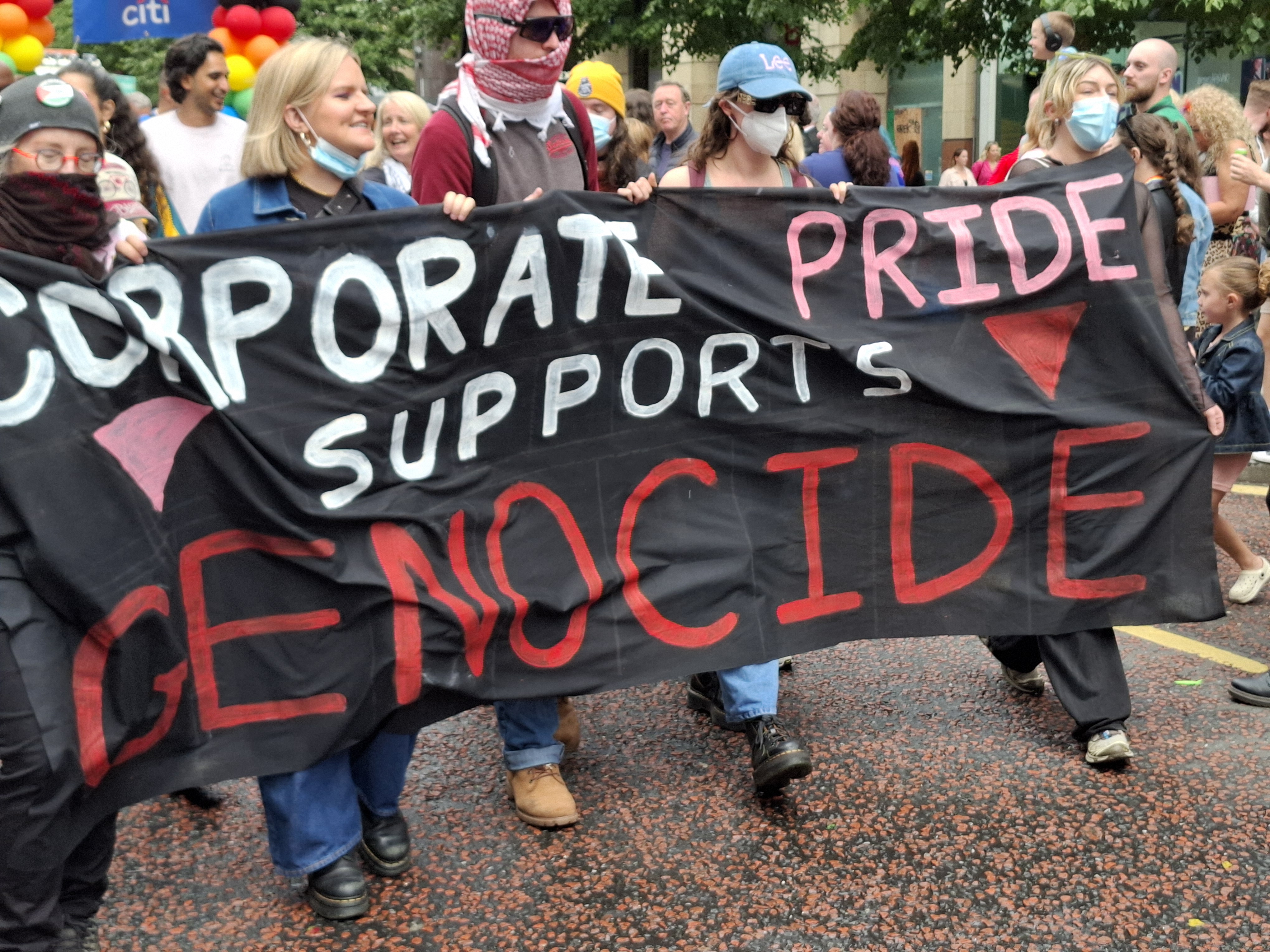
One banner at this year’s Pride parade in Belfast that hit the nail on the head.
Back to part 6
Forward to part 8
 Sráid Marx
I am always rather suspicious of people who cite what Marx and/or Engels are supposed to have said about something, without actually giving the quote, and source of it, because I have frequently found that either the claim is false, altogether, or else, the context, and text of what they said completely changes the meaning of what is being claimed. Given what they say in the Communist Manifesto about workers having no country, and the fact that they were themselves refugees from Germany, makes me doubt what is being claimed for them, here.
On the question of democratic rights and so on, where is the contradiction? Noting that bourgeois-democracy is a sham, does not prevent Marxists from illustrating that, by demanding that the principles of that democracy be adhered to consistently. The ideas that Marx sets out in his article “Political Indifferentism” have application, here, too. Lenin, was no advocate of bourgeois-democracy either, but that didn’t prevent him arguing, correctly that we should utilise it to expose it, and to also, mobilise the workers to go beyond it.
Marx and Engels opposed “the wages system”, and showed to workers that simply bargaining within the system for higher wages was a dead-end, but that didn’t mean they argued for workers NOT to, in the meantime, join unions, and bargain for higher wages.
There is nothing “abstract”, for a Marxist, about bourgeois-democratic principles. On the contrary, they are concrete and historically determined. It is the bourgeoisie that seek to claim that they are somehow innate, absolute and eternal, and apply to all, and thereby, view them only in abstract terms.
you forget to mention support for gay pride from the police who are always keen to get involved.
Thought I would mention the video essay by Paul cockshott who gathered the evidence to show that gay men are in general are situated in the higher income groups.
Paul is classed as a reactionary by the like of the socialist worked for presenting evidence to the contrary of several nostrum that have settled into what is loosely called marxism.
He did another video on the asylum and migration thing that blew up the nostrum that because of internationalism Marxist are automatically in favour of the new arrivals. Marx, as quoted by Paul was certainly not on the side of the new arrivals. As you know Marx broached social issues from the point of view of class and labour not from the point of view of the individual and their rights. What social class do asylum seekers belong to? Could it not be the social class that Marx designated as the lumpen? This is another nostrum worth investigating in future posts.
I haven’t seen Cockshott’s videos so can’t comment on his views on either gay men or on migration and asylum, although police antipathy to gay men is historically well known. What I can say is that yes, ‘Marx broached social issues from the point of view of class and labour not from the point of view of the individual and their rights’; although he did so with the view that the freedom of the individual and their development would result from the victory of the working class because it is a universal class, representing the potential freedom of all the oppressed and of humanity as a whole. This is something I have already written up and will post presently.
I have no idea what you mean by Marxists being ‘automatically in favour of the new arrivals.’ When Marx identified the point of of ‘class and labour’ it was not some ‘native’ class that he did so, or of any particular ethnic, national or regional group, but the working class as a class irrespective of any of these other characteristics. This should not need to be said and is something I would have expected you to know.
‘Asylum seekers’ cannot a priori be defined without knowing their class but as a group should have their democratic rights defended. That is the correct position, abstracting from the controversies currently raging in Europe and US etc about migration. Looking concretely at this, it is the duty of socialists to defend asylum seekers and migrants from attacks that seek to shift the blame for the failure of capitalism in general and governments in particular to advance or preserve working class interests, which are instead set back by blaming them in order to weaken the working class and its prospective unity.
In the Irish State, despite its claimed riches, the current government has gone – within one year – from apologising for its failure to provide accommodation to asylum seekers to blaming them for the housing crisis that is in no small measure its responsibility. Some on the left do indeed pretend that migration does not cause division in the working class but they do so from their moralistic approach and not from a Marxist one that recognises the material basis for divisions but seeks to overcome them by the activity of the working class itself. Without making assumptions about what Cockshott says it is not possible for me to say much more than this at the minute, although I can say that I smell the odour of shit being stirred by your comment.
actually paul cockshott has posted a three part video on marx and labour migration and how capital has always used open borders to undermine gains that had previously made. He gives an example of how marx and engels reacted to british owners bringing in german labour to weaken the labour movement in the North of England. They did not mince their words on the matter. They did not rule out recommending violence as a last resort. Though the first tactic was to insist that german unions put out a general appeal against the agents acting on behalf of the employers. The point is that internationalism is not an ethical principle of any sort but an analysis related to material conditions that are always specific and and not general like open borders and free movement are bound to become, especially in the hands of bourgeois politicians. .
I find it hard to fathom how you can heavily criticise bourgeois democracy like you did in a recent post and at the same time advocate for something you call democratic rights. The historic basis of bourgeois democracy were declarations like the rights of man, that is the aforementioned democratic rights. This has been a repeated intellectual fault line in the expression of your marxism, a fondness for pulling things like abstract principles such as democratic rights and the like as a magician pulling rabbits out of a hat. For my part I can honestly say I don’t no what these things are and I don’t possess a magicians hat.
Are your democratic rights legal claims that some how endure without the presence of a State.Natural laws are supposed to be this sort of invisible thing, an eternal astandard that measures the moral standing of any given State. As far as I know this is what natural law theorists think. Then natural law is the doctrine of Catholic Thomism. What are principles that are not really morals. The only principles I know of that are not related to morals are principles of the exercise of power as espoused by Hobbes and Nietzsche. Nietzche famously said his own noisy immoralism was supported by a doctrine he called the will to power. I have to remind you that you frequently speak about moralism in derogatory terms not as loudly as Nietzche. So I must assume the democratic principles you invoke have nothing to do with morals. I would be happier if you and others who speak up for and march out for the asylum seekers did so on the basis of some common humanitarian morality Well many of them do like the non marxists types of Care foCalais .I might not agree with humanitarian morality but at least I could say I understood what was going on. I can see how you might get around the problem by imutating an interest and not a morality to the working class. Yet let’s us assume that the bulk of the working class misrecognises the interest you impute to them or consciously rejects that interest. Well you are back with you principles again, an undisclosed humanitarian morality. It turns out therefore that lurking behind the objective interest of the working class is an undisclosed humanitarian morality. Yet you have already said Marxists reject every kind of moralism. I could go on about this but I doubt you will ever get the point. You seem to thing it is tactically expedient to denounce moralism in some situations and have it when it suits you cause.