©DIMITAR DILKOFF/AFP via Getty Images
On the first day of the Russian invasion of Ukraine my first words were that ‘the invasion of Ukraine by Russian forces should be opposed by all socialists. It will deliver death and destruction and strengthen division between the workers of each country . . . ‘
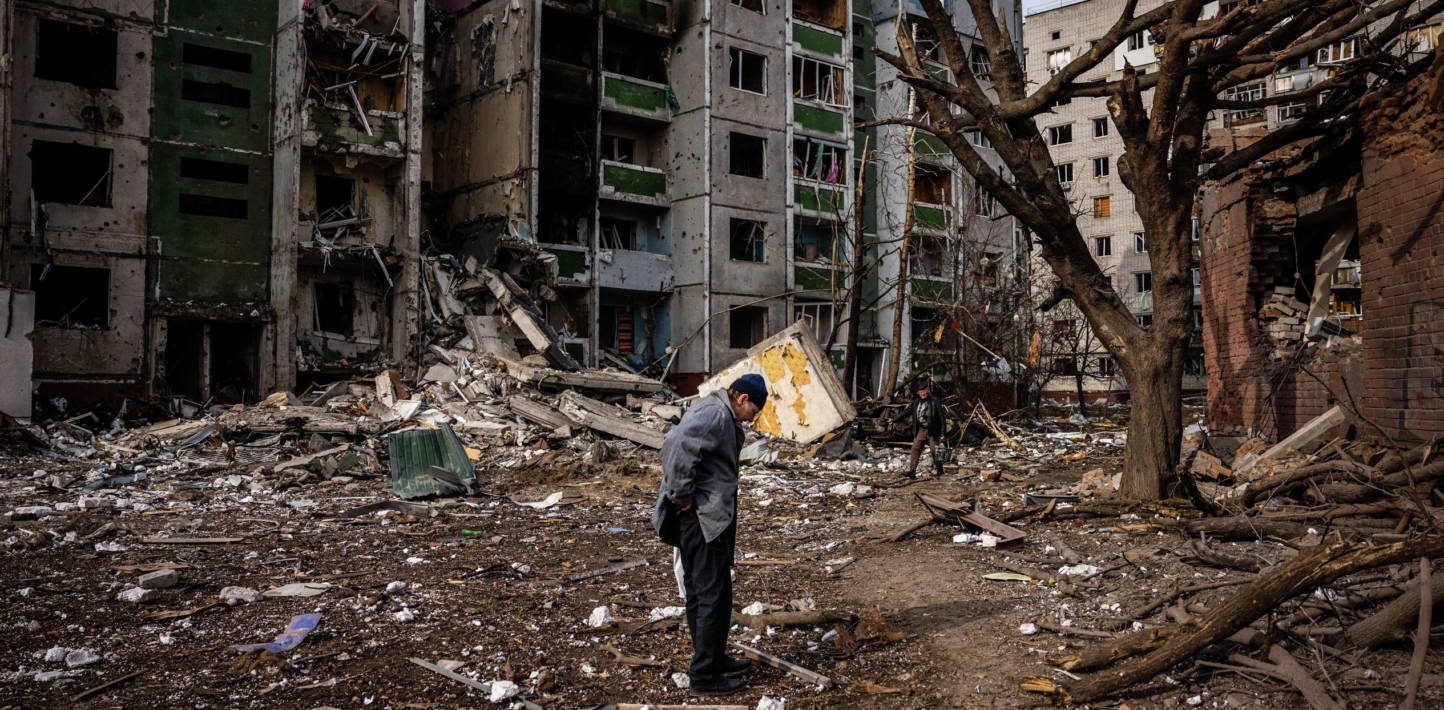
The subsequent war has certainly led to many deaths and massive destruction and the division between the workers of each country has certainly deepened. I have written around 60 articles on the war from the view that the working class and socialists should support neither Ukraine nor Russia but should oppose both by taking an independent position against the war.
If you read no more than the first few sentences of the original article you may be prompted to ask yourself the question – why, if you opposed the Russian invasion, do you not support Ukraine whose people are oppressed because of it?
Within this question are two issues: are the Ukrainian people oppressed by the war and why do you not support Ukraine?
It might be thought that I have surreptitiously changed the question from one of the Russian invasion to one of the war. Over the many sixty posts I have explained that who fired the first shot does not determine the nature of the war and since Marxists are not pacifists it may come to pass that the working class will ‘fire the first shot’ in a war against capitalism.
I have explained that the war was provoked, contrary to the many claims otherwise, by Western imperialism using Ukraine as the willing proxy for its war against Russia. Ukraine had already built up a very large army with the help of NATO, had committed itself to joining it, and had also committed itself to reoccupy regions already taken by Russia that could reasonably be thought to oppose such Ukrainian occupation. In other words, war was inevitable given the objectives and policies of both states. Being inevitable does not mean we oppose it less but rather oppose it more strongly for it is thereby not an accident or mistake but derives the character of the warring states.
It might be argued that it matters that Russia occupies parts of Ukraine and by virtue of this imposes oppression on its population, so that this should determine support for Ukraine. In searching for the correct approach, we might refer to Lenin on national oppression, where we will read the following, written in 1916:
‘ . . . hardly anybody would risk denying that annexed Belgium, Serbia, Galicia and Armenia would call their “revolt” against those who annexed them “defence of the fatherland” and would do so in all justice. It looks as if the Polish comrades are against this type of revolt on the grounds that there is also a bourgeoisie in these annexed countries which also oppresses foreign peoples or, more exactly, could oppress them, since the question is one of the “right to oppress”. Consequently, the given war or revolt is not assessed on the strength of its real social content (the struggle of an oppressed nation for its liberation from the oppressor nation) but the possible exercise of the “right to oppress” by a bourgeoisie which is at present itself oppressed. If Belgium, let us say, is annexed by Germany in 1917, and in 1918 revolts to secure her liberation, the Polish comrades will be against her revolt on the grounds that the Belgian bourgeoisie possess “the right to oppress foreign peoples”!’
‘There is nothing Marxist or even revolutionary in this argument. If we do not want to betray socialism we must support every revolt against our chief enemy, the bourgeoisie of the big states, provided it is not the revolt of a reactionary class. By refusing to support the revolt of annexed regions we become, objectively, annexationists. It is precisely in the “era of imperialism”, which is the era of nascent social revolution, that the proletariat will today give especially vigorous support to any revolt of the annexed regions so that tomorrow, or simultaneously, it may attack the bourgeoisie of the “great” power that is weakened by the revolt.’ (Lenin, The Discussion on Self-Determination Summed Up)
When Lenin was writing these lines during World War I Belgium was an imperialist power with an appalling record of brutal oppression in the Congo, yet Lenin opposed its annexation. Ukraine is not an imperialist power but it has contributed to imperialist adventures in Iraq and Afghanistan and has pursued membership of the major imperialist military alliance. It is not some colonial victim.
If it is claimed that this example of Belgium warrants support for Ukraine today then we need to understand exactly what Lenin was saying and take relevant factors into account, including that already mentioned – that Ukraine was making ready to escalate the existing low-level war.
Lenin referred to the annexation of Belgium, not to its defeat. In fact, at that time, Lenin was in favour of the defeat of all the imperialist powers. He also refers to the need to ‘support every revolt against our chief enemy, the bourgeoisie of the big states, provided it is not the revolt of a reactionary class.’ The alliance of Ukraine is with precisely the largest of imperialist ‘big states’ – the United States – so supporting Ukraine would hardly be consistent with his analysis.
The Ukrainian war is a ‘revolt of a reactionary class’, which we cannot support; we cannot support war by this class carried out by its state that is precisely the instrument everywhere of subordinating and repressing the working class and oppressed. This state and the Governments that sat upon it promised its people peace and delivered it into war.
It is utterly stupid, however, to then do what some self-proclaimed Marxists have done, which is to support Russia fighting ‘our chief enemy, the bourgeoisie of the big states.’ This ignores that Russia has its own bourgeoisie and is a big state itself, and involved in an alliance with another even bigger big capitalist state called China. Some of these socialists think it progressive if US hegemony is weakened or overturned by the growing power of this alternative capitalist alliance, forgetting that if this happened this alliance would then be ‘our chief enemy’ that they would have supported climbing into the saddle of world imperialism.
So, was Lenin wrong to say that ‘If we do not want to betray socialism we must support every revolt against our chief enemy, the bourgeoisie of the big states, provided it is not the revolt of a reactionary class’? Not at all, for we have to remember that the world he was referring to was made up of a small number of imperialist powers and a large number of colonies, and that even though these colonies were fighting for independence and not for socialism their struggle against the imperialist powers was justified and to be supported. He was decidedly not in favour of supporting one capitalist alliance against another and damned every self-proclaimed socialist who did so. Just as today we should damn as betrayers of socialism those that would support Ukraine and its imperialist backers or, alternatively, Russia.
It is therefore necessary to do what Lenin and Trotsky always advised, to treat reality as it is, concretely, and not schematically or to some pre-determined purpose alien to real conditions. So, it is not irrelevant that far from support for Ukraine being an example, as Lenin put it, of ‘support [for] every revolt against our chief enemy, the bourgeoisie of the big states’; support for Ukraine would place us on the same side, in support of, ‘the bourgeoisie of the big states’, including the US and its NATO allies.
The Ukrainian state and Armed Forces are utterly reliant on Western imperialism for money and weapons and could not continue the war without them. When we are called upon to support ‘Ukraine’ we should remember that ‘Ukraine’ is a capitalist state and definitely not to be identified with its people, which it has driven into war against their interests and on its behalf. It wages war for its own reasons and like every other capitalist state, these involve the subordination and exploitation of its working class who today are drafted into a war in which they are being slaughtered. To a very great extent this state has become a proxy and extension of US imperialism and NATO. This cannot credibly be denied even by those supporters of ‘Ukraine’ (i.e. the Ukrainian state), who must therefore rest this support on some moral claim that, because it cannot rest upon reality or any understanding of the class forces involved, is worse than useless.
The fundamental cause of the war and of the Russian invasion was, and is, the extension of the military alliance of ‘the bourgeoisie of the big states’ into Ukraine in its attempts to subordinate Russia. As we must repeat, this does not mandate support for Russia, but the character of the war is determined by this capitalist competition. We can no more support Russia because of some possible oppression by the United States than Lenin could support annexation of Belgium because of some future possible imperialist oppression by it. Our opposition to an existing capitalist war cannot be based on the possible future baleful consequences of defeat for one of the warring states. So, what of Ukrainian oppression?
Some on the left have claimed there are two wars going on, one of which is a proxy war between the US and NATO against Russia, and one of Ukrainian national liberation. I have dealt with this argument before so will not repeat it now. There is only one war and support for Ukraine by socialists will not change the outcome should it win with the support of the US and NATO – they will determine the character of any ‘victory’.
Back to part 2
Forward to part 4
 Sráid Marx
Pingback: Oppressor and Oppressed (4) – Against Annexations – 🚩 CommunistNews.net
I agree with your comments, here, but I think there is also a more fundamental point. You say,
“If you read no more than the first few sentences of the original article you may be prompted to ask yourself the question – why, if you opposed the Russian invasion, do you not support Ukraine whose people are oppressed because of it?”
As you have described, many times, including, here, the terms “Ukraine” and “people”, are abstract, concealing the fact that they are made up of antagonistic classes. As socialists, we are most definitely in favour of supporting, indeed, “defending” the Ukrainian workers – and other “masses” – against oppression be it by the Russian capitalist state, via its actions, or by the Ukrainian ruling class and its state. Indeed, we are against their oppression/exploitation by US/EU imperialism, too, which is the inevitable consequence of the alliance of Ukraine with NATO, as witnessed in the recent London Conference, from which Ukrainian workers organisations were excluded.
Whenever Lenin or Trotsky, argued in favour of rebellion against national oppression, when it came to practical support for any actual rebellion, they always meant support for a rebellion by a revolutionary proletariat. Here is where the petty-bourgeois nationalists come to grief in their arguments. The argument was made by the AWL, for example, that “if you support the right of national self-determination, it is illogical not to support the right of nations not to be annexed etc.”
But, Marxists do not support the right of national self-determination per se, as Lenin and Trotsky made clear. They support it, in practice, only as part of a process of Permanent Revolution, which itself requires that a leading role in any such revolution be taken by the revolutionary proletariat and its party! That is what Lenin says in all of his many articles on the National Question, in which he sets out the way the national bourgeoise only uses “anti-imperialist” rhetoric, and talk of national liberation, for its own ends, against the workers. It is what he says in The Theses On The National and Colonial Questions.
In China, for example, Trotsky argued against the Stalinist/Menshevik position of support for the KMT, precisely because the KMT was the party of the Chinese bourgeoisie. Yet, it was quite clearly the case that the KMT was the largest representative of the bourgeois nationalist forces opposing imperialism in China, at the time. Trotsky opposed the Stalinist position, arguing instead for giving active support only to the Chinese Communists, which he demanded be organised independently from the KMT, for the reasons Lenin set out in the Theses.
That didn’t mean that the Chinese Communists could not form an alliance, in action, with the petty-bourgeois masses, but, again, Trotsky makes clear that what he and Lenin mean by that is not with the KMT, or any other such bourgeois nationalist party/movement, but with the masses themselves.
“Lenin, it is understood, recognized the necessity of a temporary alliance with the bourgeois-democratic movement, but he understood by this, of course, not an alliance with the bourgeois parties, duping and betraying the petty-bourgeois revolutionary democracy (the peasants and the small city folk), but an alliance with the organizations and groupings of the masses themselves – against the national bourgeoisie.”
(Trotsky – Stalin and The Chinese Revolution)
So, the simple answer to the AWL’s duplicitous question is this. Marxists do not support the bourgeoisie, and certainly not bourgeois party’s let alone governments or states, in the process of bourgeois national revolutions, wars of national liberation, so why would they do so to support a bourgeoisie that has already achieved statehood? Herein lies the whole difference. Whether it is in the question of a war of national liberation, or a war between two existing capitalist states, Marxists support only the revolutionary proletariat, and their interests, as manifest in the revolutionary party. As Trotsky points out, its not even a matter of just supporting the “workers”, because there are plenty of examples of workers engaged in reactionary struggles too, as with the Ulster Workers Council Strike. That is why Trotsky made clear, in relation to China, the need to first establish revolutionary soviets before raising the question of arming the workers and peasants, i.e. you do not want to willy-nilly hand out arms to reactionary workers and peasants.
If there were a revolutionary party in Ukraine, organising separately, on a revolutionary programme, the Ukrainian workers, I would most definitely be in favour of it fighting against the Russian annexation, but that revolutionary programme, would also mean it must mobilise Ukrainian workers against Ukrainian capital, and its state, even to ensure the best conditions for the success of such action. It would need to place arms production under workers control, to ensure the provision of the best arms to workers, and so on. No such organisation exists. What the social patriots and social imperialists are supporting, therefore, is the Ukrainian bourgeoisie, its state and the continued exploitation and oppression of Ukrainian workers, not their self-liberation via the process of permanent revolution.
That is as true in relation to Ukraine, as it is in relation to the support of others given to the reactionary bourgeois nationalist regime of Hamas, or in the past to the reactionary petty-bourgeois forces of the Viet Cong, Algerian NLF, Khomeini, and so on.