Marxists do not support or defend the capitalist state because we see it as an instrument that defends bourgeois private property, which exists only in so far as the working class is exploited and oppressed by capital and this capital accumulated to ensure further exploitation. We do not do so in peacetime and there is no reason why we would do so in war, which has often been the product of the rivalry of competing capitalist powers, and amounts to their struggle over the relative shares of the resources for, and fruits of, exploitation. Why would we want to defend the structures of the system that ensures our exploitation?
Even when it comes to ensuring the most advantageous circumstances for our struggle against this exploitation and subjugation–through defending general civil and democratic rights that we sometimes have, we do not thereby either consciously or objectively support or defend the state within which we avail of them. In fact, these struggles often involve struggles against the state and its efforts to restrict our rights and freedoms.
In anti-colonial struggles or against annexation within a larger empire these struggles are against the particular capitalist state. They have, when successful, almost invariably led to the creation of new capitalist states but it is precisely socialists who will also oppose these new states and attempt through a strategy of permanent revolution to destroy them and create a new state based on the power of the working class. Of course, for nationalists, it’s all about the creation of a new capitalist state, so that for them self-determination of nations equates to their creation. For Marxists there is no reason to seek the creation of newer instruments that ensure exploitation of the working class.
For us, the struggle continues within the new state–as a class struggle with the objective of destroying it–because for us the objective is the self-determination of the working class and against any new state that will subordinate the working class to itself. For us, support for the right to self-determination does not equate to support for separation or independence; support for the right to create one does not entail automatic support for its actual creation.
We are in general opposed to the splintering of larger states into smaller ones, which are usually the projects of petty bourgeois forces seeking to advance their social position through the offices and rewards to be garnered from creation of a new state apparatus. The creation of new state borders increases divisions within the working class and obstacles to their organisation across them.
So, for example, Scottish nationalism seeks the division of the British working class, and instead of even uniting Scotland it has divided it down the middle–all in the name of the unity of the Scottish people. Even in Ireland, with many years of prior unity, the partition of the island has deepened the divisions that already existed.
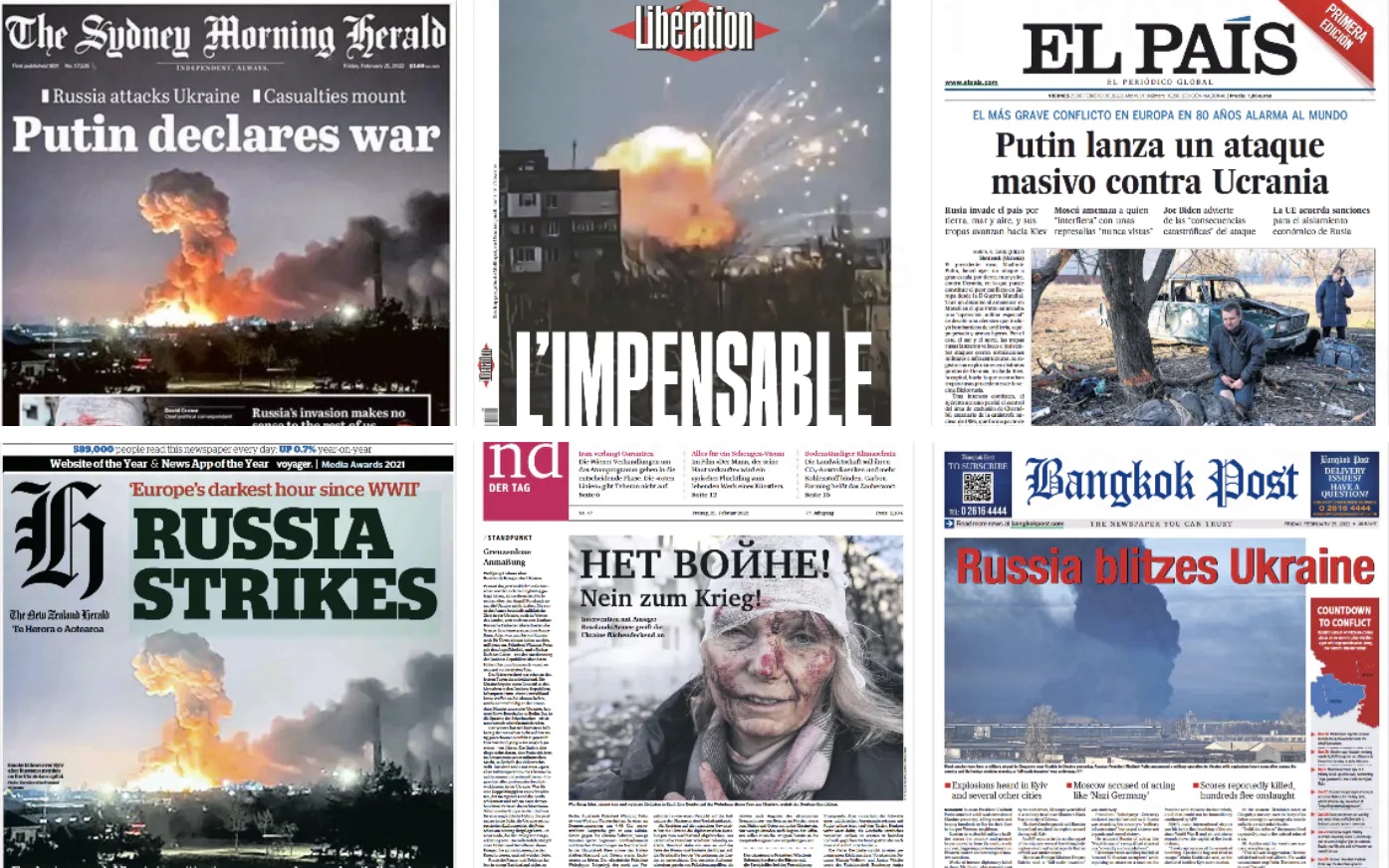
War itself causes bitterness and division and the war in Ukraine is no exception. Not only has it deepened the division between Ukrainian and Russian workers, it has deepened the existing division within Ukraine, with a significant minority living in the east of the country seeking unity with Russia. Internationally it has created deep and lasting divisions within the socialist movement, with many rejecting some or all of the arguments that will be made in this and the following post.
As part of the attempt by the US to reassert its world hegemony it has deepened division in the world with many countries seeking to avoid their subordination, and to develop their resilience to US demands and its existing military and financial power. The war has precipitated bellicose demands for rearmament and accelerated preparations for war, which are products of relative US economic decline and that has allowed developing countries more latitude in manoeuvring to protect their own state interests. Widespread rearmament and increased scope for assertion of state interests opens up the potential for yet more war.
* * *
That the onset of war doesn’t change the policy of Marxists should not be a surprise and is in accordance with the oft quoted observation of Carl von Clausewitz that “war is not merely a political act but a real political instrument, a continuation of political intercourse, a carrying out of the same by other means.” This has profound implications for those self-styled Marxists who support either of the two warring states and the two largest capitalist states that stand behind them.
If they defend these capitalist states now there is no reason that they should not have done so before the war and should not continue to do so when it ends. Their ‘Marxism’ is therefore fraudulent and worthless.
This ‘political continuation’ has had a long maturation, with the expansion of NATO across Eastern Europe eventually threatening to include Ukraine, and the crossing of the reddest of Russian red lines being the major casus belli for the Russian invasion. It explains preceding events and the immediate prominent role of the US and NATO in supporting the Ukrainian state.
The ’continuation of political intercourse’ is further demonstrated by the features of the warring parties becoming clearer through war. While western imperialism claims Ukraine is involved in a war for democracy and will be transformed by it, including by the eradication of corruption, all the developments since it erupted point to the intensification of all its previous features.
The divisions in Ukrainian society have become a chasm as the Russian leaning population will cleave to Russia even more as they become citizens of that state. Rampant anti-Russian Ukrainian nationalism has intensified further with attacks on Russian culture and celebration of the most reactionary aspects of Ukrainian nationalist history, including its collaboration with fascism during the Second World War. The trajectory of the pro-war left, determined by the objective logic of their pro-Ukraine position, and regardless of subjective intentions, has seen them prettify and decorate this reactionary movement through the disguise of ‘decolonialism’.
Far from corruption reducing as a result of war there are no indications of it falling: Transparency International records the score for Ukraine in 2022 being the same (at 33 out of 100) as the 2020 score, with even the BBC reporting on the corruption of payments by young Ukrainians in order to avoid conscription to the front. As the by-line of a Guardian article puts it ‘As the UK is set to hold a conference on how to rebuild post-war Ukraine, many worry what will happen to funds sent through a system where money disappears.’
It quotes Joe Biden in 2015 saying that “the corruption is so endemic and so deep and so consequential, it’s really, really, really, really hard to get it out of the system.” The Guardian article reads not that the war has solved the problem but that it still exists and there is concern about what to do about it. The article reports that Ukrainians don’t trust their own government to deal with the problem while some have faith that the EU might. At the same time a board member of the ‘Ukraine Anti-corruption Action Center’ blames Russia!
The article states that ‘many say checking the rise of a new oligarch class has been hampered by the abandonment under martial law of many of Ukraine’s extraordinary transparency measures, including registries of the property and income of public officials.’ The article then mentions that ‘one western lawyer closely involved in Ukrainian extradition cases over the past decade says he is still not sure European politicians quite understand how deeply corruption is ingrained in the political culture’, and notes that the court system is s big problem, and that ‘Zelenskiy has refused to accept the full recommendations from the Venice Commission to give a majority to the international judges that screen applicants for the constitutional court.’
The war has accelerated austerity, privatisation, attacks on workers’ rights, censorship, and attacks on media and opposition political parties by the Zelensky regime. It has saddled the country with more debt and complete dependence on Western imperialism, with conferences openly discussing how money can be made out of it when the war ends. It should be noted that many of the same measures in Ukraine are reflected in those western countries supporting it, including attacks on workers’ living standards through increased inflation; a media on a propaganda spree unprecedented for many years, and a threatened massive increase in arms spending.
The article from the rabidly pro-Ukraine Guardian is admission that the concentration of power in existing institutions combined with massive restrictions on democratic rights, alongside provision of huge resources (totalling $170bn) by the West to an already corrupt state is not a recipe to reduce corruption. Foreign mercenaries fighting for Ukraine who have returned home have noted the graft involving weapon supplies, even at the front. The western powers have decided to accept this on the grounds of the greater objective of weakening their geopolitical rivals but aren’t buying their own message that Ukraine is a beacon of democracy.
The imperialist project for Ukraine is no different than it is for their own working classes but somehow some on the ‘left’ in the west see one as being progressive. Unfortunately or not, they cannot be separated.
Forward to part 2
 Sráid Marx
“The Guardian article reads not that the war has solved the problem but that it still exists and there is concern about what to do about it. The article reports that Ukrainians don’t trust their own government to deal with the problem while some have faith that the EU might.”
Liberals, including those that pose as “the Left” also make this argument that having won the war, and joined the EU, the EU will be the means to bring democracy, and deal with corruption in Ukraine. Is that likely? Does Hungary, or Poland give evidence that EU membership means greater democracy? And, they are not the worst examples. A couple of years ago, a former EU official who had worked in and retired to Romania, wrote a guest post on my blog – https://boffyblog.blogspot.com/2020/09/crowds-and-power-in-sofia-and-bucharest.html – setting out the continuation, unabated of the rampant corruption in both Romania and Bulgaria.
The EU has done nothing to rein in either the lack of democracy in these former eastern and Central European countries, in the way, for example, it acted against Greece, when it proposed radical, but democratically approved policies to deal with its massive debt crisis, itself caused largely by past corruption, and by the lax monetary policies and encouragement of speculation used by central banks over the previous 30 years. On the contrary, in the same way that Gresham’s Law shows how “bad currency drives out the good”, so the introduction of embedded corruption from a given state, into a wider single market, such as the EU, creates a dynamic that makes corruption endemic in the wider body. It becomes the required means of doing business. That is particularly true in relation to government contracts, as seen with the Tories lining the pockets of their friends under the cover of COVID.
In fact, there is a good argument for saying that many of those Eastern and Central European, former Stalinist states, where corruption was a way of life, should never have been allowed to join the EU, until those issues had been totally resolved, but as with Ukraine, now, the wider agenda overruled that requirement. The agenda of capital then, and now, was to undermine the role of Russia, and to gain access to massive reservoirs of exploitable labour, and in some cases, natural resources.